Sine cura: senza preoccupazioni, senza affanni. È questa, etimologicamente, l’idea insita nel concetto di “sicurezza”. Nella società in cui viviamo domina la ricerca della sicurezza totale, assoluta. Potremmo definirlo uno dei miti più forti del nostro tempo.
Il bisogno di protezione
Quante comunicazioni pubblicitarie si fondano sullo slogan “la tua sicurezza è la nostra priorità”? Basta effettuare un’indagine su google per leggere questa frase sulle pagine di aziende come Manpower, UBI Banca, Eaton. Genericamente parlando, la ricerca di sicurezza è sempre stata una priorità per l’essere umano. Lo psicologo statunitense Abraham Maslow negli anni ’60 la poneva al secondo gradino della piramide dei bisogni umani, una teoria elaborata per classificare in maniera gerarchica le diverse esigenze dell’uomo. Dopo il soddisfacimento dei bisogni fisiologici, secondo Maslow, l’uomo ha la necessità di sentirsi tranquillo e protetto da eventuali rischi o pericoli.
L’ossessione del rischio
Da bisogno umano, negli ultimi decenni la ricerca della sicurezza sembra essersi trasformata in un’ossessione collettiva, ovunque. Siamo diventati “allergici all’imponderabile”, dimenticando che il rischio è di per sé connaturato all’esistenza di ogni organismo e di ogni organizzazione. Ricerchiamo maniacalmente la sicurezza in ogni contesto: in ambito informatico, nell’alimentazione, sulle strade, negli ambienti di lavoro. Sia a livello individuale che a livello collettivo, mettiamo in atto strategie per “mitigare” i rischi esistenti e prevedere quelli possibili. Per questo stipuliamo assicurazioni. Per questo le aziende mettono in atto procedure di assessment dei rischi, affidandosi all’expertise di manager specializzati nella gestione del rischio. Per questo ogni anno il World Economic Forum pubblica un report che analizza i maggiori rischi a livello globale.
Una polizza per la vaccinazione
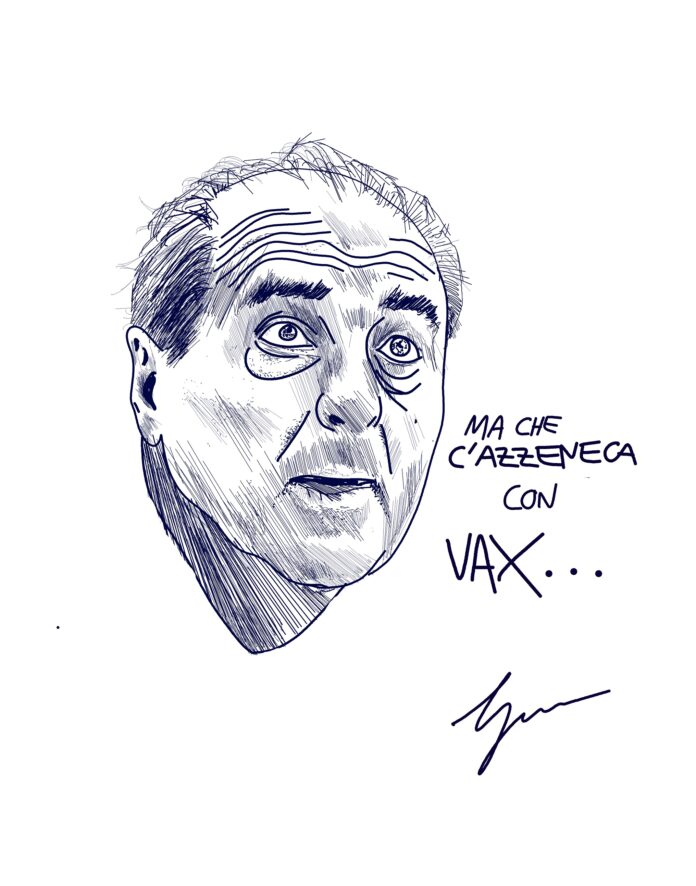
Il tema del rischio è molto “caldo” in questa fase di vaccinazione, soprattutto dopo i casi sospetti di reazioni avverse conseguenti ai vaccini AstraZeneca. Nonostante si tratti di casi estremamente rari, è su quegli eventi che il nostro pensiero si focalizza: un’indagine rivela che oltre un italiano su tre teme gli effetti avversi del vaccino e preferisce aspettare un vaccino migliore, più sicuro. In questa situazione, non potevano mancare polizze di assicurazione contro i rischi associati alla vaccinazione. È il caso della polizza Vaccino protetto: offerta gratuitamente dalla Nobis Assicurazioni ai suoi clienti, la polizza prevede la corresponsione di una diaria giornaliera agli assicurati che manifestino complicanze o sintomi collaterali entro un mese dalla vaccinazione.
Un’aspettativa irrealizzabile
I diffusi timori di fronte ai rischi associati alla vaccinazione sono lo specchio della nostra società. Una società costruita intorno alla ricerca della sicurezza totale, all’aspettativa di controllare ogni rischio. Ma questa aspettativa, ce lo ha ricordato l’arrivo della pandemia, è destinata a rimanere tale.
Sine cura: without worries, without anxieties. This is, etymologically, the idea inherent in the concept of “security”. The society we live in, the search for total, absolute security dominates. We could define it as one of the strongest myths of our time.
The need for protection
How many advertisements are based on the slogan “your safety is our priority”? Just carry out a Google survey and you will read this sentence on the pages of companies such as Manpower, UBI Banca, and Eaton. Generally speaking, the search for safety has always been a priority for human beings. In the 1960s, the American psychologist Abraham Maslow placed it at the second step of the human needs’ pyramid, a theory developed to classify the different needs of man in a hierarchical manner. According to Maslow, after the satisfaction of physiological needs, men need to feel calm and protected from any risks or dangers.
The obsession with risk
From a human need, in recent decades the search for security seems to have turned into a collective obsession, everywhere. We have become “allergic to the imponderable“, forgetting that the risk is inherent in the existence of every organism and every organization. We obsessively seek safety in every context: in the IT sector, in food, on the roads, in the workplace. We implement strategies to “mitigate” existing risks and predict possible ones both individually and collectively. For these reasons, we take out insurance, and companies implement risk assessment procedures, relying on the expertise of managers specialized in risk management. For these reasons, every year the World Economic Forum publishes a report that analyzes the major risks at a global level.
A vaccination policy
The issue of risk is very “hot” in this vaccination phase, especially after suspected cases of adverse reactions resulting from AstraZeneca vaccines. Although these are extremely rare cases, it is on those events that our thoughts are focused. In fact, a survey reveals that more than one in three Italians fear the adverse effects of the vaccine and prefer to wait for a better, safer vaccine. In this situation, insurance policies against the risks associated with vaccination could not be missing. An example is the Protected vaccine policy, which is offered free of charge by Nobis Assicurazioni to its customers. The policy provides for the payment of a daily allowance to policy holders who show complications or collateral symptoms within one month of vaccination.
An unrealistic expectation
The widespread fears of the risks associated with vaccination are the mirror of our society. A society built around the search for total security, around the expectation of controlling every risk. However, this expectation is destined to remain so, as the arrival of the pandemic reminded us.
Con la cerimonia di insediamento di Joseph Robinette Biden Jr, 46° Presidente USA, si è consumato un glorioso trionfo delle case di moda milanesi Prada e Tod’s, Largo Isarco la prima, Corso Venezia la seconda. Lady Gaga in completo da cerimonia Maison Schiaparelli/Tod’s ha cantato. Seguita poi da un recital di Amanda Gorman, poetessa afroamericana appena ventenne con cappotto giallo e cerchietto ferma capelli Prada.
Il giuramento del Presidente USA non è superato da nessun altro evento in termini di prestigio. Non c’è discorso della Regina d’Inghilterra Elisabetta II, ormai potenza di secondo rango, né intervento di Xi Jinping ai congressi del Partito Comunista Cinese che reggano il confronto.
Le strategie di Prada e Della Valle illustrano in modo dettagliato la loro visione del mondo presente e le difficoltà che Milano incontrerà nel prossimo futuro. Prada è quotata a Hong Kong. Il mercato cinese è diventato probabilmente quello più importante dal punto di vista del fatturato.
Nel postcovid la Cina sta battendo ogni record. Prada mantiene due istituzioni culturali a Milano e Venezia, qui in aperta concorrenza con François-HenriPinault/Gucci con Palazzo Grassi e con la Punta della Dogana. Ma il fiore all’occhiello della sua geopolitica strategica è a Shangai con la Fondazione Prada Rong Zhai. Nessuno degli altri gruppi della moda e del lusso ha tentato qualcosa di così ambizioso.
Diego Della Valle ha quotato invece Tod’s a Piazza Affari, spostando la sede dalle Marche a Milano e aperto con la Maison Schiaparelli una testa di ponte a Parigi. Prada, prima ancora che la Cina venisse consacrata a grande potenza antagonista agli USA dall’ex presidente Donald Trump, aveva piazzato questa ambasciata a Shangai, Fondazione Prada Rong Zhai, iniziativa che nessuno dei gruppi francesi, anche di superiore capitalizzazione, ha mai osato. La strada non era obbligata, vedasi Armani che, forse scontento, proclama l’unicità di Milano e il suo attaccamento ad essa.
La pandemia ha accelerato il trasferimento della Moda, ma anche del Design/Furniture sull’online. Le sfilate virtuali sono firmate da registi come Matteo Garrone. Per Milano si chiude un’epoca, quella delle sfilate di Moda e del Salone del Mobile come eventi obbligatori con presenza fisica degli addetti ai lavori. Certo, non scomparirà questa fruizione, ma prevederne una riduzione del 50% è cautela obbligatoria.
C’est la vie. Astrazeneca (nome della società divenuta popolare nel mondo per l’omonimo vaccino) porta un suono che ha a che fare con gli astri. A pensare al cielo è stata una vecchia azienda svedese che fino a che non si è fusa con altra ditta inglese, la Zeneca group, si chiamava semplicemente Astra AB.
Se taluni problemi che hanno accompagnato la produzione, la distribuzione e la somministrazione dell’ormai popolare vaccino Astrazeneca, dovessero essere sostituiti dall’opportuna piena tranquillità, i manager potrebbero invocare un motto latino: per aspera ad astra. Come dire che il percorso verso gli auspicati successi “astrali” è stato intricato, ma in ogni caso è bene quello che finisce bene. Probabilmente l’originaria casa svedese sin dai suoi albori aveva puntato il muso allo zenit. C’è da pensare inoltre che abbia avuto successo nel tempo, fino magari a sfidare l’altro motto antico “Si digito coelum tetìgeris (se avrai toccato il cielo con il dito). Ma se Astrazeneca, per i suoi prezzi modici e la sua ricerca ben finanziata sembra stia facendo il suo cammino “per aspera ad astra”, altre aziende consorelle stanno da tempo toccando il cielo con un dito, e via via, lo oltrepasseranno. Quasi come dire: non tutto il male viene per nuocere.
Towards a successful path, eventually?
C’est la vie. Astrazeneca (the company whose name turned into a popular one worldwide because of the vaccine bearing the same name) carries a sound that has to do with the stars. To think of the sky was an old Swedish firm that, until it merged with another English one, the Zeneca group, was simply called Astra AB.
If the problems that have crossed the production, distribution and administration of the now popular Astrazeneca vaccine, were overcome by a path towards a complete tranquility and merit, its managers could invoke the Latin motto: per aspera ad astra. As to say that the path towards the hoped astral successes, even though bumpy, anyway would have been fruitful. Probably the original Swedish house had aimed at the zenith since its inception and you can guess that it has been successful over the time, even up to challenge another ancient motto, that is “Si digito coelum tetìgeris” (if you have touched the sky with your finger). Anyway, if Astrazeneca, thanks to its modest prices and its well-funded research, is bound to be on its way “per aspera ad astra”, other sister companies have long been “touching the sky with a finger”, more and more will go across and beyond it. As to say: every cloud has a silver lining.
Se lo cercate, dio intendo, ne trovate una varia scelta su Prime Video.
Vedrete Odino, il dio dai mille nomi, che, con penetrante sguardo, vi esorta alla battaglia. La sua battaglia. Quella contro i nuovi dei, gli dei della tecnologia, del gossip, dell’informatica. Dei che si contendono il cuore degli umani. Questi ultimi fanno da sfondo ma non sempre. I protagonisti infatti sono degli umani che hanno a che fare con queste entità divine e personaggi mitologici di tutte le provenienze.
Dei e fauni in giro per la metropoli.
Troviamo slanciati leprecauni spavaldi e istrionici e jinn innamorati. Shadow Moon è al centro di tutto ciò, suo malgrado. Non sa nemmeno lui quanto queste vicende gli appartengano, all’inizio. Poi, nel corso delle tre stagioni rilasciate, le diverse trame parallele troveranno una comune conclusione.
La immaginifica penna di Neil Gaiman, come spesso accade nei suoi racconti, ci invita a lasciare a casa la razionalità per scoprire cose molto più profonde. Quella che poteva essere solo un’occasione per sfoggiare effetti speciali è invece un’originale disamina dei valori del nostro tempo e di come questi determinino la realtà.
(N.dR.) Pare che la seri sia stata sia stata fermata alla terza stagione.
If you are looking for it, god I mean, you will find a variety of choices on Prime Video. You will see Odino, the god of a thousand names, who, with a penetrating look, urges you to battle, His battle. The one against the new gods, the gods of technology, gossip, information technology. Gods vying for the hearts of humans. The latter is the background but not always. The protagonists, in fact, are humans dealing with these divine entities and mythological characters from all backgrounds. We find slender bold leprechauns and histrionics and jinn in love. Shadow Moon is at the center of it all, in spite of himself. He doesn’t even know how much these events belong to him at the beginning. Then, over the three seasons released, the different parallel plots will find a common conclusion. The imaginative pen of Neil Gaiman, as often happens in his stories, invites us to leave rationality at home to discover much deeper things. What could only have been an opportunity to show off special effects is instead an original examination of the values of our time and how these determine reality.
Sto riflettendo su cosa succede del potere con lo strapotere del digitale. Premessa: il potere è potenza, cioè possibilità, e il suo orizzonte di senso, anche fenomenico, è il possibile. É forza, autorità, consenso e controllo.
Può derivare – o possiamo pensare che derivi – da una decisione trascendente (la regalità), dall’imposizione della forza e/o carisma (totalitarismo o oligarchie) o ancora da una più meno spontanea o cosciente attribuzione del potere dal basso (varie forme della democrazia).
La politica è il potere sovrano; in essa sta il monopolio della forza/potenza/possibilità. Nella modernità il potere supremo si è incarnato nella forma Stato.
L’origine del potere
Il potere politico si dà come volontaria cessione di libertà da parte dei singoli mediante un patto reciproco in vista dell’autoconservazione (Thomas Hobbes) e nel contempo, come capacità di un soggetto (singolo o collettivo) di esercitare (talvolta attraverso l’uso della forza) un controllo sui comportamenti di altri soggetti, anche senza il consenso di questi, condizionandone le decisioni e quindi la vita (Max Weber).
Per alcuni il potere ha le sue radici nella fiducia, nella paura, nella speranza e, a volte, nella disperazione, e dal bisogno di protezione: da qui l’obbedienza. Ha una logica interna che va al di là di chi lo subisce ma anche di chi lo esercita (Carl Schmitt). Non ha identità, ma produce identità, quelle ben descritte dalla dialettica servo/padrone della Fenomenologia dello spirito di Georg Wilhelm FriedrichHegel: il servo è la produzione, il padrone è il consumo. Il servo non è disposto a morire, mentre il padrone sì.
Il potere come discorso
Il potere può essere anche visto come un campo relazionale mai gestito da qualcuno. Esso è vittima di se stesso. È, prima di tutto, un “discorso” (una proliferazione di discorsi) che si autocostituisce in seguito a stratificazioni di un senso piuttosto che di un altro (Michel Foucault). Il potere è sempre incarnato e il suo territorio è quello della biopolitica. Nel contempo la sua soggettività è oggettività.
Questo il quadro (maledettamente sintetico). E nel tempo del digitale dove si colloca il potere? Quale la sua fenomenologia? Comunque sia, il dominio sta sul controllo: dimmi le forme del controllo sociale in atto e ti dirò che di tipo di potere, o di Stato, sei.
Il digitale permette il controllo di tutto e su tutti e ciò che controlla ed elabora sono in-formazioni, dati, e tutto è manipolabile come informazione, compresa la nostra stessa vita (nuda o vestita che sia). Questo significa che il dominio, nel tempo del digitale (e noi tutti siamo volenti o nolenti nel digitale) non potrà che essere totale e – per essere espliciti – non potrà configurarsi che come totalitarismo, persino irridendo ciò che chiamiamo democrazia? Cercherò di rispondere nella prossima spigolatura.
What is power?
I’m thinking about what happens to power with the overwhelming power of digital. Premise: power is capability, or better possibility, and its horizon of meaning (even phenomenal) is the possible.
Power is strength, authority, consent. It can derive – or we can think that it derives – from a transcendent decision (royalty), from the imposition of force and / or charisma (totalitarianism or oligarchy) or from a less spontaneous or conscious attribution of power from below (various forms of democracy).
Politics is sovereign power; the monopoly of force / power / possibility lies in it. In modernity the supreme power is embodied in the form of the state.
The origin of power
Political power is given as a voluntary cession of freedom by individuals through a reciprocal pact in view of self-preservation (Thomas Hobbes) and at the same time, as the ability of a subject (single or collective) to exercise (sometimes through the use of force) a control over the behavior of other subjects, even without their consent, conditioning their decisions and therefore their life (Max Weber).
For some people, power has its roots in trust, fear, hope and, at times, despair, and the need for protection: hence obedience. It has an internal logic that goes beyond those who are subjected to it but also those who exercise it (Carl Schmitt). It has no identity, but it produces identities, which are well described by the slave / master dialectic of Georg Wilhelm Friedrich Hegel‘s Phenomenology of the Spirit: the servant is production, the master is consumption. The servant is not willing to die, while the master is.
The power as a discourse
Power can also be seen as a relational field never managed by anyone. Power is a victim of itself. First of all, it is a “discourse” (a proliferation of discourses) which is self-constituting as a result of the stratifications of one sense rather than another (Michel Foucault). Power is always embodied, and biopolitics is its territory. At the same time its subjectivity is objectivity.
This is the (insanely synthetic) picture. And in the digital age, where does power lie? What is its phenomenology? In any case, the domination is on control: tell me the forms of social control in place and I’ll tell you what kind of power, or state, you are.
The digital allows the control of everything and everyone, controlling and processing information, and data. Everything can be manipulated as information, including our own life (naked or clothed). Does this mean that the domination of digital over time (and we all like it or not in digital) may be absolute and – to be explicit – may only be configured as totalitarianism, even mocking what we call democracy? I will try to answer in the next glean.
Appena lasciato Fiumicino avvisano Lady Gaga che è stata rapita la sua coppia di mini bulldog. Il dogsitter è rimasto ferito. Dispiaciuta ma determinata sarà Patrizia Reggiani Gucci nel film “Gucci”, regia di Ridley Scott. Nel cast ci sono Robert De Niro, Al Pacino, Jared Leto e Jeremy Irons.
Patrizia Reggiani era sposata con Maurizio Gucci, nipote di Guccio Gucci, fondatore della maison. Vivevano a Milano e lui era l’erede del primo brand italiano con un impatto mondiale. Patrizia Reggiani Gucci è stata condannata come mandante dell’omicidio del marito Maurizio Gucci nel 1995. Ha scontato una ventina di anni di carcere. Gli anni Novanta, a metà dei quali fu commesso l’omicidio, hanno visto una crescita esuberante della Moda italiana e lo spostarsi del suo baricentro da Firenze a Milano.
Tom Ford, stilista di Gucci, gravitava tra le due città. Da Firenze, culla di una moda aristocratica, a Milano la moda italiana si trasforma, si industrializza.
Ma ora Ridley Scott intende raccontare questa storia di glamour e sangue in giro per l’Italia riducendo la scena di Milano a un ruolo marginale. Alcuni lo interpretano come un segnale che il ciclo della moda ormai maturo, iniziato negli anni Ottanta del secolo scorso, è entrato in una mutazione profonda. Milano è stata supervisionata in modo attento dagli sceneggiatori di Ridley Scott. Secondo molti, Milano ha consumato se stessa ed è arrivata a un turning point. Ridley Scott ha voluto Lady Gaga per interpretare alla perfezione Patrizia Reggiani Gucci. Lei però si è offesa perché la cantante americana non ha voluto conoscerla.
Milano invece lo ha convinto meno. Ma l’inquietudine serpeggia già da tempo. Milano ha investito molto nell’ecosistema della moda. Forse è diventato “overextended”. La mancanza di fisicità per la sospensione delle sfilate nell’ultimo anno, l’online, il digitale, hanno rivelato la stanchezza e l’abitudine che hanno connotato il sistema della moda a Milano nell’ultimo decennio. Milano ha visto ciclicamente cambiare la propria base industriale. Quindi è giusto chiedersi: cosa ci si può aspettare da tre motori in panne del made in Milano “Furniture, Fashion, Food”?
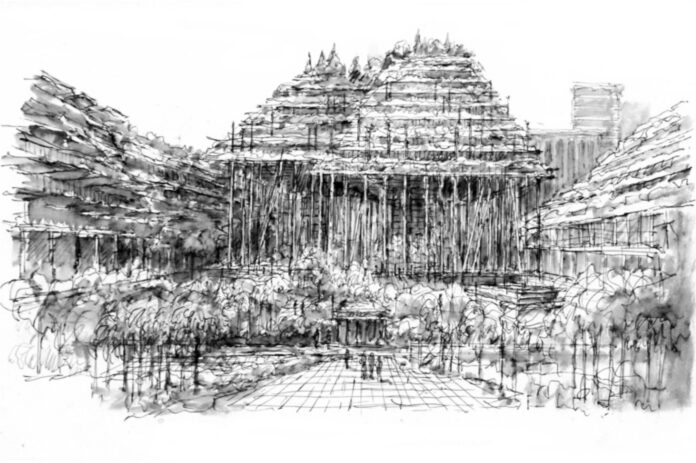
Città della Pubblica Amministrazione, centro città - inchiostro e lavaggio - Nam-myeon, Corea del Sud - 2007
Già pubblicato su FYINpaper il 09 novembre 2020
La pandemia di Covid e l’architettura
L’impatto della pandemia di coronavirus ha lasciato la scena del design in uno stato di ambivalenza unico, in cui tutti i fattori decisivi per il successo sembrano essere in collisione frontale con la realtà. Come artista/architetto, dedito a priorità concettuali, teoriche ed estetiche, mi fa sentire un po’ il proprietario di un ristorante costoso, con tavoli ravvicinati, costretto ad operare a distanza. L’urgenza della mia professione sembra problematica, per non dire altro.
Nessuna fine in vista per quanto riguarda questo scenario globale di minacce per la salute, pericolo economico e conflitto politico. Questa situazione ha azzerato tutte quelle ipotesi basate sulla carriera di un professionista di lungo corso. E dunque viene da interrogarsi su tutti i criteri regolarmente approvati per lo sviluppo commerciale, il consumo di energia, gli standard abitativi, l’economia della costruzione e la pianificazione dello spazio pubblico.
Come artista che ha invaso l’architettura da una porta secondaria, posso dire che, per me, lavorare in questo contesto ibrido, rappresenta uno scenario di benedizioni contrastanti. Il mio impegno per l’integrazione delle arti ha generato una combinazione di montagne russe di polemiche critiche, rifiuto professionale, instabilità economica, innovazione concettuale, attenzione dei media, soddisfazione artistica e alcuni momenti di gloria lungo il percorso.
L’approccio muldisciplinare tra arte e architettura
La sfida principale, per me, è stata effettivamente praticare questa fusione delle arti. Ciò ha significato che sia i clienti che il pubblico dovevano condividere il mio approccio basato sulla giustapposizione delle varie specialità e anche sentirsi a proprio agio con relazioni estetiche non convenzionali.
“Quando mi sono avventurato tra i territori delle arti dalla fine degli anni ’60, ho iniziato a utilizzare le connessioni tra arte e architettura come un terreno ibrido di mezzo, che ho definito arte-arco” (Cito dal mio libro intitolato De-architecture, 1987).
Marcel Duchamp ha saggiamente osservato che “per essere veramente creativi nella vita bisogna pulire la scrivania almeno tre volte”. Avevo già messo da parte tutto il bagaglio accademico regressivo che mi veniva dal college, rigettato le mie prime opere d’arte e messo in dubbio la rilevanza artistica della mia scultura pubblica (che aveva ottenuto consensi fino alla fine degli anni ’60).
La nascita e lo sviluppo di SITE
Incoraggiato dal grande architetto austriaco Frederick Kiesler – che mi consigliò di abbandonare tutto quel coinvolgimento antiquato con l’arte astratta – ho abbandonato una carriera di scultore influenzato dal costruttivismo e mi sono tuffato nell’architettura. Poiché mi ero imbarcato in questa trasformazione con un’esperienza limitata e ambizioni ingenue, la mia decisione più giudiziosa è stata quella di registrare la mia nuova organizzazione (SITE) come organizzazione no-profit 501C3. E questo mi permise di ricevere sovvenzioni da una fondazione per i finanziamenti. Tra il supporto extra di alcuni dei miei attuali mecenati, ci sono i collezionisti Sidney e Frances Lewis e anche David Bermant. Ho preso al volo il loro interesse nello sviluppare e le proposte e le teorie di SITE. Questo supporto finanziario mi concesse il tempo di pensare, organizzare una struttura di uffici e attirare l’attenzione dei media sia per quanto riguarda l’arte sia per quanto riguarda l’architettura.
I nuovi paradigmi dell’architettura durante e dopo il Covid
In un mondo post-pandemico ci occuperemo delle realtà con budget ridotti, con un focus sul bisogno di nuovi habitat e sui conflitti tra popoli in espansione, contro le richieste di una ridotta scala degli edifici. Storicamente, la creazione di paradigmi completamente nuovi di solito ha richiesto centinaia di anni; quindi, questa opzione deve rimanere nel campo della teoria rivoluzionaria e della trasformazione dolorosamente lenta.
In termini di obiettivi immediati da perseguire per la sopravvivenza della pratica progettuale, il mio elenco include: a) aumentare il riutilizzo adattativo degli edifici esistenti; b) intensificare la ricerca sulle fonti energetiche alternative; c) implementare approcci molteplici al trasporto e a nuove scelte di riscaldamento e raffrescamento; d) offrire proposte per la riduzione dell’uso di materiali da costruzione tossici, gassosi e derivati dal petrolio; e) ampliare l’applicazione nella modellazione 3D per la progettazione creativa e la tecnologia di costruzione; f) concentrare maggiormente la ricerca sullo sviluppo urbano a più livelli e sullo spazio pubblico che soddisfi i requisiti sia di distanziamento sociale che di raggruppamento della folla; g) ampliare le opzioni per una vegetazione maggiormente orientata alle aree urbane, ai tetti verdi e all’agricoltura cittadina; h) esplorare modalità creative per ridurre le dimensioni degli spazi abitativi, occupandosi anche di un fenomeno più che mai attuale, l’aumento della popolazione; i) innovare edifici di modeste dimensioni con soluzioni volte a migliorare la comunicazione visiva e i valori della qualità della vita, evitando al contempo l’uso, nel settore del design attuale, di materiali costosi e la propensione estetica per configurazioni scultoree massicce.
Tutto questo nonostante e oltre l’attuale pandemia. In effetti, alcune delle più grandi esplosioni creative della storia – il Rinascimento italiano, per esempio – fiorirono durante i periodi politicamente conflittuali, devastati dalla guerra oppure dalla peste.
Thinking of Arch-art, between Past, Pandemic and Post
Already published in FYINpaper on 09 November 2020
The coronavirus pandemic’s impact has left the design scene in a state of unique ambivalence, where all of the qualifying rituals for success appear to be in head-on collision with reality. As an artist/architect, dedicated to conceptual, theoretical and aesthetic priorities, it makes me feel a little like the proprietor of a pricey restaurant, with closely spaced tables, forced to operate in a world of social distancing.
The urgency of my services seems problematic, to say the least. No end in sight regarding this global scenario of health threats, economic peril and political
Conflict. This situation has decimated all of those career-based assumptions of a seasoned practitioner. And you can questioning all of the routinely endorsed criteria for commercial development, energy consumption, housing standards, construction economics and public space planning.
As an artist who invaded architecture through the back door, I can say that for me, working in this hybrid context, has been a scenario of mixed blessings.
My commitment to the integrative arts has generated a roller coaster combination of critical controversy, professional rejection, economic instability, conceptual innovation, media attention, artistic satisfaction and a few moments of glory along the way.
The main challenge, for me, has been actually practicing this fusion of the arts. It has meant that both clients and audience were required to share my juxtaposition-of-specializations approach and feel comfortable with unconventional aesthetic relationships. In an 1987 book, entitled ‘De-architecture,’ I described this mission as follows; “When I ventured into between the arts territories during the late 1960’s, I began to use the connections linking art and architecture as a hybrid middle ground, which I referred to as arch-art.” (I quote from my book entitled De-architecture, 1987).
Marcel Duchamp wisely observed that “to be truly creative in life means you have to clean off your desk at least three times.”
From my own ‘desk cleaning’ perspective, during the 1960s, I had already
dismissed all of the regressive academic baggage from college, rejected my early art works and questioned the artistic relevance of my public sculpture (which had flourished successfully up until the late 60s). Encouraged by the great Austrian architect Frederick Kiesler – who advised me to abandon all of that old-fashioned involvement with abstract art – I discarded a Constructivist-influenced sculpture career and plunged into architecture.
Since I had embarked on this transformation with limited experience and naïve ambitions, my most judicious decision was to register my new organization (SITE) as a 501C3 non-profit organization. And this allowed me to receive foundation grants for funding. Among the extra support of a few of my existing art patrons, there are the collectors Sidney and Frances Lewis and also David Bermant. I could engage
their interest in SITE’s evolving theories and propositions. This financial assistance gave me time to think, organize an office structure and attract the attention of both art and architecture media.
In a post-pandemic world we will deal with the realities of reduced budgets and with a questionable need for new habitat and the conflicts between burgeoning populations, versus the demands of a reduced scale for buildings. Historically, the establishment of entirely new paradigms has usually taken hundreds of years; so, this option must remain in the realm of revolutionary theory and painfully slow transformation.
In terms of immediate territories to pursue for design practice survival, my list includes: a) increase the adaptive re-use of existing buildings; b) intensify research on alternative energy sources; c) multiple approaches to transportation and new choices of heating and cooling; d) offer proposals for a reduction in the use of toxic, off-gassing and petroleum-based building materials; e) broaden the application of 3D modeling for creative design and construction technology; f) focus more research on multi-layered urban development and public space that satisfies requirements for both social distancing and crowd clustering; g) expand the options for more city-oriented vegetation, green roofs and urban agriculture; h) explore inventive means for reducing the size of dwelling spaces; but, also dealing with the actuality of burgeoning populations; i) innovate with modestly scaled building
solutions that improve visual communication and quality-of-life values, while avoiding the current design world’s use of expensive materials and aesthetic propensity for massive sculptural configurations.
All this in spite of and beyond the current pandemic. In fact, some of the greatest creative explosions in history – the Italian Renaissance, as case in point – flourished during the most plague-ridden, politically conflicted and war-ravaged times.
Alla Scala si torna in streaming alle coreografie di Rudolf Nureyev, il fuggitivo che nel 1961 scelse l’ovest sfidando i servizi segreti russi nel famoso abbraccio con i poliziotti francesi all’aeroporto di Parigi, l’esiliato viaggiante a lungo apolide, il rianimatore del balletto in Occidente, a partire dalle radici doc pietroburghesi con il gusto però di ricamarci sopra tanti passi, virtuosismi ardui e intricati.
Manuel Legris, il nuovo direttore francese all’Opéra de Paris, di carriera nureyeviana, gli ha reso omaggio programmando una serata di estratti dai titoli di grande repertorio “à la Rudy”. Dopo l’epoca d’oro in cui alla testa della compagnia milanese operò il russo Makhar Vaziev, ora a capo del balletto del Bolshoi di Mosca, che portò una ventata nuova promuovendo i giovani e nominando coreografo residente Alexei Ratmanky, quei giovani sono di nuovo alle prese con Nureyev.
Cresciuto nell’epoca in cui non era più necessario scappare per danzare e coreografare fuori dall’ex URSS, Ratmansky, nato nel 1968, è “il” nuovo nome mondiale della coreografia russa”; già direttore al Bolshoi, adesso è autore residente all’American Ballet Theatre. Ma è di nuovo Nureyev la figura-mito ereditata dai tempi della guerra fredda, per sempre agli onori nel tempio del balletto italiano per via francese.
Il balletto e la Guerra Fredda
Bisogna, a questo punto, ricordare che il balletto dal secondo dopoguerra è sempre stata una delicata questione di geopolitica culturale e che ogni orientamento artistico è stato sempre una precisa scelta di campo, ivi compresi i paesi satelliti dell’Unione Sovietica.
Solo Cuba, con Alicia Alonso, scelse la propria via nazionale al balletto, russo-americana-caraibica, amica dei sovietici, ma non moscovita o pietroburghese.
Dagli Stati Uniti, dove il balletto faticò ad avere cittadinanza, perché considerato prodotto elitario e a-democratico del Vecchio Continente, affermandosi alla fine in nuove vesti anti-romantiche e con plot americani, sulla linea estetica dei fuorusciti russi George Balanchine-Mikhail Mordkin, le compagnie USA furono inviate per il tramite di Fondazioni ed Enti-paravento della CIA come ambasciatrici culturali in Europa in funzione antisovietica, sia al Festival di Spoleto sia alla Biennale Musica di Venezia.
Ma alcuni artisti moscoviti, rappresentanti dell’URSS, Vladimir Vasiliev, Ekaterina Maximova e Maya Plisetskaya, intanto si esibirono al Festival di Nervi con l’autorizzazione a superare la cortina di ferro, auspice Iréne Lidova, russo-francese.
Nei parchi della cittadina ligure giunsero anche gli artisti inglesi, laddove il balletto era fiorito dalla costola dei Ballets Russes di Sergej Diaghilev recentemente, alla fine degli anni venti del 900.
Nureyev’s legacy
At La Scala, we return to streaming to the choreography of Rudolf Nureyev, the fugitive who in 1961 chose the west by challenging the Russian secret services in the famous embrace with the French policemen at the Paris airport, the long-term stateless traveling exile, the reanimator of ballet in the West, starting from the St. Petersburg DOC roots with the pleasure, however, of embroidering many steps on it, arduous and intricate virtuosity.
Manuel Legris, the new French director of the Paris Opera, of Nureyevian career, paid tribute to him by planning an evening of excerpts from the titles of great repertoire “à la Rudy”.
After the golden age in which the Russian Makhar Vaziev operated at the head of the Milanese company, now in charge of the ballet of the Bolshoi in Moscow, who brought a new breath promoting young people and nominating resident choreographer Alexei Ratmanky, those young people are again grappling with Nureyev.
Raised at a time when it was no longer necessary to run away to dance and choreograph out of the former URSS, Ratmansky (born in 1968), is “the new world name of Russian choreography”; former director at the Bolshoi, he is now a resident author at the American Ballet Theatre.
But, Nureyev is again the myth-figure inherited from the Cold War, forever to the honours in the temple of Italian ballet via French.
Ballet and Cold War
It should be remembered, at this point, that ballet since the Second World War has always been a delicate matter of cultural geopolitics and that every artistic orientation has always been a precise choice of field, including the Satellite Countries of the Soviet Union. Only Cuba, with Alicia Alonso, chose his national path to ballet, Russian-American-Caribbean, friend of the Soviets, but not Muscovite or Petersburg.
From the United States, where ballet struggled to have citizenship, because it is considered an elitist and a-democratic product of the Old Continent, eventually establishing itself in new anti-romantic guises and with American plots, on the aesthetic line of the Russian exiles George Balanchine-Mikhail Mordkin. US companies were sent through CIA foundations and screen bodies as cultural ambassadors to Europe in an anti-Soviet function, both at the Spoleto Festival and at the Venice Biennale of Music.
But some Muscovite artists, representing the USSR, Vladimir Vasiliev, Ekaterina Maximova e Maya Plisetskaya, meanwhile they performed at the Nervi Festival with permission to overcome the Iron Curtain, hoped Iréne Lidova, Russian-French. English artists also came to the parks of the Ligurian town, where ballet had flourished from the rib of Sergej Diaghilev’s Ballets Russes recently, in the late 1920s.
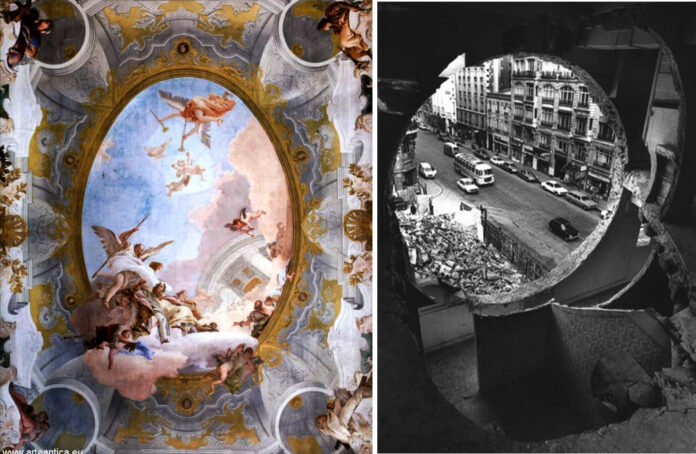
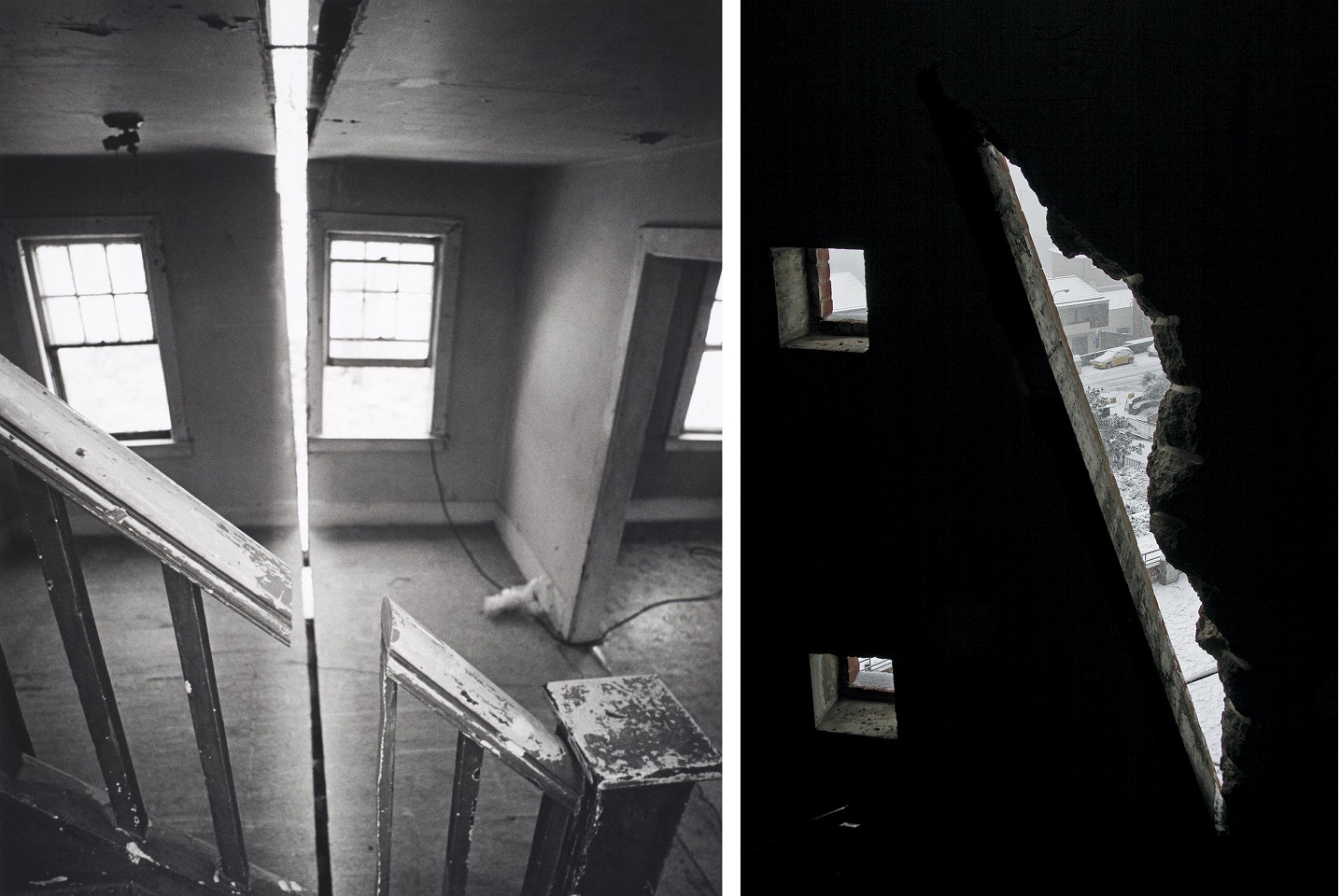
G.B. Tiepolo,Venezia,1757 and Gordon Matta, Paris, 1975
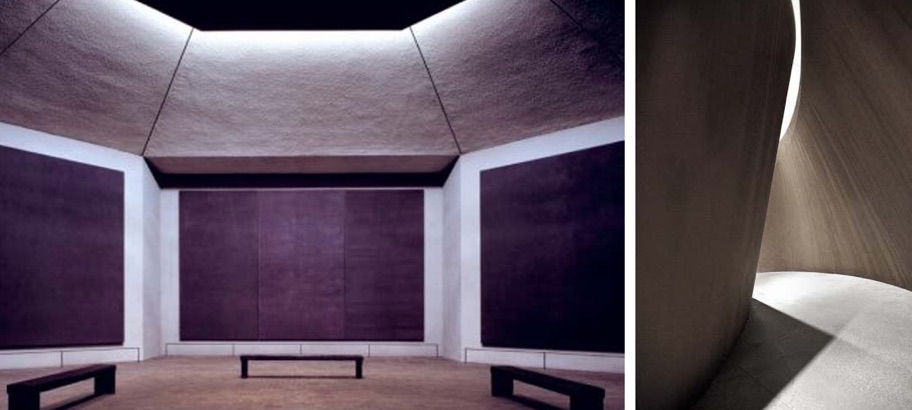
M. Rotchko, Huston, 1971 and R. Serra, Venezia, 2005
Pubblicato su Fyinpaper il 25 febbraio 2021
Published in Fyinpaper on 25 February 2021
It is a pleasure to lend an ear to two megaphones of the caliber of the two artists cited to get at that colossus (of Rhodes?) that bears the name of Marcel Duchamp. It’s been exactly 34 (1) years since I started my battle, but my bullets bounced off a rubber wall rebounding to the sender. I have to thank heaven if I have come out unscathed so far. The thread of the discourse of the two unravels very clearly in different fields that never touch visual art, but it is also valid for this. Substantiated by very few others (including Susan Sontag and Franco Vaccari), it cannot be dismissed as biased: which, if one speaks of music and the other of poetry?
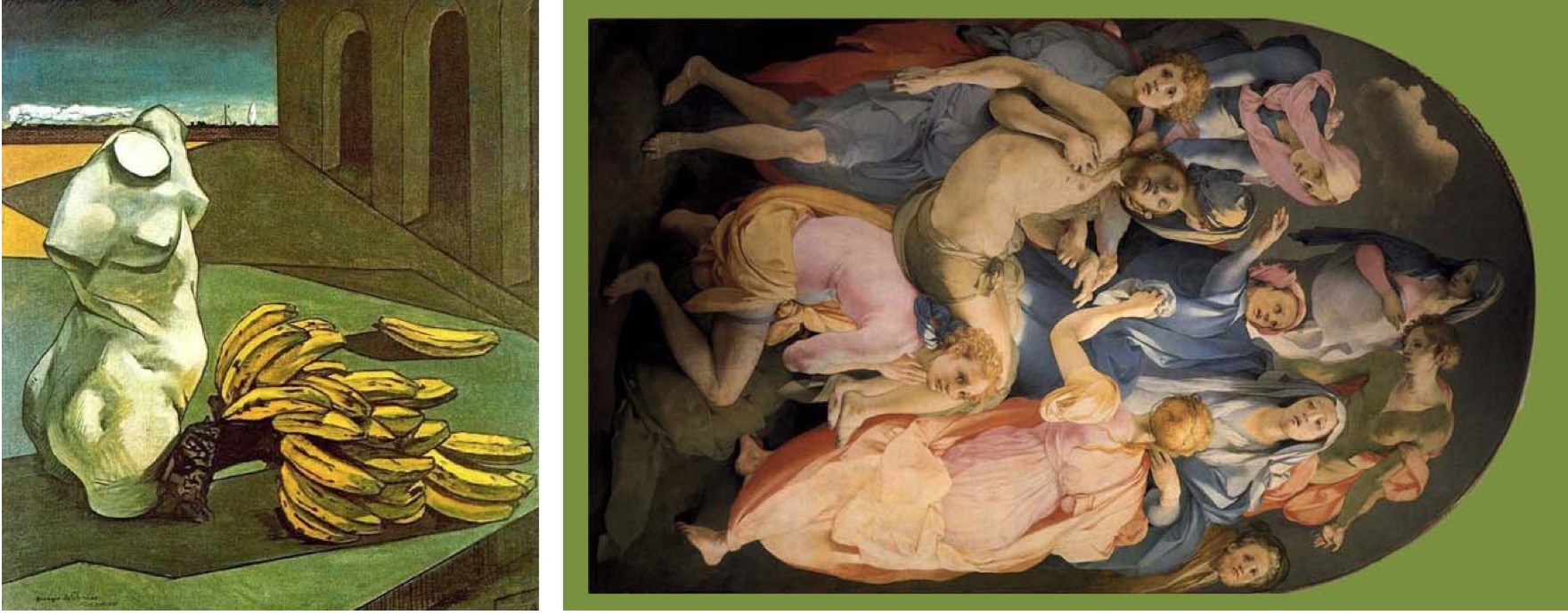
G. de Chirico, 1913, and Pontormo in S. Felicita, Firenze,1526/27
So let’s keep in mind what JB and GG say about their fields, but let’s ask ourselves why there should be a different discourse in that of visual art. If we give the etymological meaning to semantics and not that of the expression of its content, every interpretation, as Sontag (2) states, is a usurpation, a grand deception. Art cannot exhibit any semantic content separate from its form, because it is exactly this that conveys it. The ambiguity linked to the meaning does not interest us, but the mystery of form does (3). If a plethora of exegetes have strived, with good results for their profit, to give an explanation to the convoluted arguments of the “Frenchman”, this does not justify forgetting that the visual language possesses an autonomy of signs that do not preclude the past and are in search of a future that has nothing to do with the lingua franca, even that of the most distinguished critics, one that does not suffer from a translation. Even mine right now: I don’t pretend to do poetry.
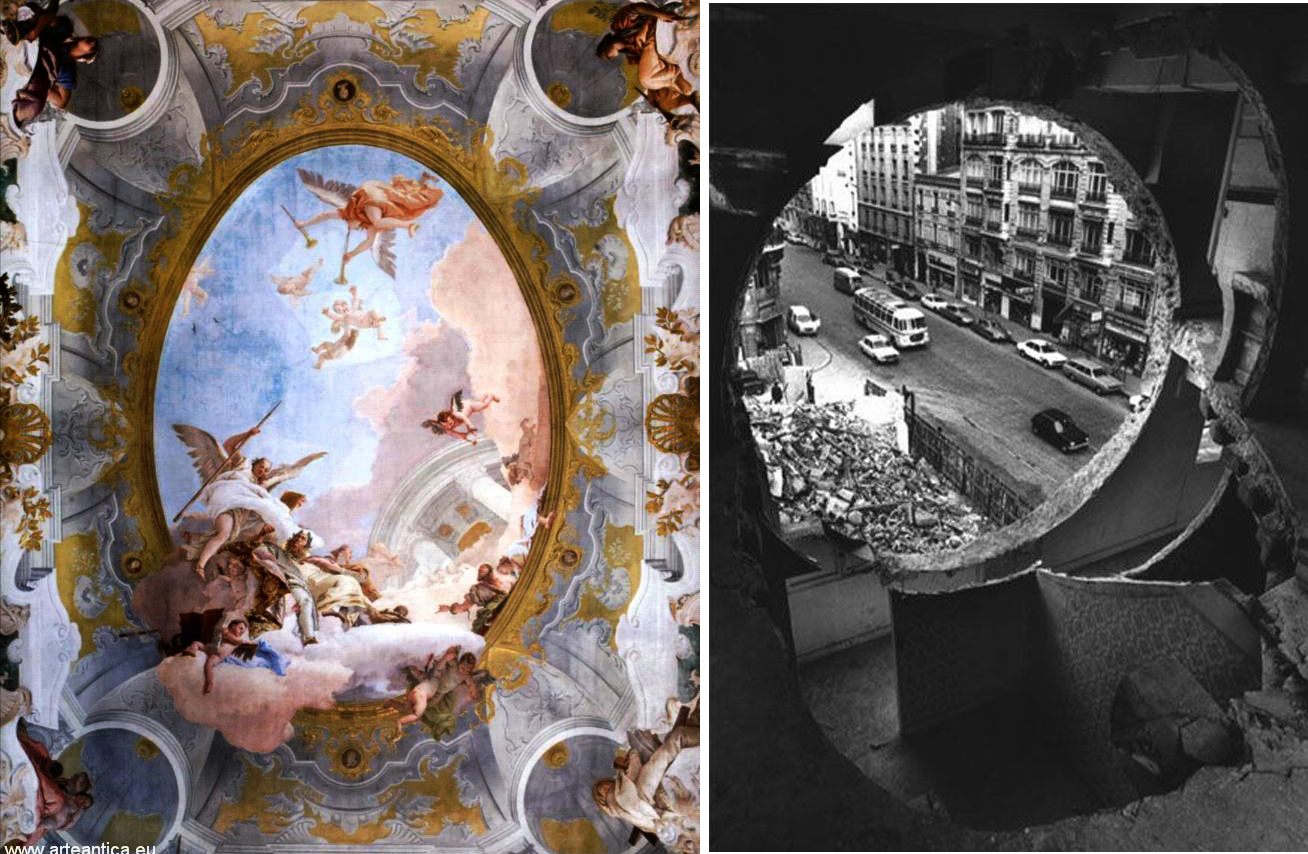
G.B. Tiepolo,Venezia,1757 and Gordon Matta, Paris, 1975
Mine is an effort of collation of arguments produced in the lingua franca by two true artists: each of their own words, carefully chosen by me, can be applied to the green of a Poet’s dream as to the Conical hole of Gordon Matta-Clark or Tiepolo, to the pink of Santa Felicita (or to the Hand that indicates it; who? the Pontormo or Giovanni Anselmo?) as to the black of the Rothko Chapel, to the unbalanced Spiral space of Serra as to the agitation of Erasmus of Narni (who is able to curb it in its stillness?). There are no borders in art, nothing sets and often the classics are revived.
Gordon Matta, NY, 1974 and Federico De Leonardis, Peccioli (PI),1990
Here is the series of promised quotes. I’ll start with Gould. After pointing out Bach’s indifference if not unwillingness to write for a given keyboard instrument, Gould uses terms such as smug, silken, legato spinning resource for his own Steinway. This says a lot about the attention to the characteristics of one’s own expressive language:
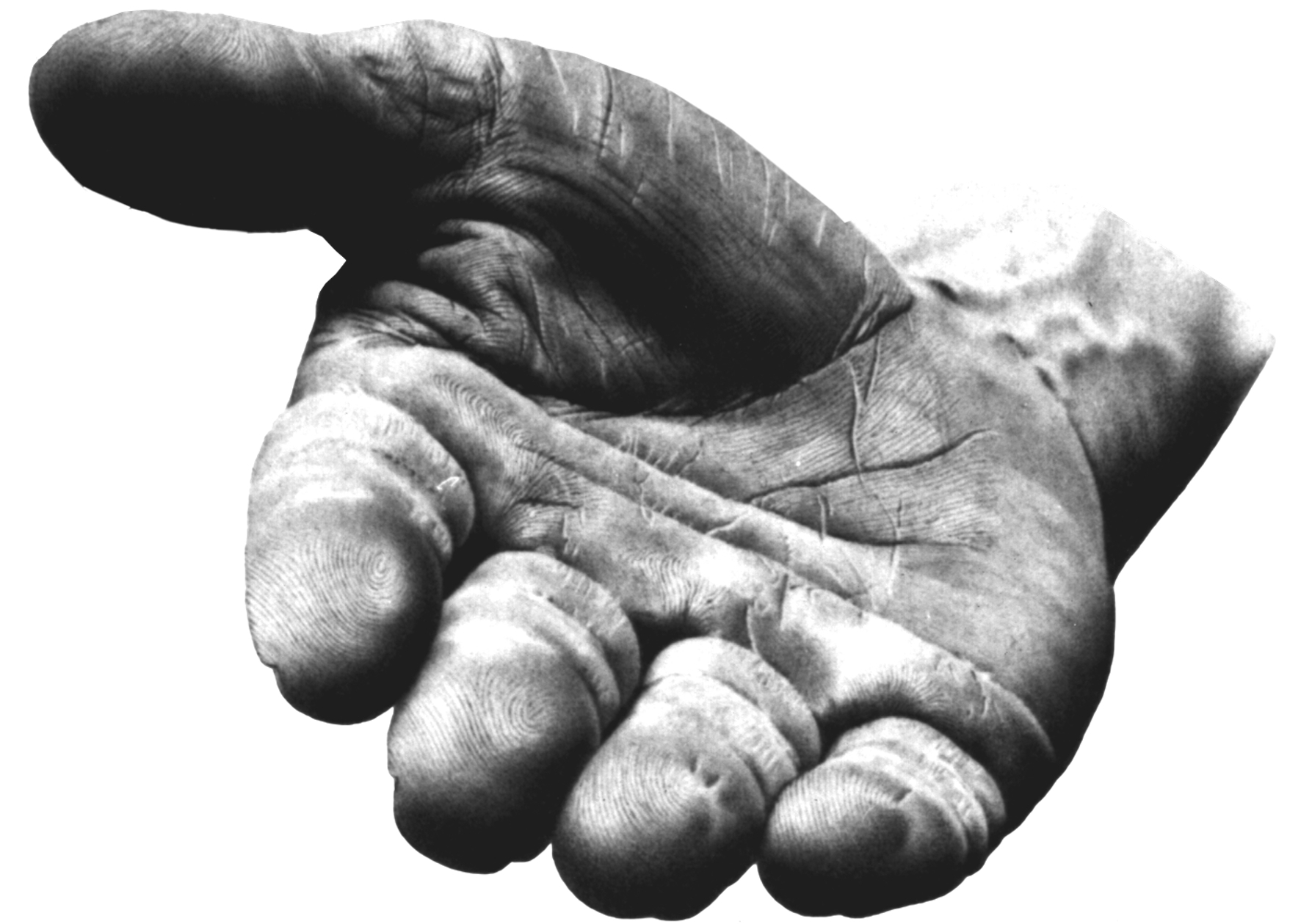
Giovanni Anselmo, Pointing hand
Bach’s compositional method, of course, was distinguished by his disinclination to compose at any specific keyboard instrument. And it is indeed extremely doubtful that his sense of contemporaneity would have appreciably altered had his catalogue of household instruments been supplemented by the very latest of Mr. Steinway’s “accelerated action” claviers. It is at the same time very much to the credit of the modern keyboard instrument that the potential of its sonority—that smug, silken, legato-spinning resource can be curtailed as well as exploited, used as well as abused.
I suspect I may have unwittingly engaged in a dangerous game, ascribing to musical composition attributes which reflect only the analytical approach of the performer. This is an especially vulnerable practice in the music of Bach, which concedes neither tempo nor dynamic intention, and I caution myself to restrain the enthusiasm of an interpretative conviction from identifying itself with the unalterable absolute of the composer’s will. Besides, as Bernard Shaw so aptly remarked, parsing is not the business of criticism.
As for the reasons for his abandonment of concert halls for recording ones:
Well, you see, Bruno, I don’t really enjoy playing any concertos very much. What bothers me most is the competitive, comparative ambience in which the concerto operates. I happen to believe that competition rather than money is the root of all evil, and in the concerto we have a perfect musical analogy of the competitive spirit. Obviously, I’d exclude the concerto grosso from what l’ve just said.
Marliave’s mention of “the intimate and contemplative appeal to the ear“ illustrates an approach to these works based upon philosophical conjecture rather than musical analysis. Beethoven, according to this hypothesis, has spiritually soared beyond the earth’s orbit and, being delivered of earthly dimension, reveals to us a vision of paradisiacal enchantment. A more recent and more alarming view shows Beethoven not as an indomitable spirit which has overleapt the world but as a man bowed and broken by the tyrannous constraint of life on earth, yet meeting all tribulation with a noble resignation to the inevitable. Thus Beethoven, mystic visionary, becomes Beethoven, realist, and these last works are shown as calcified, impersonal constructions of a soul impervious to the desires and torments of existence. The giddy heights to which these absurdities can wing have been realized by several contemporary novelists, notable offenders being Thomas Mann and Aldous Huxley.
If you are particularly fond of the last works of Strauss, as I am, it is essential to acquire a more flexible system of values than that which insists upon telling us that novelty equals progress equals great art. I do not believe that because a man like Richard Strauss was hopelessly old-fashioned in the professional verdict, he was, therefore, necessarily a lesser figure than a man like Schoenberg who stood for most of his life in the forefront of the avant-garde. If one adopts that system of values, it brings about the inevitable embarrassment of having to reject, among others, Johann Sebastian Bach as also being hopelessly old-fashioned.
His opinion on the relationship between the tastes of the time and the eternity of language see the following fragments:
The generation, or rather the generations, that have grown up since the early years of this century have considered the most serious of Strauss’s errors to be his failure to share actively in the technical advances of his time. They hold that having once evolved a uniquely identifiable means of expression, and having expressed himself within it at first with all the joys of high adventure, he had thereafter, from the technical point of view, appeared to remain stationary—simply saying again and again that which in the energetic clays of his youth he had said with so much greater strength and clarity. For these critics it is inconceivable that a man of such gifts would not wish to participate in the expansion of the musical language, that a man who had the good fortune to be writing masterpieces in the days of Brahms and Bruckner and the luck to live beyond Webern into the age of Boulez and Stockhausen should not want to search out his own place in the great adventure of musical evolution. What must one do to convince such folk that art is not technology, that the difference between a Richard Strauss and a Karlheinz Stockhausen is not comparable to the difference between a humble office adding machine and an IBM computer?
The great thing about the music of Richard Strauss is that it presents and substantiates an argument which transcends all the dogmatisms of art—all questions of style and taste and idiom—all the frivolous, effete preoccupations of the chronologist. It presents to us an example of the man who makes richer his own time by not being of it; who speaks for all generations by being of none. It is an ultimate argument of individuality—an argument that man can create his own synthesis of time without being bound by the conformities that time imposes.
But one last examination of this hypothetical piece: let us assume that instead of attributing it to Haydn or to any later composer, the improviser were to insist that it was a long-forgotten and newly discovered work of none other than Antonio Vivaldi, a composer who was by seventy—five years Haydn’s senior. I venture to say that, with that condition in mind, this work would be greeted as one of the true revelations of musical history-a work that would be accepted as proof of the farsightedness of this great master, who managed in this one incredible leap to bridge the years that separate the Italian baroque from the Austrian rococo, and our poor piece would be deemed worthy of the most august programs. In other words, the determination of most of our aesthetic criteria, despite all our proud claims about the integrity of artistic judgment, derives from nothing remotely like an “art-for-art’s-sake” approach. What they really derive from is what we could only call an “art-for-what-its-society-was-once-like” sake.
The deficiencies of this argument arise from the fact that its proponents simply cannot tolerate the idea that the participation in a certain historical movement does not necessarily impose upon the participant the duty to accept the logical consequences of that movement. One of the irresistibly lovable facts about most human beings is that they are very seldom willing to accept the consequences of their own thinking. The fact that Strauss deserts the general movement of German expressionism (presumably, in Rosenfeld‘s terms, the embodiment of “Nietzsche‘s modernism”) should not be more disturbing than the fact that the unquestioned innovator Arnold Schoenberg found it extremely difficult in his later years to fulfill the rhythmic extenuations of his own motivic theories. The fact is that above and beyond the questions of age and endurance, art is not created by rational animals and in the long run is better for not being so created.
It would be most surprising if the techniques of sound preservation, in addition to influencing the way in which music is composed and performed (which is already taking place), do not also determine the manner in which we respond to it. And there is little doubt that the inherent qualities of illusion in the art of recording those features that make it a representation not so much of the known exterior world as of the idealized interior world-will eventually undermine that whole area of prejudice that has concerned itself
with finding chronological justifications for artistic endeavors and which in the post-Renaissance world has so determinedly argued the case of a chronological originality that it has quite lost touch with the larger purposes of creativity.
Whatever else we would predict about the electronic age, all the symptoms suggest a return to some degree of mythic anonymity within the social-artistic structure. Undoubtedly most of what happens in the future will be concerned with what is being done in the future, but it would also be most surprising if many judgments were not retroactively altered because of the new image of art. If that happens, as I think it must, there will be a number of substantial figures of the past and near past who will undergo major reevaluation and for whom the verdict will no longer rest upon the narrow and unimaginative concepts of the social-chronological parallel.
And so it seems to me a great mistake to read into the fantastic transition of music in our time a total social significance. Undeniably, there do exist correlations between the development of a social stratum and the art which grows up around it, just as the public manner of early baroque music related to some degree to the prosperity of a merchant class in the sixteenth century; but it is terribly dangerous to advance a complicated social argument for a change which is fundamentally a procedural one within an artistic discipline.
Of course, the early propagandists for atonality pointed with a good deal of pride to the fact that the movement toward abstract art began at almost exactly the same time as atonality, and there are certain comfortable parallels between the careers of the painter Kandinsky and the composer Schoenberg.
But l think it is dangerous to pursue the parallel too closely, for the simple reason that music is always abstract, that it has no allegorical connotations except in the highest metaphysical sense, and that it does not pretend and has not, with very few exceptions, pretended to be other than a means of expressing the mysteries of communication in a form which is equally mysterious.
The figure of Schoemberg outlined by the writings of G is emblematic for understanding the linguistic work of a great composer and his responsibility in the detachment of cultured music from popular music:
But the odd thing about it was that with this oversimplified, exaggerated system Schoenberg began to compose again; and not only did he begin to compose: he embarked upon a period of about five years which contains some of the most beautiful, colorful, imaginative, fresh, inspired music which he ever wrote. Out of this concoction of childish mathematics and debatable historical perception came an intensity, a ioie de vivre, which knows no parallel in Schoenberg‘s life. How could this be, then? By what strange alchemy was this man compounded that the sources of his inspiration flowed most freely when stemmed and checked by legislation of the most stifling kind? I suppose part of the answer lies in the fact that Schoenberg was always intrigued by numbers and afraid of numbers and attempting to read his destiny in numbers –and, after all, what greater romance of numbers could there be than to govern one’s creative life by them? I suppose part of it was due to the fact that after fifteen years awash in a sea of dissonance, Schoenberg felt himself to be on firm ground once again. Still another part of it is certainly that all music must have a system, and that particularly in those moments of rebirth such as Schoenberg had led us into, it is much more necessary to adhere to the system, to accept totally its consequences, than at a later, more mature stage of its existence.
I think there can be no doubt that its fundamental effect has been to separate audience and composer. One doesn’t like to admit this, but it is true nonetheless. There are many people around who believe that Schoenberg has been responsible for shattering irreparably the compact between audience and composer, of separating their common bond of reference and creating between them a profound antagonism. Such people claim that the language has not become a valid one for the reason that it has no system of emotional reference that is generally accepted by people today. Certainly concert music of today—
that part of it, at any rate, which owes a great deal to the Schoenbergian influence—plays a very small part in the life of many people. It cannot by any means claim to excite the curiosity that was generally aroused by significant new works fifty or sixty years ego. One must remember that at the turn of the century, any new work by a Richard Strauss or a Gustav Mahler or a Rimsky-Korsakov or a Debussy was a major event not only for the cognoscenti but for a very large lay audience as well.
No matter how little interest there may be in the more significant developments of music in our time, I think that there is little doubt that there are some areas in which the vocabulary of atonality—using this term now in a collective sense—has made quite an unobjectionable contribution to contemporary life. It has done this particularly in media in which music furnishes but a part—operas, to a degree (if you can consider styling Alban Berg’s Wozzeck a “hit”), but most particularly in that curious specialty of the twentieth century known as background music for cinema or television. If you really stop to listen to the music accompanying most of the grade-B horror movies that are coming out of Hollywood these days, or perhaps a TV show on space travel for children, you will be absolutely amazed at the amount of integration which the various idioms of atonality have undergone in these media.
Until here: Glenn Gould. Let us now turn to quoting Brodsky. The following fifteen lines (taken from On Grief and Reason) represent an eloquent summary of his thinking on art in general and poetry in particular, as well as on the meaning of the word “language”. Below I have collected other fragments (also taken from Less Than One) that specify its depth and richness. The only fundamental difference with the visual arts is on the affirmation of the inalienability of the word to the semantic value (unfortunately), but with the specification that this does not apply to the other arts.
For poetic discourse is continuous; it also avoids cliché and repetition. The absence of those things is what speeds up and distinguishes art from life, whose chief stylistic device, if one may say so, is precisely cliché and repetition, since it always starts from scratch. It is no wonder that society today, chancing on this continuing poetic discourse, finds itself at a loss, as if hoarding a runaway train. I have remarked elsewhere that poetry is not a form of entertainment, and in a certain sense not even a form of art, but our anthropological, genetic goal, our linguistic, evolutionary beacon. We seem to sense this as children, when we absorb and remember verses in order to master language. As adults, however, we abandon this pursuit, convinced that we have mastered it. Yet what we’ve mastered is but an idiom, good enough perhaps to outfox an enemy, to sell a product, to get laid, to earn a promotion, but certainly not good enough to cure anguish or cause joy. Until one learns to pack one’s sentences with meanings like a van or to discern and love in the beloved’s features a “pilgrim soul”; until one becomes aware that “No memory of having starred I Atones for later disregard, / Or keeps the end from being hard”—until things like that are in one’s bloodstream, one still belongs among the sublinguals. Who are the majority, if that’s a comfort.
In that, it-life-differs from art, whose worst enemy, as you probably know, is cliché. Small wonder, then, that art, too, fail-s to instruct you as to how to handle boredom. There are few novels about this subject; paintings are still fewer; and as for music, it is largely nonsemantic. On the whole, art treats boredom in a self-defensive, satirical fashion. The only way art can become for you a solace from boredom, from the existential equivalent of cliché, is it you yourselves become artists. Given your number, though, this prospect is as unappetizing as it is unlikely.
Herein lies the ultimate distinction between the beloved and the Muse; the latter doesn’t die. The same goes for the Muse and the poet: when he’s gone, she finds herself another mouthpiece in the next generation. To put it another way, she always hangs around a language and doesn’t seem to mind being mistaken for a plain girl. Amused by this sort of error, she tries to correct it by dictating to her charge now
pages of Paradise, now Thomas Hard}-“s poems of 1912-13; that is, those where the voice of human passion yields to that of linguistic necessity—but apparently to no avail. So let’s leave her with a flute and a wreath wildflowers. This way at least she might escape a biographer.
Of course, when talking about the signs of the word (semanticity) one cannot avoid addressing the theme of the relationship between art and life:
Now, the purpose of evolution is the survival neither of the fittest nor of the defeatist. Were it the former, we would have to settle for Arnold Schwarzenegger; were it the latter, which ethically is a more sound proposition, we’d have to make do with Woody Allen. The purpose of evolution, believe it or not, is beauty, which survives it all and generates truth simply by being a Fusion of the mental and the sensual. As it is always in the eye of the beholder, it can’t he wholly embodied save in words: that’s what ushers in a poem, which is as incurably semantic as it is incurably euphonic.
In “Home Burial“ (Frost’s poem) it results is both. For every Galatea is ultimately a Pygmalion’s self-projection. On the other hand, art doesn’t imitate life but infects it. …
… This is a poem about languages terrifying success, for language, in the final analysis, is alien to the sentiments it articulates. No one is more aware of that than a poet; and if “Home Burial”
is autobiographical, it is so in the first place by revealing Frost’s grasp of the collision between his métier and his emotions. To drive this point home, may I suggest that you compare the actual sentiment you may feel toward an individual in your company and the word “love.” A poet is doomed to resort to words. So is the speaker in “Home Burial.” Hence, their overlapping in this poem; hence, too, its autobiographical reputation. …
… So what was it that he was after in this, his very own poem? He was, I think, after grief and reason, which, while poison to each other, are languages most efficient fuel—or, if you will, poetry’s indelible ink. Frost’s reliance on them here and elsewhere almost gives you the sense that his dipping into this ink pot had to do with the hope of reducing the level of its contents; you detect a sort of vested interest on his part. Yet the more one dips into it, the more it brims with this black essence of existence, and the more one’s mind, like one’s fingers, gets soiled by this liquid. For the more there is of grief, the more there is of reason. As much as one may be tempted to take sides in “Home Burial,” the presence of the narrator here rules this out, for while the characters stand, respectively, for reason and for grief, the narrator stands for their fusion. To put it differently, while the characters’ actual union disintegrates, the story, as it were, marries grief to reason, since the bond of the narrative here supersedes the individual dynamics— well, at least for the reader. Perhaps for the author as well. The poem, in other words, plays fate.
For poetic discourse is continuous; it also avoids cliché and repetition. The absence of those things is what speeds up and distinguishes art from life, whose chief stylistic device, if one may say so, is precisely cliché and repetition, since it always starts from scratch. It is no wonder that society today, chancing on this continuing poetic discourse, finds itself at a loss, as if hoarding a runaway train. I have remarked else-
where that poetry is not a form of entertainment, and in a certain sense not even a form of art, but our anthropological, genetic goal, our linguistic, evolutionary beacon. We seem to sense this as children, when we absorb and remember
For art is something more ancient and universal than any faith with which it enters into matrimony, begets children—but with which it does not die. The judgment of art is a judgment more demanding than the Final Judgment.
Rilke’s Orfeo gives him the cue to clarify his thought on art, which in addition to the close relationship with the meaning of death, arises precisely from the rubbish of life:
This economy is art’s ultimate raison d’être, and all its history is the history of its means of compression and condensation. In poetry, it is language, itself a highly condensed version of reality. In short, a poem generates rather than reflects.
For why should we empathize with him? Less highborn and less gifted than he is. we never will be exempt from the law of nature. With us, the journey to Hades is a one-way trip. What can we possibly learn from his story? That a lyre takes one farther than a plow or a hammer and anvil? That we should emulate geniuses and heroes? That perhaps audacity is what does it? For what if not sheer audacity was it that made him undertake this pilgrimage?
A man of my occupation seldom claims a systematic mode of thinking; at worst, he claims to have a system—but even that, in his case, is a borrowing from a milieu, from a social order, or from the pursuit of philosophy at a tender age. Nothing convinces an artist more of the arbitrariness of the means to which he resorts to attain a goal—however permanent it may be—than the creative process itself, the process of composition. Verse really does, in Akhmatova’s words, grow from rubbish; the roots of prose are no more honorable. …
… Art, generally speaking, always comes into being as a result of an action directed outward, sideways, toward the attainment (comprehension) of an object having no immediate relationship to art. It is a means of conveyance, a landscape flashing in a window—rather than the conveyance’s destination. “If you only knew,” said Akhmatova, “what rubbish verse grows from . . .” The farther away the purpose of movement, the more probable the art; and, theoretically, death (anyone’s, and a great poet’s in particular, for what can be more removed from everyday reality than a great poet or great poetry?) turns into a sort of guarantee of art.
The hierarchy between ethics and aesthetics further clarifies his thinking on the relationship between art and life. This applies to all the arts, as the discourse about what art language means also always applies to all:
On the whole, every new aesthetic reality makes man’s ethical reality more precise. For aesthetics is the mother of ethics. The categories of “good” and “bad” are, first and foremost, aesthetic ones, at least etymologically preceding the categories of “good” and “evil.” If in ethics not “all is permitted,” it is precisely because not “all is permitted” in aesthetics, because the number of colors in the spectrum is limited. The tender babe who cries and rejects the stranger who, on the contrary, reaches out to him, does so instinctively, makes an aesthetic choice, not a moral one.
Unlike life, a work of art never gets taken for granted: it is always viewed against its precursors and predecessors. The ghosts of the great are especially visible in poetry, since their words are less mutable than the concepts they represent.
In such an absence, art grows humble. For all our cerebral progress, we are still greatly subject to relapse into the Romantic (and, hence, Realistic as well) notion that “art imitates life.” If art does anything of this kind, it undertakes to reflect those few elements of existence which transcend “life,” extend it beyond its terminal point—an undertaking which is frequently mistaken for art’s or the artist’s own groping for immortality. In other words, art “imitates” death rather than life; i.e., it imitates that realm of which life supplies no notion: realizing its own brevity, art tries to domesticate the longest possible version of time. After all, what distinguishes art from life is the ability of the former to produce a higher degree of lyricism than is possible within any human interplay. Hence poetry’s affinity with–if not the very invention of—the notion of afterlife.
Poetry after all in itself is a translation; or, to put it another way, poetry is one of the aspects of the psyche rendered in language. It is not so much that poetry is a form of art as that art is a form to which poetry often resorts. Essentially, poetry is the articulation of perception, the translation of that perception into the heritage of language—language is, after all, the best available tool. But for all the value of this tool in ramifying and deepening perceptions-revealing sometimes more than was originally intended, which, in the happiest cases, merges with the perceptions—every more or less experienced poet knows how much is left out or has suffered because of it.
It would be false as well as unnecessary to try to divorce Platonov from his epoch; the language was to do this anyway, if only because epochs are finite. In a sense, one can see this writer as an embodiment of language temporarily occupying a piece of time and reporting from within. The essence of his message is LANGUAGE I5 A MILLENARIAN DEVICE, HISTORY ISN’T”, and coming from him that would be appropriate.
A great writer is one who elongates the perspective of human sensibility, who shows a man at the end of his wits an opening, a pattern to follow.
Burning books, after all, is just a gesture; not publishing them is a falsification of time. But then again, that is precisely the goal of the system: to issue its own version of the future.
Whether one likes it or not, art is a linear process. To prevent itself from recoiling, art has the concept of cliché. Art’s history is that of addition and refinement, of extending the perspective of human sensibility, of enriching, or more often condensing, the means of expression. Every new psychological or aesthetic reality introduced in art becomes instantly old for its next practitioner. An author disregarding this rule, somewhat differently phrased by Hegel, automatically destines his work—no matter what good press it
gets in the marketplace—-to assume the status of pulp.
But to clarify the undemocratic nature of the language, just these sketches taken from some of his most important essays are enough:
Herein, of course, lies arts saving grace. Not being lucrative, it falls victim to demography rather reluctantly.
For if, as we’ve said, repetition is boredom’s mother, demography (which is to play in your lives a far greater role than any discipline you’ve mastered here) is its other parent. This may sound misanthropic to you, but I am more than twice your age, and I have lived to see the population of our globe double. By the time you’re my age, it will have quadrupled, and not exactly in the fashion you expect. For instance, by the year 2000 there is going to be such cultural and ethnic rearrangement as to challenge your notion of your own humanity.
Starting with the authors mentioned above, some may find these notes maximalist and biased; most likely they will ascribe these flaws to their author’s own métier. Still others may find the view of things expressed here too schematic to be true. True: it’s schematic, narrow, superficial. At best, it will be called subjective or elitist. That would be fair enough except that we should bear in mind that art is not a democratic enterprise, even the art of prose, which has an air about it of everybody being able to master it as well as to judge it.
For poetic discourse is continuous; it also avoids cliché and repetition. The absence of those things is what speeds up and distinguishes art from life, whose chief stylistic device, if one may say so, is precisely cliché and repetition, since it always starts from scratch. It is no wonder that society today, chancing on this continuing poetic discourse, finds itself at a loss, as if hoarding a runaway train. I have remarked elsewhere that poetry is not a form of entertainment, and in a certain sense not even a form of art, but our anthropological, genetic goal, our linguistic, evolutionary beacon. We seem to sense this as children, when we absorb and remember
The evaluation of reality made through such a prism—the acquisition of which is one goal of the species—is therefore the most accurate, perhaps even the most just. (Cries of “Unfair!” and “Elitistl” that may follow the aforesaid from, of all places, the local campuses must be left unheeded, for culture is “elitist” by definition, and the application of democratic principles in the sphere of knowledge leads to
equating wisdom with idiocy.)
taking inspiration from a poem by W. Auden, B. engraves his thoughts on language:
Time that is intolerant
Of the brave and innocent,
And indifferent in a week
To a beautiful physique,
Worships language and forgives
Everyone by whom it lives;
Pardons cowardice, conceit,
Lays its honours at their feet.
But for once the dictionary didn’t overrule me. Auden had indeed said that time (not the time) worships language, and the train of thought that statement set in motion in me is still trundling to this day. For “worship” is an attitude of the lesser toward the greater. If time worships language, it means that language is greater, or older, than time, which is, in its turn, older and greater than space. That was how I was taught, and I indeed felt that way. So if time—which is synonymous with, nay, even absorbs deity—worships language, where then does language come from? For the gift is always smaller than the giver. And then isn’t language a repository of time? And isn’t this why time worships it?
Uncertainty, you see, is the mother of beauty, one of whose definitions is that it’s something which isn’t yours. At least, this is one of the most frequent sensations accompanying beauty. Therefore, when uncertainty is evoked, then you sense beauty’s proximity. Uncertainty is simply a more alert state than certitude, and thus it creates a better lyrical climate. Because beauty is something obtained always from without, not from within. And this is precisely what’s going on in this stanza.
But you don’t dissect a bird to find the origins of its song: what should be dissected is your ear. In either case, however, you’ll be dodging the alternative of “We must love one another or die,” and I don’t think you can afford to.
Già pubblicato in italiano su Fyinpaper il 25 febbraio 2021.
Already published in italian on Fyinpaper on February 25, 2021
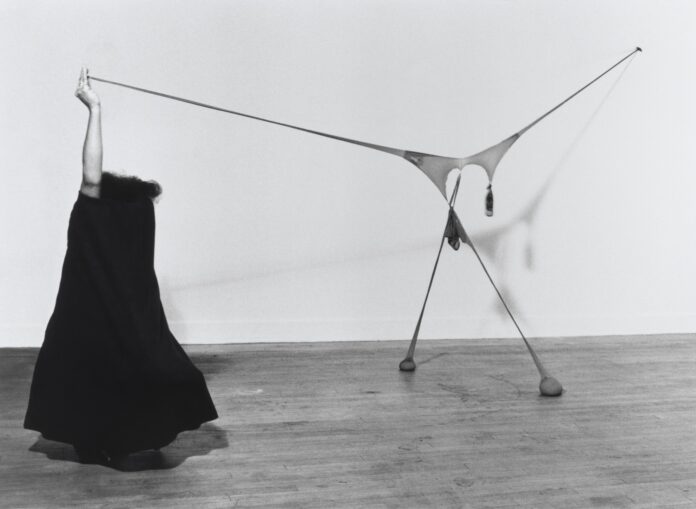
Senga Nengudi, Studio Performance with RSVP 1976. Gelatin silver print.
Courtesy: Sprüth Magers, Thomas Erben Gallery e Lévy Gorvy
L’arte non ha età
In un periodo in cui da parte di gallerie e musei vengono proposte mostre quasi esclusivamente a giovani artisti o a artisti degli anni ’50 e ’70, è abbastanza sorprendente questa mostra incentrata su 16 artiste di oltre 70 anni. Meglio, artiste di età compresa tra 71 e 105 anni con una carriera che copre oltre 50 anni che provengono da 14 paesi diversi. E ancora determinate a proseguire il proprio percorso creativo con incrollabile convinzione.Another Energy: Power to Continue Challenging – 16 Women Artists from around the World (Un’altra energia: il potere di continuare a sfidare – 16 donne artiste da tutto il mondo) a cura di Kataoka Mami (Direttore, Mori Art Museum), e Martin Germann (Curatore indipendente) al Mori Art Museumdi Tokyo, Japan dal 22 Aprile al 26 Settembre 2021. Dipinti, video, sculture, installazioni, performance. Non manca nulla.
Etel Adnan
Ad esempio Etel Adnan nata nel 1925 a Beirut lavora dagli anni ’60, come poetessa, scrittrice e pittrice, collegando con immagini e testo, Oriente e Occidente, rappresentando la diaspora intellettuale araba. «To write is to draw», afferma la poetessa che esprime così la sua relazione dinamica con il mondo, con la memoria e la storia. Abbiamo visto il suo lavoro a Punta della Dogana in occasione della mostra “Luogo e Segni” (2019).
Phyllida Barlow
Phyllida Barlow nata nel 1944 a Newcastle upon Tyne, Regno Unito, ha rappresentato il Regno Unito alla 57a Biennale di Venezia nel 2017. Le sue imponenti installazioni in cartone, tessuto, compensato, polistirolo, tela e cemento, dipinte con colori industriali e vibranti, risultano colossali accatastamenti a volte eccessivi, a volte giocosi.
Anna Boghiguian
Anna Boghiguian natanel1946 al Cairo, vista a Documenta 13 a Kassel, si muove tra lavori estremamente drammatici e altri che ricordano il teatro delle marionette e delle ombre. Al Castello di Rivoli una grande retrospettiva nel 2017 raccoglieva uno straordinario numero di taccuini, disegni, pitture, fotografie, sculture scenografiche, installazioni ambientali, libri d’artista da lei realizzati dall’inizio della sua attività negli anni ottanta del secolo scorso fino a oggi. Ha anche vinto il Leone d’Oro per il miglior padiglione (Armenia) alla 56° Biennale di Venezia nel 2015.
Miriam Cahn
Miriam Cahn, nata nel1949 a Basilea, Svizzera, è stata influenzata dal movimento anti-nucleare, dalle questioni sociali come la discriminazione e la violenza, la guerra e la sua identità di donna ebrea. Nel 2017 ha preso parte a documenta 14. Ha usato solo nero, bianco e sfumature di grigio nei suoi primi lavori e ha iniziato a usare il colore nel 1994, per evidenziare parti scelte delle sue figure umane, i genitali, il seno, le labbra o gli occhi, suggerendo un’idea di fragilità e fecondità.
Lili Dujourie
I primi lavori diLili Dujourie, nata nel 1941 a Roeselare, Belgio, sono considerati una reazione femminista ai dogmi impersonali del minimalismo degli anni ’60. Dagli anni ’80, ha realizzato piccoli oggetti in argilla che rappresentano forme organiche come ossa e foglie. La serie “Maelstrom” (2009-10) consiste in opere più grandi di ferro curvo che hanno a che fare con la potente corrente di marea vicino alla Norvegia, evocando l’energia delle onde.
Anna Bella Geiger
Anche i lavori della brasiliana Anna Bella Geiger, nata nel 1933 a Rio de Janeiro, riflettono le forme organiche del corpo in uno stile che il critico d’arte Mário Pedrosa ha definito la “fase viscerale”. Successivamente la cartografia e la topografia sono diventate motivi importanti nel suo lavoro, influenzate dal marito, Pedro Geiger, geografo, per via del problema della divisione e la riallocazione delle terre indigene.
Beatriz González
Beatriz González, nata nel 1938 a Bucamaranga, Colombia, ha prodotto opere partendo da immagini sia dalla storia dell’arte occidentale che dai giornali locali, con tende, mobili, carte da parati, quasi una risposta al movimento della pop art. Ultimamente i suoi lavori fanno riferimento agli attuali conflitti socio-politici nel suo Paese d’origine, la Colombia.
Carmen Herrera
Amica degli artisti dell’allora emergente espressionismo astratto e poi pioniera dell’astrazione geometrica, Carmen Herrera, nata nel 1915 all’Avana, con la serie di sculture “Estructuras (Strutture)” ha promosso l’astrazione orientata verso l’architettura.
Kim Soun-Gui
Nata nel 1946 a Buyeo, Corea del Sud, Kim Soun-Gui si è trasferita in Francia nel 1971 lavorando sul multimediale: video, performance, installazione, suono, scultura, fotografia, col supporto della semiologia ed estetica ma influenzata dalle filosofie buddiste e taoiste e dall’indagine di Ludwig Wittgenstein sul linguaggio, esplora la natura del tempo o il gioco linguistico sulle questioni della vita e dell’arte.
Suzanne Lacy
Arte socialmente impegnata quella di Suzanne Lacy, nata nel 1945 a Wasco, CA. Con sede principalmente a Los Angeles dagli anni ’70, attraverso il suo dialogo con le comunità locali ha affrontato questioni sociali come il femminismo, il razzismo, l’invecchiamento, la violenza, l’accesso ai sistemi di comunicazione.
Mishima Kimiyo, Miyamoto Kazuko e Senga Nengudi
E ancora Mishima Kimiyo nata nel 1932 a Osaka, per i suoi lavori bidimensionali altamente sperimentali alla fine degli anni ’50, Miyamoto Kazuko nata nel1942 a Tokyo, assistente di Sol LeWitt, Senga Nengudi nata nel 1943 a Chicago, Illinois, che subisce l’influenza delle forme teatrali giapponesi come il Kabuki e il Butoh, così come le pratiche rituali dell’Africa occidentale per costruire il suo linguaggio visivo.
Nunung WS
Nunung WS, nata nel1948 a Lawang, East Jawa, Indonesia, ha studiato belle arti all’Accademia di Belle Arti di Surabaya e in onore del tradizionale divieto islamico dell’idolatria, sin dall’inizio della sua carriera si è concentrata su dipinti in stile astrattista geometrico, trovando ispirazione nei paesaggi montani e nella luce del sole di Giava.
Arpita Singh
Arpita Singh, nata nel 1937 a Baranagar, India. Testi e i numeri appaiono nei suoi dipinti in piani pittorici che intrecciano astratto e figurativo, essendo le sue fonti insegne pubblicitarie, TV e giornali.
Robin White
Robin White, nata nel 1946 a Te Puke, Nuova Zelanda, ha lavorato attivamente a una serie di progetti insieme a donne di Kiribati, Fiji, Tonga e di altre parti del Pacifico.
Insomma, Arte finché morte non ci separi!
Art has no age
In a period in which galleries and museums exhibitions are offered almost exclusively to young artists or artists of the 1950s and 1970s, it is quite surprising this exhibition focused on 16 artists over 70 years old. Even better, artists between the ages of 71 and 105 years with a career spanning over 50 years who come from 14 different countries. And still determined to continue their creative journey with unwavering conviction. Another Energy: Power to Continue Challenging – 16 Women Artists from around the World curated by Kataoka Mami (Director, Mori Art Museum) and Martin Germann (independent curator)at the Mori Art Museum of Tokyo, Japan; from 22 April to 26 September 2021. Paintings, video, sculpture, installations, performances. Missing nothing.
Etel Adnan
For example, Etel Adnan was born in 1925 in Beirut, and has been working since the 1960s: as a poet, writer and painter, linking with pictures and text, both East and West, representing the Arab intellectual diaspora. “To write is to draw”, says the poet who thus expresses her dynamic relationship with the world, with both memory and history. We saw her work at Punta della Dogana on the occasion of the “Location and Signs” exhibition (2019).
Phyllida Barlow
Phyllida Barlow was born in 1944 in Newcastle, Tyne, in the United Kingdom. She represented Great Britain at the 1957 Venice Biennial in 2017. Her impressive cardboard installations, fabric, plywood, polystyrene, canvas and cement, painting with industrial and vibrant colours, resulted in colossal stacking and sometimes excessive, sometimes playful.
Anna Boghiguian
Anna Boghiguian was born in Cairo in 1946. Her art was seen at Documenta 13 in Kassel. She moves between extremely dramatic and others reminiscent of puppet and shadow theatre. At the Castello di Rivoli, a major retrospective in 2017, collected an extraordinary number of notebooks, drawings, paintings, photography, scenographic sculptures, environmental instillations, artist’s books she made since the beginning of her activity in the 1980’s to this day. She also won the Leone d’Oro for the best pavillian (Armenia) at the 56th Biennale di Venezia in 2015.
Miriam Cahn
Miriam Cahn, born in Basilea, Switzerland in 1949, was influenced by the anti-nuclear movement, from social issues such as discrimination and violence, war and her identity as a Jewish woman. In 2017, she took part in Documenta 14. She used only black, white and shades of grey in her early works. She started to use colour in 1994, to highlight selected parts of her human figures, genitals, breasts, lips or eyes, suggesting an idea of fragility and fruitfulness
Lili Dujourie
The first works of Lili Dujourie (born in 1941 at Roeselare, Belgium) are considered a feminist reaction to the impersonal dogma’s of 1960s minimalism. Since the 1980s, she made small clay objects that represent organic shapes such as bones and leaves. The “Maelstrom” series (2009-2010) consisted of larger works of curved iron that had to do with the powerful tidal current near Norway, evoking the energy of the waves.
Anna Bella Geiger
Also the works of the Brazilian Anna Bella Geiger (born in 1933 at Rio de Janeiro) reflect the organic shapes of the body in a style which the art critic, Mário Pedrosa, called it the “visceral phase”. Subsequently the cartography and the topography had become important reasons in her work, influenced by her husband, Pedro Geiger (geographer), because of the problem of the division and reallocation of indigenous lands.
Beatriz González
Beatriz González was born in 1938 at Bucamaranga, Colombia. She produced works starting from images from both Western art history and local newspapers, with curtains, furniture, wallpaper, almost a response to the pop art movement. Lately, her works refer to the current socio-political conflicts in her country of origin, Colombia.
Carmen Herrera
Friend of the artists of the then emerging abstract expressionism and then pioneer of geometric abstraction, Carmen Herrera (born in 1915 in Havana), with her series of sculptures “Estructuras” (Structures) promoted architecture-oriented abstraction.
Kim Soun-Gui
Born in 1946 at Buyeo, South Korea, Kim Soun-Gui transferred to France in 1971 working in multimedia: video, performance, installations, sound, sculpture, photography, with the support of semiology and aesthetics. She was influenced by Buddhist and Taoist philosophies and from Ludwig Wittgenstein’s investigation of language. She explored the nature of time or on the linguistic game on the issues of life and art.
Suzanne Lacy
Socially engaged art that of Suzanne Lacy, born in 1946 at Wasci, CA. She was primarily based in Los Angeles since the 1970s, through her dialogue with local communities she has addressed social issues such as feminism, racism, aging, violence, access to communication systems.
Mishima Kimiyo, Miyamoto Kazuko e Senga Nengudi
Mishima Kimiyo, born in 1932 at Osaka, she had highly experimental two-dimensional works at the end of the 1950s. Miyamoto Kazuko, born in Tokyo in 1942, was an assistant to Sol LeWitt. Senga Nengudi was born in 1943 in Chicago, Illinois, which was influenced by Japanese theatrical forms, such as Kabuki and Butoh, as well as the ritual practices of West Africa to construct its visual language.
Nunung WS
Nunung WS, born in 1948 at Lawang, East Jawa, Indonesia, studied fine arts at the Academy if Fine Arts of Surabaya, and in honor of the traditional Islamic ban on idolatry, since the beginning of her career she has concentrated on paintings in the geometric abstraction style, finding inspiration in the mountain landscapes and in the light of the Java sun.
Arpita Singh
Arpita Singh was born in 1937 in Baranagar, India. Texts and numbers appear in her paintings in pictorial planesthat intertwine abstract and figurative, her sources being commercials, TV and newspapers.
Robin White
Robin White, born in 1946 in Te Puke, New Zealand, has actively worked on a number of projects together with women of Kiribati, Fiji, Tonga and other parts of the Pacific.
L’industria farmaceutica lombarda è parte attiva nella catena del valore delle più importanti aziende europee. L’irrompere del Covid mette in crisi un’industria, quella farmaceutica, completamente soddisfatta dalle sue performance.
Milano è una delle capitali europee dell’industria farmaceutica. Questa è la ragione per cui ha sfidato Amsterdam per l’Agenzia del Farmaco Europea, ma non ha avuto successo.
Big Pharma è di casa a Milano. I componenti dei vaccini vengono dall’ India grazie ai prezzi bassi. Ma i Paesi grandi produttori rimangono Belgio e Germania.
Quella del maggior produttore mondiale, il Serum Institute of India di Adar Poonawalla, è una storia di coraggio. A maggio 2020 riceve da Oxford un campione del vaccino: ChAdOx1 nCoV-19. Il Serum Institute ha bisogno di tre mesi per incominciare la produzione. Poonawalla capisce che il momento è critico. Le banche indiane non vogliono finanziarlo. Dopo un giro di telefonate con membri importanti della comunità indiana expat in USA, telefona a Bill Gates. Il maggior azionista di Microsoft risponde e alla fine della telefonata decidono di dividersi il rischio: 400 milioni di dollari a carico della Fondazione Bill e Melinda Gates, 400 milioni di dollari di autofinanziamento di Poonawalla. Con i fondi vengono ordinati infialatori e reattori in Italia e Germania.
In dicembre 2020 incomincia su larga scala la produzione del vaccino Astra Zeneca/Oxford. La Fondazione di Bill Gates ottiene anche 200 milioni di dosi. Il Serum Institute si accorda con il governo che metà della produzione deve rimanere in India. Gli industriali farmaceutici lombardi, a questo punto, incominciano a chiedersi se convenga stare nelle catene di valore o alla fine se proprio lo starci non riduca la capacità di guardarsi attorno e cogliere le occasioni.
Gli incontri del nuovo Ministro per lo Sviluppo Economico Giancarlo Giorgetti sembrano deporre sul fatto che gli industriali nelle catene di valore ci stiano bene ma questo si può trasformare in un grande svantaggio per il sistema Paese. Mancanza di capacità produttiva è il dato di fondo, quello vero che caratterizza l’insufficiente risposta alla crisi sanitaria determinata dal Covid.
Alexander Lukashenko, opening of Slavianski Bazar 2014.jpg by Okras is licensed under CC BY-SA 4.0
Alexander Lukashenko all'apertura dello Slavianski Bazar 2014 by Okras is licensed under CC BY-SA 4.0
Contro la libertà e la democrazia i governi autoritari di due importanti Paesi portano avanti una dura repressione
Per quanto diversi e lontani siano il popolo bielorusso e quello turco, in questo momento storico essi sono accomunati da una accanita lotta alla democrazia portata avanti da due dittatori, Alexander Lukašenko e Recep TayyipErdogan. Le manifestazioni che si tengono nello stato ex sovietico e nella repubblica fondata da Ataturk per la libertà d’opinione e il rispetto dei diritti civili, vengono sistematicamente represse con estrema violenza dalle forze dell’ordine.
La situazione in Bielorussia
In Bielorussia la giornalista e il medico che avevano diffuso le notizie sulla morte di Roman Bondarenko, selvaggiamente picchiato dalla polizia nel novembre 2020, sono stati condannati rispettivamente a 6 mesi e 2 anni di detenzione. L’accusa che viene mossa normalmente contro i dimostranti è di «estremismo», ma le manifestazioni di protesta vanno avanti nei maggiori centri urbani del Paese e Lukašenko, al potere da 27 anni, non intende attenuare la repressione del dissenso. Molti docenti universitari e funzionari statali sono stati licenziati o arrestati per aver appoggiato le proteste.
La situazione in Turchia
Al di là del Mar Nero il panorama non è molto diverso. Erdogan ha deliberato il ritiro della Turchia dalla Convenzione di Istanbul sul contrasto alla violenza contro le donne, il cui primo firmatario nel 2011, era stato – paradossalmente – il governo di Ankara. Dopo il tentativo di colpo di stato del 2016, Erdogan aveva riempito le carceri di amministratori, giuristi, docenti, avvocati e ufficiali accusati di alto tradimento. Poi, progressivamente, ha minato le basi della laicità dello stato trasformando Santa Sofia da monumento di interesse internazionale a moschea. L’8 marzo delle donne turche è stato il più amaro degli ultimi cento anni. Attiviste, giornalisti e esponenti del movimento LGBT sono stati arrestati e minacciati di morte durante la preparazione della manifestazione. Ma ancora prima dell’8 marzo, nella notte fra il primo e il due febbraio la polizia a Istanbul era entrata nel campus dell’università di Boğaziçi, arrestando 159 studenti con l’accusa di «assalto ai valori islamici». Sono i giovani pacifisti disarmati che, grazie a internet e ai contatti con la nutrita comunità turca in Germania, dispongono di strumenti ideologici utili a contrastare l’involuzione teocratica.
Against freedom and democracy, the authoritarian governments of two important countries carry out a harsh repression
As different and distant as the Belarusian and Turkish people are, in this historical moment they are united by a fierce struggle for democracy against two dictators, Alexander Lukašenko and Recep Tayyip Erdogan. The demonstrations for freedom of opinion and respect for civil rights, held in the former Soviet state and in the republic founded by Ataturk, are systematically repressed with extreme violence by the police.
The situation in Belarus
In Belarus, the journalist and the doctor who spread the news about the death of Roman Bondarenko, savagely beaten by the police in November 2020, were sentenced to 6 months and 2 years of detention respectively. The accusation that is normally leveled against the demonstrators is of “extremism”. However, protests continue in the major cities of the country and Lukašenko, in power for 27 years, does not intend to mitigate the repression of dissent. Many academics and state officials have been fired or arrested for supporting the protests.
The situation in Turkey
Beyond the Black Sea, the situation is not very different. Erdogan approved Turkey’s with drawal from the Istanbul Convention on combating violence against women, whose first signatory in 2011 was – paradoxically – made by the Ankara government. After the 2016 coup attempt, Erdogan had filled the prisons with administrators, jurists, professors, lawyers, and officers accused of high treason. Then, gradually, it undermined the foundations of the secular state by transforming Hagia Sophia into a mosque. Last 8 March for Turkish women was the bitterest of the last hundred years. Activists, journalists, and members of the LGBT movement were arrested and threatened with death during the preparation for the demonstration. However, even before 8 March, on the night between 1 and 2 February, the police in Istanbul entered the campus of Boğaziçi University, arresting 159 students accusing them of “assaulting Islamic values”. They are the young unarmed pacifists who, thanks to the internet and contacts with the large Turkish community in Germany, have ideological tools that are useful for countering theocratic involution.
Interior Minister Süleyman Soylu tweeted: https://twitter.com/suleymansoylu/status/1355260314904879108 “Four LGBT perverts disrespected the Magnificent Kaaba and were arrested.”
Se quell’uomo viene verso di te correndo senza mascherina e a bocca aperta, quello è un tuo nemico.
Se quella coppia sta per approssimarsi, mano nella mano, e sghignazzando, sicché la mascherina copre a malapena la bocca, si tratta di nemici.
Se sei pronto ad attraversare la strada sulla quale è in corsa sulla bici una gentile signora in pantaloncini autorizzata a non indossare la mascherina, quella è una nemica, quindi arretra a debita distanza e aspetta un poco prima di riprendere l’attraversamento.
Se il solito ragazzo sta pulendo le scale del condominio senza maschera, è un nemico, fermati e lo inviti con decisione a indossare a indossare la mascherina.
Se vuoi essere anche tu un nemico protagonista, non hai che da imitare quei nemici.
The enemies
If that man running without a mask and with his mouth open is near to cross you, that is your enemy.
If that couple is about to approach, hand in hand, and chuckling, so that the mask barely covers their mouths, they are enemies.
If you are ready to cross the road where a nice lady in shorts and authorized not to wear a mask is racing on her bike, she is an enemy, so turn back and wait a little before resuming the crossing.
If the usual guy is cleaning the stairs of your building without wearing a mask, he is an enemy, so stop and firmly invite him to put on his mask.
If you too want to be a protagonist enemy, you just have to imitate those enemies.
Per la Giornata mondiale del teatro (27 marzo 2021) il Teatro Out Off di Milano ha progettato una tre giorni di live streaming (25, 26, 27 marzo) dedicata al critico Franco Quadri, a 10 anni dalla sua morte. Intervistiamo Mino Bertoldo, fondatore del famoso teatro milanese.
Molte le testimonianze di chi ha lavorato con Quadri, collaboratori della sua casa editrice Ubulibri, critici musicali, altri editori, registi, attori, drammaturghi. Dalle loro testimonianze – diverse cariche di ricordi personali – emerge il carattere e le peculiarità professionali di Quadri, severo osservatore e padre di “ingiustizie” nel giudicare i teatranti, una figura dalla cui penna si trae il catalogo delle proposte drammaturgiche a partire dagli anni ’60. Quadri osservava, giudicava e determinava chi era fuori e chi dentro il mondo del teatro. Il ruolo del critico oggi è latitante ed è sostituito dalla moltitudine delle voci degli spettatori. Ma il fatto che alla figura del critico si sia pesantemente sovrapposta la moltitudine di voci urlanti (social e altro) ci fa sentire ancora più vicina e opportuna la figura di Franco Quadri.
Mino Bertoldo, fondatore del teatro Out Off, a Milano, dalla sede in viale Montesanto, la cantinona, allo sfratto, alle sedi temporanee, sino al definitivo spazio di via Mac Mahon. Franco Quadri è stato molto vicino al suo teatro, sin dalla prima casuale discesa in sala. Lei, più vicino ad altre forme di arti visive, ha avuto l’opportunità di trarre vantaggio dalle vostre distanze?
La magia stava nel grande amore che Franco aveva per il teatro. Mi ha avvicinato a quel tipo di teatro che lui cercava e spesso trovava in luoghi barbari, selvaggi, sempre con un entusiasmo totale. Quel tipo di teatro potente, al quale capita ogni tanto di avvicinarsi, ma che lo portava a trovare grandi artisti. Franco cercava il dialogo in tutto ciò che faceva, e ciò che ci ha avvicinato era sicuramente la curiosità e il senso della scoperta. La sua capacità di analisi era più solida della mia, più sviluppata, al contrario della mia, emotiva e istintiva.
Si può dire che il vostro dialogo avveniva su uno stesso terreno ma con linguaggi diversi?
Certamente sì, linguaggi diversi sullo stesso terreno. Franco ricercava e coglieva i più scatenati e i più rigorosi e li coltivava, come del resto è capitato di fare a me Oggi cerchiamo nuovi linguaggi, ma lo streaming non è la soluzione. Le iniziative di quest’ultimo anno sono nate per arrivare al pubblico attraverso quello strumento, non sono state adattate perché sarebbe stato un tradimento assoluto. Così, prossimamente, il Teatro Out Off presenterà sulle piattaforme tecnologiche, anziché dal vivo, un lavoro studiato per essere proposto in alcune parti quasi come una serie. Senza alcuna forzatura poiché lo sviluppo del testo originale permette una divisione in capitoli. Aspettiamo di poter tornare dal vivo, lavorando e studiando.
Il futuro letto attraverso il presente, avendo sempre in mente la tradizione. La sperimentazione, in una parola, e le sue scelte teatrali. Da Antonio Syxty a oggi quanto è cambiato l’orizzonte del teatro di ricerca?
La ricerca dovrebbe avere luogo sempre: non c’è tempo o motivo che possa giustificare minore sperimentazione. Tuttavia, la mancanza di un referente autorevole, in grado di mantenere elevato il livello del dialogo, può determinare assenza di confronto e conseguente abbassamento del livello delle produzioni. E il venir meno della figura del critico colto, preparato, ha determinato il proliferare di quella del curatore, che fa un mestiere diverso. Franco era sempre alla ricerca di nuovi artisti dotati, si procurava le occasioni per trovarli, in Italia ma anche all’estero, nel mondo del teatro ma anche della danza. Fu lui a portare in Italia Pina Bausch e Bob Wilson.
Il ruolo del critico impietoso, ma pertinente, è stato soppiantato dai social? Non c’è un equivoco nel pensare che il critico sia parziale nell’emettere giudizi, cioè schierandosi, e che le comunità dei social non lo siano?
Il ruolo del critico non esiste più, richiede capacità di assunzione di responsabilità e coraggio. E ciò dipende dalla stampa, i cui direttori hanno destinato sempre minore spazio alla cultura, alla terza pagina. Le stroncature del critico erano una dichiarazione d’amore nei confronti dei teatranti. I social sono una chiacchiera fastidiosa, voci di un gregge privo di autorevolezza. Spesso i social sono anche depistanti e pericolosi. L’equivoco è pensare che quantità – di follower – corrisponda a qualità. Innanzitutto, chi decide dov’è la qualità? E poi, la competizione, sana, fra chi vuole correre, in queste condizioni non può esistere.
La chiusura dei teatri, l’assenza di creazione, la sussidiarietà della cultura. Come riportare la cultura in cima alle necessità umane, restituendole il ruolo di provocatrice di coscienza civica?
Un anno fa ho pensato che sarebbe stato difficile aprire presto, nel mezzo di una pandemia. Ci sarebbe voluto almeno un anno, o più. Abbiamo dovuto rinunciare allo spettacolo di Dario Fo e Franca Rame, che a dicembre abbiamo mandato in pillole, attraverso le piattaforme streaming. Ma abbiamo anche deciso di spostare l’attenzione su temi da approfondire. Il lavoro su Fo/Rame è diventato l’occasione per trattare la questione della parità di genere, scoprendo quanto il nostro Paese sia indietro. Poi abbiamo individuato alcune figure isolate, particolari, come Gianni Sassi e Franco Quadri. Poi ci occuperemo di Joseph Beuys, artista a 360 gradi. Ci esercitiamo con riflessioni su personaggi che non possono lasciarci indifferenti, che ci impongono di fare qualcosa nei nostri spazi, per il nostro territorio.
Ritiene che Milano sia o possa ridiventare culla di cultura innovativa?
Milano potenzialmente è capace di assolvere a tale ruolo. Da questa città provengono figure come quella di Nanda Vigo. Ma non sembra vi siano movimenti e ciò può essere pericoloso per le piccole realtà, mentre quelle maggiori e robuste potranno sopravvivere. Proprio come la storia dell’Uomo.
Elezioni comunali spostate a ottobre ma soprattutto il quadro politico cambia a velocità supersonica. Cinque municipi su otto alle elezioni comunali del 2016 andarono agli avversari di Beppe Sala. Lo scarto di voti tra vincitori e perdenti fu di proporzioni modeste. Questa volta le previsioni sono ancora più difficili. La conversione europea e alla governabilità voluta da Giancarlo Giorgetti, ministro dello Sviluppo Economico nel governoDraghi, e da Luca Zaia presidente della Regione Veneto, hanno cancellato il Matteo Salvini amico di Vladimir Putin e frequentatore entusiasta del Papeete.
Rimane in pista un altro Salvini filoeuropeo e moderato che fa da copertura alla partecipazione della Lega al Governo Draghi. Il candidato sindaco, non ancora scelto, del centrodestra grazie a questa normalizzazione sarà credibile e di qualità. Un’insidia non da poco sul cammino della rielezione del sindaco Sala. Ma un’insidia ancora maggiore è quella che il sindaco Sala deve affrontare con i Cinque Stelle. Il loro plenipotenziario milanese Stefano Buffagni vuole arrivare a un accordo con il sindaco Sala sin dal primo turno. Vuole essere parte integrante e organica della coalizione che sostiene Beppe Sala.
Lo schieramento tradizionale di centrosinistra milanese è legato alla tradizione socialista riformatrice. Si aggiunga la richiesta dei grillini di entrare nel gruppo socialista europeo. Il centrosinistra a Milano raccoglie voti dalla classe media e il suo elettorato guarda per ora ai Cinque Stelle come a qualcosa di estraneo. Un’imposizione dall’alto a Beppe Sala di un’alleanza fin dal primo turno con i Cinque Stelle alle elezioni il prossimo ottobre per le elezioni comunali sarebbe un incredibile regalo per il centrodestra. Potrebbe però essere una condizione non derogabile imposta da una politica di alleanze negli altri grandi centri come Torino, Bologna, Napoli e Roma dove anche lì si vota. Il processo di normalizzazione di Cinque Stelle e Lega, la loro partecipazione al governo Draghi inasprisce e rende più difficili le scelte del centrosinistra e di Beppe Sala a Milano.
Voyage to Revolution, Carolyn Gibson, New Zealand, da The Detail Behind the Design, WOW Close up, Museum of New Zealand Te Papa Tongarewa. 2020 – 2021
Si sono appena chiuse le iscrizioni al Word of WearableArt Award (WOW), un concorso unico al mondo che premia i più impensabili abiti di scena. WOW si svolge in Nuova Zelanda, a Wellington, e attrae i migliori talenti internazionali, creativi nel campo della moda e del design.
Le regole del concorso sono: iscriversi in tempo, scegliere uno dei temi fra quelli proposti (tre dei quali ricorrenti), formare un team con altri due designer e creare un capo completo cioè l’opera d’arte indossabile.
Dal 1987, anno della prima edizione, WOW riunisce stilisti visionari partecipanti al concorso e li combina con artisti della danza, del teatro, della musica, rendendoli protagonisti della maggiore produzione teatrale neozelandese – Word of WearableArt Award Show – che quest’anno si terrà dal 30 settembre al 17 ottobre, con tredici date. Sono attesi sessantamila spettatori. A sfilare sul palco saranno le migliori idee, le più immaginabili opere indossabili, che vivranno sul corpo di ballerini, attori, artisti circensi nello show.
La fondatrice di WOW è Dame Suzie MoncrieffDNZM (Suzanne Elizabeth Dick), scultrice e imprenditrice d’arte neozelandese che ha istituito WOW Awards allo scopo di creare una galleria d’arte collettiva con opere spostate dalle immobili pareti ai corpi in movimento.
The applications for the Word of WearableArt Award (WOW), a unique competition in the world that rewards the most unthinkable stage costumes, have just closed. WOW takes place in New Zealand, in Wellington, and attracts the best international talent, creative in the field of fashion and design.
The rules of the competition are: register on time, choose one of the themes proposed (three of which are recurring), form a team with two other designers and create a complete garment – a wearable piece of art.
Since 1987, the year of the first edition, WOW brings together visionary stylists participating in the competition and combines them with artists of dance, theatre, music, making them the protagonists of the major New Zealand theatrical production – Word of WearableArt Award Show – which this year will be held from September 30 to October 17, with thirteen dates. Sixty thousand spectators are expected. Parade on stage will be the best ideas, the most imaginable wearable works, which will live on the body of dancers, actors, circus artists in the show.
WOW founder, also leader of the jury award, is Dame Suzie Moncrieff DNZM (Suzanne Elizabeth Dick) a New Zealand sculptor and art entrepreneur. She set up WOW Awards in order to create a local cooperative art gallery, by moving works from stable walls to bodies in movement.
La morfosintassi del linguaggio giuridico si declina in stile commatico, con costrutti come l’enclisi del clitico al verbo reggente, la sovraestensione dell’infinito, l’uso di frasi ridotte participiali.
La descrizione tecnico-linguistica appena riferita riguarda il linguaggio delle leggi, degli atti amministrativi, delle sentenze e dei testi giuridici accademici e di quelli difensivi. Si tratta di un lessico settoriale specifico che difficilmente viene compreso dalla gente comune, pur riguardando la totalità dei cittadini.
Naturalmente è comprensibile la specialità lessicale del diritto, come per qualsiasi altro ambito culturale e scientifico; ma occorre distinguere tra lessico e morfosintassi (Roberta Colonna – Università di Lunds-Svezia): quest’ultima, che riguarda la combinazione di parole, sintagmi e frasi, è decisiva per la comprensione del testo, e può e deve essere migliorata.
Il linguaggio giuridico, soprattutto quello normativo, è particolarmente importante perché riguarda noi tutti. Nel corso del tempo, dagli anni 80’ in poi, si è verificata una involuzione bizantineggiante del linguaggio giuridico. Basta confrontare le leggi approvate fino agli anni 70’ con quelle successive, per rendersi conto della grande differenza di chiarezza espositiva. Probabilmente l’ampollosità giuridica delle generazioni post-belliche ha risentito della sovrabbondanza economica del Paese.
Tuttavia, molti operatori del diritto denunciano da tempo la deriva espressiva del linguaggio giuridico: “la disfunzione del linguaggio legale, che ha raggiunto forme di vera inconsistenza a causa della crescente oscurità, tortuosità, vaghezza e talora contraddittorietà dei testi legislativi” (Luigi Ferrajoli, giurista, ex magistrato, docente universitario).
Anche la Corte di Cassazione ha denunciato la mancanza di chiarezza degli atti processuali, con violazione dell’art. 3 Cost. (sull’eguaglianza formale e sostanziale dei cittadini), dell’art. 111 Cost. (sulla durata ragionevole del processo), della leale collaborazione tra le parti in causa (Cass. SS.UU. 964/2017).
Invero, quella giuridica è purtroppo l’Antilingua, come la chiamava Italo Calvino, dove i significati sono costantemente allontanati, in una prospettiva di distacco dalla realtà per l’affermazione di un ruolo. Così, secondo lo scrittore, “dove trionfa l’antilingua – l’italiano di chi non sa dire ‘ho fatto’ ma deve dire ‘ho effettuato – la lingua viene uccisa”.
Into the maze of law language
The law language’s syntax assumes the way of paragraph, by constructing enclises and proclises with the governing verb, the overextension of the infinitive, the use of reduced participial phrases.
The above mentioned technical-linguistic description concerns the language of laws, administrative acts, judgments and academic and defensive legal texts. It is a specific sectorial lexicon that is difficult to understand by ordinary people, even though it concerns all citizens. Of course, the lexical specialty of law is understandable, as in any other cultural and scientific sphere.
However, it is necessary to distinguish between lexicon and morphosyntax (Roberta Colonna – University of Lunds-Sweden): the latter, which concerns the combination of words, phrases and phrases, is decisive for the understanding of the text, and can and must be improved.
Legal language, especially regulatory language, is particularly important because it affects us all. From the 1980s onwards, there has been a Byzantine involution of the legal language. It is enough to compare the laws approved up to the 1970s with the subsequent ones, to realize the great difference in exposition clarity. Probably the legal bombast of the post-war generations was affected by the country’s economic overabundance.
However, many legal practitioners have long denounced the expressive drift of legal language: “the dysfunction of legal language, which has reached forms of true inconsistency due to the growing obscurity, tortuosity, vagueness and sometimes contradiction of legislative texts” (Luigi Ferrajoli, jurist, former magistrate, university professor).
The Court of Cassation also denounced the lack of clarity of the procedural documents, in violation of art. 3 of the Constitution (on the formal and substantial equality of citizens), of art. 111 of the Constitution (on the reasonable duration of the process), of the loyal collaboration between the parties involved (Cass. SS.UU. 964/2017).
Indeed, the legal language is unfortunately the Antilanguage, as Italo Calvino called it, in which the meanings are constantly distanced, in a perspective of detachment from reality in order affirm a role. Thus, according to the writer, “where the antilanguage triumphs – the Italian of those who cannot say ‘I did’ but must say ‘I conducted’ – the language is killed”.
ISPI (Istituto per gli Studi di Politica Internazionale con sede a Milano), autorevole think tank, giovedì 25 marzo, alle ore 18,00 organizza in streaming un incontro sul tema dei vaccini.
Partecipano alla discussione, fra gli altri, Ilaria Capua (Direttore di One Health Center of Excellence, Università della Florida), Paolo Magri (Vice Presidente Esecutivo di ISPI) e Stefano Feltri (Direttore responsabile di Domani)
Focus: gli ultimi mesi della pandemia e la gestione dei vaccini da parte dell’Eu, anche in relazione ai risultati del Regno Unito, da poco fuoriuscito dall’Unione, e alle azioni degli altri membri. E gli sviluppi del futuro prossimo.
Streaming sulla pagina Facebook, sul canale YouTube e sul sito di ISPI.
Questo sito web utilizza cookie o tecnologie simili per finalità tecniche e, con il tuo consenso, anche per altre finalità come specificato nella cookie policy. Puoi liberamente prestare, rifiutare o revocare il tuo consenso in qualsiasi momento. La chiusura del banner comporta il consenso ai soli cookie tecnici necessari.
Quando visiti un sito Web, esso può archiviare o recuperare informazioni sul tuo browser, principalmente sotto forma di cookies. Controlla qui i tuoi servizi di cookie personali.