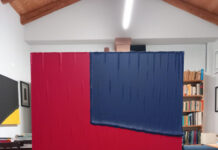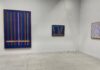

“Vision in motion is seeing while moving in time and space. It is a synthesis of
creative, emotional, and intellectual faculties functioning as a unit.”
Moholy-Nagy, László. Vision in Motion, 1947.
In this art review, I adopt a phenomenological approach to visual art, wherein light, color, and motion converge into a sensorial experience through the work of Elay Li (1985), a leading figure of the Azerbaijani contemporary avant-garde based in Milan. Through his pioneering conceptual innovations, the artist redefines the Riflessionismo (reflectionism) movement, positioning himself as a sculptor of light upon form, rendering the invisible visible — an approach that resonates with the avant-garde ethos of reimagining perception and materiality.

As the very notion of the avant-garde implies innovation and forward-thinking exploration, in this context, concerned with subjective-first-person experience, I wish to draw attention to the Azerbaijani contemporary avant-garde artist Elay Li. Elay’s work exemplifies this ethos through the interrelation of light, color, reflection, and perception. At the core of this synchronicity lies an intentional exploration of how light interacts with monochromatic spatial configurations. Canvas becomes a physical stimulus, color a phenomenal quality, sound not only a vibration, but a temporal phenomenon that draws the body into rhythm, movement, and relational orientation.

In phenomenology, seeing a color, hearing a tone, and feeling a light-space are events of consciousness, affect, and attention. Phenomenology recognizes cross-modalities: our senses are not isolated but intertwined. Light resonates, sound shimmers, color vibrates, these are metaphors, but also experiential realities in sensorial experience. Maurice Merleau-Ponty, in Phenomenology of Perception (1964), does not treat light as an object among others, but as the medium through which visibility is made possible. Light is lived through the body, through touch, warmth, and spatial depth. He writes:
“The light of day is not a thing among other things, but rather the condition for all things to appear.”
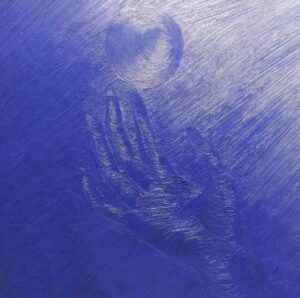
In this phenomenological framework, Elay Li’s artistry renders these theoretical dimensions tangible, inviting viewers to put in motion the space where light sculpts form, and where the invisible is made visible through a choreography of reflection. In this tactile experience with the light, reflection is a dynamic interplay between visibility and invisibility, motion and transcendence. The artistic use of reflected light thus operates not only as a visual effect but as a metaphysical and perceptual phenomenon.
In positioning Elay Li’s artistry within the phenomenological aesthetics and avant-garde experimentation, it becomes clear that his art does not only revive the fascination with light and surface, but they reconfigure it. By merging artistic creation with scientific inquiry and material experimentation, the avant-garde artist reconsiders reflection in sensory experience as a conceptual tool.
As a result, Reflectionism in Elay Li’s art invokes the condition of appearing and emerges not simply as a stylistic innovation but as a neuroaesthetic manifestation, where light, sound, matter, and perception interrelate.