mercoledì 25 Novembre 26

Daily Geoculture Review

Criticism Behaviour Imagination

Carmelo Strano editor

Home Blog Pagina 56

L’eclettismo di Esther Ségal

Nella fotografia l'installazione di Ester Ségal composta da quattro fotografie in cui sono rappresentati uomini, donne e ambienti naturali con sfondo nero
Séries des sables, tirage couleur numérique, 90x150 cm, 2017-2018

Esther Ségal è nata nel 1973 a Parigi, città in cui vive. Dopo gli studi universitari ha svolto un dottorato presso il dipartimento di Scienze dell’Arte. Dal 2000 ad oggi, ha partecipato a circa sessanta mostre in Francia e all’estero. Dal 2016 espone alla galleria Baudouin-Lebon. Io stesso l’ho invitata a varie mostre collettive: tra queste cito ” Il Nero” (allestita alla Villa Tamaris di La Seyne-sur-Mer e al Musée Jose Luis Cuevas a Città di Messico), “Kafka era Praga, Praga era Kafka” (allestita tra l’altro al centro d’arte Baudouin di Anthony e alla galleria Scoglio di Quarto a Milano) e “Leçons de ténèbres” (allestita al Centre d’art de Mont-de-Marsan, église de Beaugency).

Esther ha lavorato come attrice di teatro e come fotografa, principalmente ritratti. Ha scritto anche vari libri tra cui, nel 2016, uno sull’estetica della fotografia (“De l’Un-précis”) e nel 2017 l’opera teatrale “Rédemption”. Infine, da anni collabora alla Radio Fréquence, emittente protestante, dove tiene una rubrica settimanale.


La sua opera si è sviluppata dapprima su di una superficie fotografica dal carattere astratto, incisa con numerose punture d’ago fino a creare una scrittura simile all’alfabeto Braille; la superficie astratta ha poi lasciato spazio ai paesaggi. Di recente Esther ha dato vita a quadri di ispirazione classica, come trittici e polittici. Queste opere si caratterizzano per la sovversione dei codici iconografici del tempo passato, senza tuttavia una vena critica, blasfema o umoristica. La sua ispirazione ai codici classici conserva l’aspetto formale dei grandi temi religiosi o mitologici.

Nel grande ambito dell’arte che insiste nella fotografia, Esther Ségal è uno degli autori più affascinanti e originali.

Esther Ségal’s eclecticism

In the photograph, the installation by Ester Ségal consisting of four photographs depicting men, women and natural environments with a black background
Séries des sables, tirage couleur numérique, 90x150 cm, 2017-2018

Esther Ségal was born in 1973 in Paris, a city where she still lives. After her university studies she obtained her PhD at the Department of Art Sciences. From 2000 until today, she participated in about sixty exhibitions in France and abroad. Since 2016 she exhibits at the Baudouin-Lebon gallery. I myself have invited her to various group exhibitions: which I will mention a few – “The Black” (set up at Villa Tamaris in La Seyne-sur-Mer and Musée Jose Luis Cuevas in Mexico City), “Kafka was Prague, Prague was Kafka” (set up, among other things, at Anthony’s Baudouin art centre and at the Scoglio di Quarto gallery in Milan) and “Leçons de ténèbres” (set up at the Centre d’art de Mont-de-Marsan, église de Beaugency).

Esther worked as a theatre actress and as a photographer with portraiture. She has also written various books, including, in 2016, one on the aesthetics of photography (“De l’Un-précis“), and in 2017 the play “Rédemption”. Lastly, for years she has collaborated with the Protestant Radio Fréquence, where she has a weekly column.


Her work first developed on a photographic surface with an abstract character, engraved with numerous needle-sticks to create a writing similar to the Braille alphabet; the abstract surface then gave way to landscapes. Esther has recently created classically inspired paintings, such as triptychs and polyptychs. These works are characterized by the subversion of the iconographic codes of the past, without, however, a critical vein, blasphemous or humorous: her inspiration for classical codices preserves the formal aspect of great religious or mythological themes.

This way of conceiving art makes Esther Ségal one of the most fascinating and original artists in the world of photography and art in general.

Vita, morte e resurrezione di Arthur Aeschbacher

Ci ha lasciato poche settimane fa, a quasi novantotto anni, per un tumore al cervello. Ma ha resistito per più di sei mesi e non ha mai perso la testa, malgrado la gravità della sua situazione. Per me è stata una perdita enorme – di più, era l’ultimo d’una catena di amici che hanno cambiato la mia vita nella seconda parte degli anni Settanta, Brion Gysin, William S. Burroughs, Bernard Heidseick, Henri Chopin, Françoise Janicot, sono andati via tutti.                                                                                

Arthur Aeschbacher è sempre stato molto riservato riguardo alle proprie origini. Sappiamo che era nato a Ginevra, ma non ha mai rivelato nulla della sua infanzia né di suo padre. Evocava talvolta sua madre, che era cavallerizza in un piccolo circo chiamato Cavallini. Qualche anno fa ha scritto un bel testo sul circo con delle bellissime illustrazioni. E non parlava neanche dei suoi inizi in arte.

Non si sa se abbia studiato o no e, se l’ha fatto, dove. Raccontava solo di qualche amico e di alcuni incontri a Parigi. Non parlava neppure delle sue opere risalenti a prima degli anni Sessanta. Sono solo riuscito a scoprire che faceva quadri dallo spirito post-cubista di cui ho potuto vedere qualche riproduzione.

Insomma, tutta la sua storia ha inizio intorno al 1960, quando comincia a utilizzare la forma del manifesto e lascia dietro di sé la figurazione. Eppure non ha mai rinunciato del tutto alla pittura, pur privilegiando la scrittura. Ha usato soprattutto le lettere, che sono diventate strumenti d’una poesia che poteva essere più figlia della poesia di Arthur Rimbaud « Les voyelles » che dellettrismo di Isidore Isou.

All’epoca, Pierre Restany aveva creato il Nuovo Realismo, a cui avevano aderito artisti che usavano manifesti affissi sui muri e strappati come poesia visuale della strada urbana moderna. Malgrado la grande differenza formale e concettuale dei suoi lavori, Aeschbacher è stato considerato come un antagonista. Egli però ha proseguito nella sua ricerca e ha dimostrato che la sua via aveva poco a che fare con i lavori di Villeglé o di Rotella.

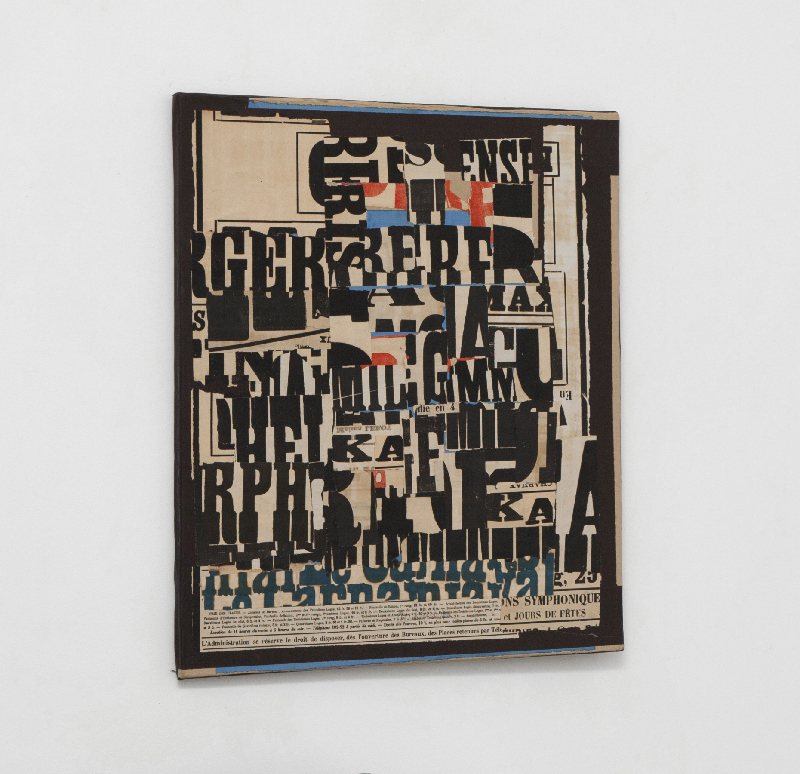
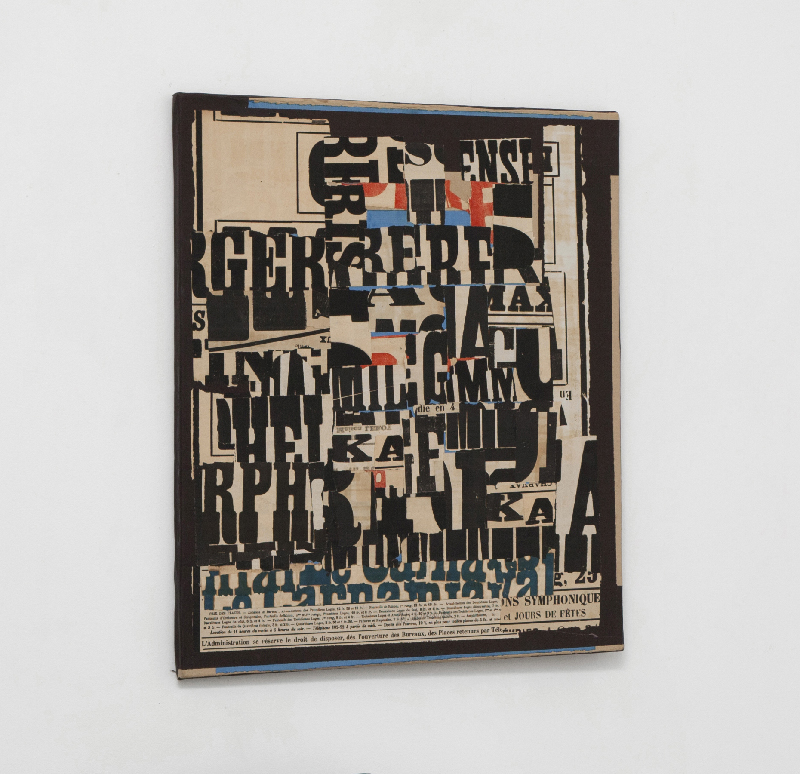
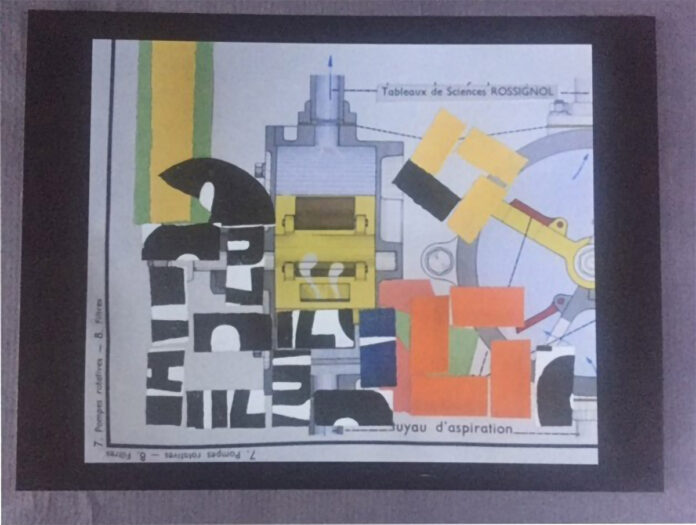
L'immagine mostra un collage su tela, appeso ad una parete bianca. Il quadro è composto interamente da ritagli di titoli di giornale a caratteri maiuscoli e in grassetto, circondati da una sottile cornice neraHa elaborato quadri con strati di manifesti, mostrando parti orizzontali e irregolari di testi di manifesti degli inizi della Belle Epoque. É infine giunto a un gran numero di soluzioni formali in cui le lettere e una sorta di gioco geometrico derivato dal costruttivismo o dal neoplasticismo erano abbinati. Il collage e le linee cromatiche sono stati spesso il fondamento della sua creazione.    

A ciò si deve aggiungere che, durante tutti questi anni, questo artista ha ideato serie di lavori molto particolari. Come le Stores/Surfaces (tapparelle/superfici), un gioco di parole sul gruppo di artisti francesi della fine degli anni ’60. Si trattava di tapparelle con frammenti di lettere che si muovevano quando si alzava o si abbassava la tapparella.

Tra le tante altre cose, ci sono le opere ispirate alla cultura popolare messicana, come le scatole gialle della birra « Pacifico» oppure le maschere dei lottatori che godevano di un grande favore popolare. Ha anche usato le vecchie insegne dei parrucchieri dalla forma cilindrica e tricolore, che si vedevano nei tempi passati per le strade di Parigi. Adesso che ci ha lasciato, la sua opera verrà considerata con più attenzione.

Personalmente, ritengo Arthur Aeschbacher uno degli artisti più inventivi dal dopoguerra fino ai nostri giorni. Varie mostre sono già in preparazione, il mercato dell’arte ha fatto lo stesso con Modigliani. Sempre post mortem.

Life, Death and Resurrection of Arthur Aeschbacher

The picture shows a collage on a grey background

He left us a few weeks ago, at almost ninety-eight years old, from a brain tumour. But, he resisted for more than six months and never lost his mind, despite the seriousness of his situation. For me it was a great loss – he was the last of a chain of friends who changed my life in the second part of the Seventies: Brion Gysin, William S. Burroughs, Bernard Heidseick, Henri Chopin, Françoise Janicot – they have all passed on.

Arthur Aeschbacher has always been very reserved about his origins. We know he was born in Geneva, but never revealed anything about his childhood or his father. He sometimes evoked his mother, who was a horseman in a small circus called Cavallini.

A few years ago, he wrote a nice text about the circus with beautiful illustrations. And he didn’t even talk about how he started art. It is not known whether or not he studied and, if he did, where. He only spoke of a few friends and a few meetings in Paris.

He did not even mention his works dating back to the early 1960s. I only managed to discover that he made paintings with a post-cubist spirit of which I could see some reproductions. In short, all his history begins around 1960, when he began to use the form of the manifesto and leaves figuration behind him.

Yet he never gave up painting altogether, while favouring writing. He mainly used letters, that have become instruments of a poem which could have been more a daughter of Arthur Rimbaud’s poetry “Les voyelles”, that of the electrism of Isidore Isou.

At the time, Pierre Restany had created the New Realism, joined by artists who used posters posted on the walls and torn as visual poetry of the modern urban street. Despite the great formal and conceptual difference in his works, Aeschbacher was regarded as an antagonist. However, he continued his research and proved that his way had little to do with the works of Villeglé or Rotella.

the picture shows a collage painting on a white wall. The painting is composed of pieces of newspaper titles whit black bold letters, surrounded by a black lineHe elaborated paintings with layers of posters, showing horizontal and irregular parts of poster texts from the early Belle Epoque. It finally came to a large number of formal solutions in which the letters and a kind of geometric game derived from constructivism or neoplasticism were combined. Collage and colour lines have often been the foundation of its creation.
We must add that throughout all these years this artist has created very special series of works. Such as ‘Stores/Surfaces’, a play on words on the group of French artists from the late 1960s. It consisted of shop shutter-doors with fragments of letters, which moved when one raised it or lowered it.

Among many other things, there are works inspired by Mexican popular culture, like the yellow beer boxes “Pacific”, or, the masks of the wrestlers which enjoyed great popularity. He also used old hairdressers’ signs which were cylindrical and tricolour that were seen in past times on the streets of Paris.

Now that he’s left us, his work will be considered more carefully. Personally, I consider Arthur Aeschbacher one of the most inventive artists from the post-war period to the present day. Various exhibitions are already in preparation, the art market did the same with Modigliani. Always post mortem.

Alta Velocità

logo della rubrica Spazio Milano con l'immagine della facciata del Duomo e la scritta Spazio Milano

Alla stazione Centrale di Milano, lungo i marciapiedi dove si accalcano i viaggiatori in attesa dei treni ad alta velocità, di folla ce ne è sempre stata.

I Frecciarossa italiani non sono gli Shinkansen o bullet train, i treni pallottola, che collegano ben 22 città lungo tutta la lunghezza dell’arcipelago giapponese. É una questione di status, loro sono stati i primi.

In un aspetto ora però Shinkansen, Frecce, Italo si assomigliano: hanno pochissimi passeggeri. Prima della pandemia l’Alta velocità italiana sembrava in grado di compensare, sia in termini di immagine che di utili, la rete ordinaria. Dello stesso erano convinti i giapponesi quando misero sul mercato le società che gestivano il servizio. Unica in Europa, l’Italia, molto prima della Francia, aveva aperto le tratte dell’Alta Velocità alla concorrenza di Italo NTV, poi venduto dai suoi azionisti originari a un fondo di investimento USA.

I treni ad alta velocità hanno degli alti costi fissi e soprattutto non possono cambiare rotta o destinazione come gli aerei. Ora stanno soffrendo come molti altri settori il cambiamento del modo di lavorare nelle aziende. É molto probabile che i pendolari da alta velocità, anche quando la situazione dovesse normalizzarsi, non torneranno con gli stessi numeri di prima della pandemia.

Il calo dei turisti sulla rete giapponese degli shinkansen è stata del 99%, quella per l’adozione del lavoro a distanza del 70%. I numeri italiani sono un po’ meglio, ma Milano con le sue tre stazioni dell’alta velocità, Centrale, Rogoredo, Porta Garibaldi, soffre.

Ora le Ferrovie dello Stato sono una delle agenzie più titolate a ricevere cospicui finanziamenti europei del New Generation Found. Saranno spesi per il rinnovo della rete ferroviaria ordinaria e probabilmente per quella dell’Alta Velocità. I sindaci di ogni schieramento politico si sentono danneggiati se le città che governano non dispongono di una stazione dell’Alta Velocità.

Non avercela rende la vita più difficile, ma i sindaci lombardi e quello di Milano questa volta stanno sulla barricata opposta all’Alta Velocità. Avendola già avuta, eccetto che sulla Genova Milano, vogliono finanziamenti per la rete ordinaria al servizio dei pendolari e per le metropolitane.

Humboldt Forum a Berlino

Fotografia della facciata barocca interna dell'Humboldt Forum, museo a Berlino
Humboldt Forum, foto Alexander Schippel, fonte Facebook @humboldtforumberlin

Il museo, ricco contenitore

Lo ospita una ricostruzione, copia perfetta dello Stadtschloss che fu residenza degli Hohenzollern. Su tre lati è in stile barocco e su un quarto in stile centro congressi razionalista. Ospiterà un museo della storia della città ma soprattutto le collezioni di Arte Asiatica, delle Americhe, dell’Oceania e dell’Africa. Più di cinquecentomila pezzi esibiti a rotazione che, nel corso degli anni, verranno digitalizzati e corredati da storia e provenienza.

La lentezza delle procedure hanno però provocato le dimissioni della storica dell’Arte Bénédicte Savoy. 677 milioni di euro il costo fino ad ora, ma con le spese di riordino delle collezioni e digitalizzazione, si potrebbe arrivare nel giro di pochi anni a un miliardo di euro.

É qualcosa di molto diverso dai Musée du quai Branly a Parigi e British Museum a Londra. Il primo, inaugurato nel 1995, è una creatura tipicamente novecentesca, il secondo è nato nella seconda metà del Settecento. Non è solo una questione di dimensioni delle collezioni, 8 milioni di pezzi quella del British, poco meno quella del museo parigino, ma sono gli anni dopo la crisi del 2008 che contano.

L’inaugurazione digitale dello Humboldt Forum

Di mezzo, dopo venti anni di globalizzazione, c’è l’ascesa del mondo postcoloniale e la presa d’atto delle sue aspirazioni, del suo voler esserci, della libertà dei suoi giudizi sul mondo industrializzato e ricco. L’inaugurazione digitale dello Humboldt Forum ha toccato il tema dell’arte rubata “Raubkunst” e di #blacklivesmatter. Il filmato dell’abbattimento della statua di un commerciante di schiavi ma anche benefattore della città di Glasgow e il suo successivo trascinamento da parte della folla nelle acque del porto della città inglese, ha costituito parte dell’atto di battesimo di questa nuova istituzione culturale.

Il sito è quello dell’isola dei Musei bagnata dalla Sprea, luogo principe della tradizione classica e neoclassica europea. Ma è al mondo postcoloniale figlio della globalizzazione a cui la Germania, massima potenza esportatrice e baricentro dell’Europa, guarda e dove ha trovato un nuovo posto nel mondo. Se la valenza è questa, risulta spiegabile la presentazione agile, senza retorica, tutta improntata all’idea di una ricerca comune con altri partecipanti e culture, nessuno in posizione subordinata.

Dal ristorante all’ultimo piano di questa criticatissima copia di palazzo barocco si scorge non lontano la cupola trasparente del Reichstag e appena più in là, lungo la Sprea, l’ospedale della Charitè dove è stato ricoverato e salvato Aleksej Naval’nyj, l’uomo politico russo avvelenato in Siberia. Questa ricostruzione sulle ceneri del palazzo imperiale e poi su quelle del Republik Palast, sede del parlamento della DDR, demolito senza pietà, vuole essere un atto di sfida anche all’establishment dei musei di Etnografia.


Leggi anche:

Berlino, riunificata ma ora bloccata

Humboldt Forum in Berlin

Photograph of the interior baroque facade of the Humboldt Forum, museum in Berlin
Humboldt Forum, photo Alexander Schippel, source Facebook @humboldtforumberlin

 The museum, a rich container

Humboldt Forum is housed in a reconstruction, a perfect copy of the Stadtschloss that was the residence of the Hohenzollerns. Three sides are in the Baroque style, while the fourth is in the rationalist congress center style. It will house a museum of the history of the city but above all the collections of Asian, American, Oceanian and African art. More than five hundred thousand pieces will be exhibited in rotation which, over the years, will be digitized and accompanied by their stories and origins.

However, the slowness of the procedures resulted in the resignation of the art historian Bénédicte Savoy. 677 million euros have been spent up to now, but with the costs of reorganizing the collections and digitization, one billion euros could be reached in a few years.

It is something very different from the Musée du Quai Branly in Paris and the British Museum in London. The first, inaugurated in 1995, is a typical twentieth-century building; the second was built in the second half of the eighteenth century. It is not just a question of the size of the collections: in the British Museum there are about 8 million pieces; in the Parisian museum there are slightly fewer. However, the years after the 2008 crisis are what matters.

The digital inauguration of the Humboldt Forum

Centrally, after twenty years of globalization, there is the rise of the postcolonial world and the acknowledgment of its aspirations, of its desire to be there, and of the freedom of its judgments on the industrialized and rich world. The digital inauguration of the Humboldt Forum touched the theme of stolen art “Raubkunst” and #blacklivesmatter. The video of the demolition of the statue of a slave trader and benefactor of the city of Glasgow and its subsequent dragging by the crowd into the waters of the English city harbor was part of the baptismal certificate of this new cultural institution.

The site is on Museum Island washed by the Spree, the main place of the classical and neoclassical European tradition. However, Germany, the greatest exporting power and center of gravity of Europe, looks to the postcolonial world, where Germany has found a new place in the world. If this is the value, the agile presentation can be explained, without rhetoric, all based on the idea of ​​a common research with other participants and cultures, none in a subordinate position.

From the restaurant on the top floor of this highly criticized copy of a Baroque palace, not far away, you can see the transparent dome of the Reichstag and just beyond, along the Spree, the Charitè hospital where Alexej Naval’nyj, the Russian politician poisoned in Siberia, was hospitalized and saved. This reconstruction on the ashes of the imperial palace and then on the RepublikPalast, seat of the parliament of the GDR, which has been mercilessly demolished, is intended to be an act of defiance also to the establishment of ethnographic museums.


You can also read:

Berlin, reunited but stuck

Soul, la recensione di anime animate

Suicide squad 2, la recensione suicida - The suicidal review

Dalla caleidoscopica Pixar Animation Studios nasce un nuovo capolavoro dalle inaspettate sfaccettature. Il tema avrebbe potuto essere la musica, come in “Lalaland“, l’essere afroamericano a New York come in “Fa la cosa giusta“. Oppure avrebbe potuto essere un film sull’al di là come “ll paradiso può attendere“. Invece è un manuale pratico per uscire da dilemmi esistenziali e riportarci a contatto con la semplice vibrante gioia di vivere. 

La strabordante creatività dei disegnatori Pixar si esprime sul triplice design dei personaggi generando tre diversi tipi di forme anatomiche. Umani, delle anime e degli esseri semidivini in forme di semplice linea. Tre sono anche le dimensioni dell’esistenza, la realtà, il mondo delle anime e la via di mezzo delle anime perdute dove operano i “mistici senza frontiere”.

La parte più originale del racconto. 

vedi anche:

Soul triler

Soul, the Animated Souls Review

From kaleidoscopic Pixar Animation Studios a new masterpiece with unexpected facets is born. The theme could have been music, like in “La La Land”, or being African American in New York such as “Do the Right Thing”. Or it could have been a film about the beyond, like “Heaven can wait”. Instead, it’s a practical manual to get out of existential dilemmas and bring us back into contact with the simple vibrant joy of life.

The overwhelming creativity of Pixar designers expresses itself on the triple design of the characters generating three different types of anatomical forms. Human, souls and of semi-divine beings in simple line forms. There are also three dimensions of existence, the reality, the world of souls and the middle way of the lost souls where the “mystics without frontiers” operate.

The most original part of the story.

Also:

Soul Trailer

News for institutional rulers, the virus is not rushed!?

Skateboard logo that this week deals with the Covid 19 and the italian politicians

News for institutional rulers, the virus is not rushed!?

Notizie per i governanti: il virus non ha premura!?

logo della rubrica Skateboard con la scritta in bianco e nero Skateboard e l'immagine di un teschio bianco con la lettera F sulla fronte

Notizie per i governanti: il virus non ha premura!?

What is the sacred?

Digital Aristotele logo with the Aristotele's face

It’s what never fails to come back:

it is the origin which always reappears at the same time different and equal to itself;

it is the order that cannot forget chaos;

it is what, precisely because it exists, belongs to no one:

it is the impossibility of the absolute which becomes presence;

it is what transcends in order to make us able to think about other than what we are;

it is what reminds us that we are immanent to ourselves;

it is what reopens the possible between life and death, between rational and irrational;

it is what makes hate and love alike;

it is what continually reopens the space of the possible;

it is what allows the work of man to survive man;

it is the splendor of the beautiful and the absolute power of the ugly;

it is the “totally other thing”;

it is the key of the decision;

it is the violence which holds the victim and the perpetrator together;

it is royalty and its gallows: dead the king, long live the king!

it is the monstrosity of the holocaust and its victims: the sacred never fails to return;

it is the ritual blood to distinguish the outside (of all) and the inside (of no one): together in the temple;

………………………………………………………;

it is the absolute need for a sacrificial victim, for an original crime, in order to legitimize any social pact. It is what allows us to be together because we give ourselves a victim; it is what, with rites and liturgies, is collectively remembered if we do not all want to become victims.


To become society, some of us must become a victim. It is the sacred that founds the political.

If the principle by which the sacred never fails to return holds true, the underlying political question is not in its negation. On the other hand, since it is so powerful that it never fails to return, its underlying political question is on how we can all manage to prevent the sacred from making us what it wants.

However, we have a debt to our pride: it is called free will.


I have mentioned the relation between sacred and beautiful. Here, there are the words of Rainer Maria Rilke:

“……the beautiful is just

The first note of Tremendous. To be

hold and admired is our job

only because it does not bother to destroy us.”


Tremendous is therefore the beautiful as much as the sacred.

How can we ensure that the sacred (and the beautiful) continue not to care for us? And how can we make sure that politics is not the weapon of sacredness against us? Or, conversely, how to make politics defend us from the terrible?

And what happens where the sacred intersects with the power of digital and pandemic expansion?

Before trying to answer, a clarification is fundamental. The sacred undoubtedly feeds the world of religions, but it is not resolved in and with religions. In some cases, religions distance themselves from the sacred. For example, Buddhism, which tries the horse’s move by removing all forms of violence from itself. As well as but in a much more radical way, Christianity tries to oppose the sacred and fights it while knowing, or precisely because it knows fully, that never fails to return. I’ll leave here next week.


You can also read the introductory article by the same author:

So, it is

Che cos’è il sacro?

logo della rubrica Aristotele Digitale che mostra una scultura del filosofo, ma solo la testa

È ciò che non manca mai di tornare: 

è quell’origine che sempre si ripresenta nel contempo diversa e uguale a se stessa; 

è l’ordine che non può dimenticare il caos;

è ciò che proprio perché è, non è di nessuno:

è l’impossibilità dell’assoluto che si fa presenza;

è ciò che trascende per poterci pensare altro da ciò che siamo;

è ciò che ci ricorda che siamo immanenti a noi stessi;

è ciò che riapre il possibile tra la vita e la morte, tra razionale e irrazionale;

è ciò che rende simili l’odio e l’amore;

è ciò che riapre continuamente lo spazio del possibile;

è ciò che permette all’opera dell’uomo di sopravvivere all’uomo;

è lo splendore del bello e l’assoluta potenza del brutto;

è il totalmente altro; 

è la crucialità della decisione;

è la violenza che tiene assieme la vittima e il carnefice;

è la regalità e il suo patibolo: morto il re, viva il re!

è la mostruosità dell’olocausto e delle sue vittime: il sacro non manca mai di tornare;

è il sangue rituale per distinguere il fuori (di tutti) e il dentro (di nessuno): insieme nel tempio;

………………………………………………….;

è l’assoluto bisogno di una vittima sacrificale, di un delitto originario, per legittimare qualsiasi patto sociale;  è ciò che ci permette di stare assieme perché si dà una vittima; è ciò che va, con riti e liturgie, ricordato collettivamente se non vogliamo diventare tutti vittime.


Per diventare società qualcuno tra di noi deve diventare vittima. É il sacro che fonda il politico. 

Se vale il principio che il sacro non manca mai di tornare la questione politica di fondo non è nella sua negazione, visto che è così potente da non mancare mai nel tornare, ma sul come tutti noi possiamo riuscire ad impedire che il sacro faccia di noi ciò che vuole. 

Abbiamo comunque un debito con il nostro orgoglio: si chiama libero arbitrio.


Ho detto della relazione tra il sacro e il bello. Ecco cosa ci dice Rainer Maria Rilke:

“…… il bello è solamente

la prima nota del Tremendo. E dato

di sostenerlo e di ammirarlo è a noi,

solo perché non cura di annientarci.”


Tremendo è quindi il bello quanto il sacro.

Come fare affinché il sacro (e il bello) continui a non curarsi di noi? E come fare in modo che non sia proprio la politica l’arma della sacralità contro di noi? O, di contro, come fare affinché la politica ci difenda dal tremendo?

E cosa succede là dove il sacro si incrocia con la potenza del digitale e l’espansione pandemica?

Prima di provare a rispondere è fondamentale una precisazione: il sacro indubbiamente alimenta il mondo delle religioni, ma non si risolve nelle e con le religioni. In alcuni casi le stesse religioni prendono le distanze dal sacro. Ad esempio il buddismo, che prova la mossa del cavallo allontanando da sé ogni forma di violenza, o, in modo ben più radicale, il cristianesimo, che prova a contrapporsi al sacro e lo combatte pur sapendo, o proprio perché sa sino in fondo, che non manca mai di tornare. Partirò da qui la prossima settimana.


Leggi dello stesso autore l’articolo introduttivo:

Così è

Robots and the new frontiers of dance

Uomo attaccato ad un ingranaggio volteggia nell'aria
Danza con me, Fonte Rai

Danza con me by Roberto Bolle on Rai 1 is a popular party which has welcomed 2021 in style, with 3,848,000 spectators and 17% share. This edition has focused on Vasco Rossi who presented his new single entitled Una canzone d’amore buttata via. The focus was also on Diodato, who proved to be also a good dancer in the theme song of Bond-007 and on Ghali. Bolle, in an original hip hop style, also involved Michelle Hunziker for musical accents from Flashdance to La La Land, leaving aside, in the era of Zoom, the pax de deux between the dancer and a technological partner, proposed in the previous years.

The duet with laser lights, recorded at the UN, however, had been already proposed at the inaugural gala on 7 December, on TV, to open the new season at La Scala. Similarly, the love dialogue with a large robot had made its debut on the small screen during the New Year’s show in 2019.

The American Boston Dynamics, for the 2021 celebration, made some of its human-resembling robots, called the Atlas, dance together with Spot, a yellow dog-like robot. The synchronized choreography, twist style on Do You Love Me by Contours, has been designed by Monica Thomas, an all-out experimenter with the Mad King Thomas working group.

However, in 2013 the choreographer and videomaker Blanca Li, friend of Pedro Almodovar, had already used the Japanese robots NAO and the creatures of Maywa Denki in order to make Robot!, a human-machine dance with irresistible effects. 

Merce Cunningham, the old big man, father of the American postmodern dance, caused a stir in 1999 with Biped. He used the motion-capture by putting sensors on dancers’ bodies in order to create a choreography in which humans interact with the virtual projections of dancers. 

In 2020, dance became familiar with image and sound technologies, on all kinds of machine-devices, and continued to live remotely on all types of screens, from mobile phones to television. Those who had hesitated to jump into the web before last summer, hoping for the return to the scene, in autumn-winter, in theaters now closed indefinitely, threw themselves headlong into the waves of internet. There are no alternatives.

Nuove frontiere della danza tra digital e robot

Uomo attaccato ad un ingranaggio volteggia nell'aria
Danza con me, Fonte Rai

Danza con me di Roberto Bolle su Rai 1, una festa popolare per accogliere in bellezza il 2021, con 3.848.000 spettatori e il 17% di share, ha puntato stavolta su Vasco Rossi che ha presentato il suo nuovo singolo intitolato Una canzone d’amore buttata via. Focus anche su Diodato, pure buon ballerino nella sigla di Bond-007 e su Ghali. Bolle, in inedito stile hip hop, ha coinvolto anche Michelle Hunziker per accenti musical da Flashdance a La La Land, lasciando da parte, nell’era di Zoom trionfante e defatigante, i passi a due tra il ballerino e un partner tecnologico, proposti negli anni precedenti. 

Il duetto con le luci laser, registrato all’ONU, Bolle l’aveva però riproposto al gala inaugurale del 7 dicembre, in tv, per aprire la nuova stagione alla Scala, mentre il dialogo amoroso con un grande robot aveva debuttato sul piccolo schermo per il Capodanno 2019. 

L’americana Boston Dynamics, per gli auguri 2021, ha fatto danzare alcuni suoi robot, gli Atlas, dalle fattezze umane, insieme a Spot, un simil-cane giallo, in una coreografia sincronizzata, stile twist su Do You Love Me dei Contours, con movimenti disegnati da Monica Thomas, sperimentatrice a tutto campo con il gruppo di lavoro Mad King Thomas.

Ma già nel 2013 la coreografa e videomaker spagnola Blanca Li, amica di Pedro Almodovar, aveva utilizzato i robottini giapponesi NAO e le creature dell’artista Maywa Denki per una danza umano-androide in Robot!, con effetti esilaranti irresistibili.

Fece sensazione, nell’ormai lontano 1999, Merce Cunningham, il grande vecchio, il padre nobile della postmodern dance USA quando ideò Biped, usando la motion capture tramite sensori posti sul corpo dei ballerini per creare e proiettare danzatori virtuali in una coreografia condivisa tra esseri umani e segni frutto dei loro movimenti.

Nel 2020 la danza ha familiarizzato con tutte le tecnologie dell’immagine e del suono, su ogni genere di macchine-device, e ha continuato a vivere da remoto su ogni tipo di schermo, dal cellulare alla televisione. Chi aveva esitato a buttarsi nel web prima della scorsa estate, aspettando speranzosamente il ritorno in scena, nell’autunno-inverno, in teatri ormai chiusi sine die, si è lanciato a capofitto nelle onde dell’etere e della rete. Non ci sono alternative.

Disuguaglianza e democrazia

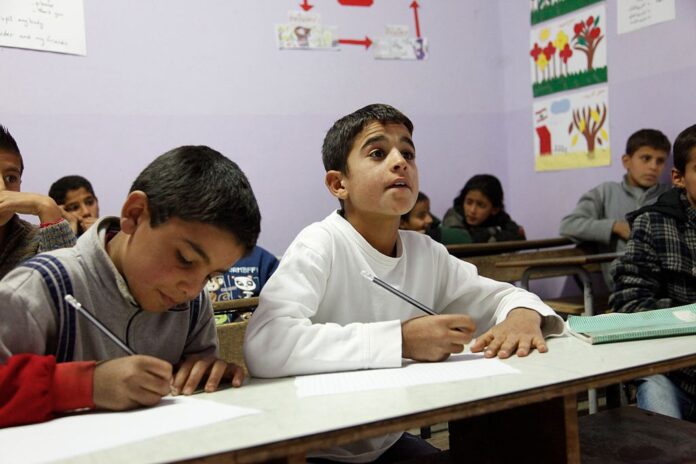
in questa foto a colori si vedono alcuni bambini sui banchi di scuola
Muhanad and Ahmad, refugees from Syria in school in Lebanons Bekaa Valley (11174124233).jpg" by DFID - UK Department for International Development is licensed under CC BY 2.0.

In modo perentorio e forse disorientante, alcuni politici ed economisti hanno messo l’accento su queste topiche: a) Non ci sarebbe alcuna connessione necessaria tra democrazia e uguaglianza, un certo grado di disuguaglianza economica è inevitabile, la democrazia è impotente contro di essa; b) la globalizzazione non avrebbe causato alcuna disuguaglianza, anzi favorirebbe l’uguaglianza; c) gli aiuti ai paesi poveri sarebbero inutili o superflui.


Il primo punto va riferito a Adam Przeworsk, politologo di fama internazionale. Il secondo è legato a Peter Lindert, John Williamson, Andrea Boltho, Giuseppe Toniolo, oltre che alla Banca Mondiale (World Development Report). Il terzo punto, quello sugli aiuti, è di Angus Deaton, premio Nobel per l’economia nel 2015, secondo il quale “se le condizioni del paese beneficiario degli aiuti sono ostili allo sviluppo, gli aiuti sono inutili; se invece sono favorevoli gli aiuti diventano superflui. Ciò che serve, è accrescere il supporto tecnico e smettere di vendere armi ai paesi poveri”.


Il primo concetto è forse il più duro da accettare, anche se comprovato dall’esperienza americana. Infatti, negli Usa il divario interno tra ricchi e poveri è costantemente aumentato fino al 2008; anche se nel XX secolo, al contrario dei secoli precedenti, l’80% della disuguaglianza globale rifletteva la disuguaglianza tra le nazioni, mentre solo il 20% era attribuibile a disparità interne ad esse (Branko Milanovic, in Review of Economics and Statics, 2015). In verità, solo l’egualitarismo politico e giuridico è il vero fulcro della democrazia, mentre non lo è quello economico, che può al massimo costituire un principio generale, come nell’art.3 della Costituzione Italiana, l’unico in cui si parli di uguaglianza senza alcuna declinazione in altre specifiche norme.


Peraltro viviamo e condividiamo l’idea del libero mercato, e “nella misura in cui la democrazia ha bisogno del libero mercato e la politica non riesce a controllare le regole operative, la democrazia finisce per convivere con la disuguaglianza economica: le due possono essere compatibili” (Alacevich – Soci Breve storia della disuguaglianza, Laterza 2019).


Qualcuno si chiede: la disuguaglianza economica può minare la democrazia? Certamente sì, rispondono economisti e politologi quali Thomas Piketty, Branko Milanovic, François Bourguignon, Paul Krugman. Il potere economico e sociale si convertirebbe in potere politico, portando all’oligarchia. Infatti  il sistema politico è usato o praticato di più da chi si posiziona meglio nella società (Nadia Urbinati – Micromega 2014).

Dei tre principali fattori della disuguaglianza, assistenza sanitaria – istruzione – mobilità sociale,  l’istruzione, elemento fondamentale della qualità delle risorse umane, è diventato determinante anche per la crescita economica dei ricchi. Poiché la disuguaglianza è fattore disgregante del capitale umano, alle classi ricche potrebbe convenire ridurre la disuguaglianza per proprio interesse (Alacevich-Soci). Un contrappasso economico che non deve meravigliare, dato che da sempre siamo tutti nella stessa barca, come dice Papa Francesco.

Inequality and democracy

in this coloured photo you can see some pupils at school
Muhanad and Ahmad, refugees from Syria in school in Lebanons Bekaa Valley (11174124233).jpg" by DFID - UK Department for International Development is licensed under CC BY 2.0

In a peremptory and perhaps disorienting way, some politicians and economists have emphasized three topics: a) There would be no necessary connection between democracy and equality, some degree of economic inequality is inevitable, democracy is powerless against it; b) globalization would not have caused any inequality, on the contrary, it would promote equality; c) aid to poor countries would be useless or unnecessary.


The first point is referred to Adam Przeworsk, internationally renowned political scientist. The second is linked to Peter Lindert, John Williamson, Andrea Boltho, Giuseppe Toniolo, as well as the World Bank (World Development Report). The third point, the one on aid, is by Angus Deaton, Nobel Prize in Economics in 2015, according to which “if conditions in the recipient country are hostile to development, aid is useless; if, on the other hand, aid is favorable it becomes superfluous. What it takes, is to increase technical support and to stop selling weapons to poor countries”.


The first concept is perhaps the hardest to accept, even if proven by American experience. In fact, in the USA the internal gap between rich and poor has steadily increased until 2008, even if in the twentieth century, unlike previous centuries, 80% of global inequality reflected inequality between nations,while only 20% was attributable to internal disparities (Branko Milanovic, in Review of Economics and Statics, 2015). The truth is that only political and legal egalitarianism is the true fulcrum of democracy, while the economic one is not, which can at most constitute a general principle, as in Article 3 of the italian Constitution, the only one in which equality is spoken of without any declination in other specific rules.

Moreover, we live and share the idea of the free market, and “to the extent that democracy needs the free market and political policy fails to control the operating rules, democracy ends up living with economic inequality: the two can be compatible” (Alacevich – Soci Breve storiadelladisuguaglianza,Laterza 2019).

Some people wonder: can economic inequality undermine democracy? Certainly yes, stated by economists and political scientists such as Thomas Piketty, Branko Milanovic, François Bourguignon, Paul Krugman. The economic and social power would convert to political power, leading to oligarchy. In fact, the political system is used or practiced more from those who rank better in society (Nadia Urbinati – Micromega 2014).


Of the three main factors of inequality, health care, education, social mobility, fundamental element of the quality of human resources, it has also become crucial to the economic growth of the rich. Since inequality is a disintegrating factor of human capital, the wealthy classes might be better off reducing inequality for their own sake (Alacevich-Soci). An economic setback that should come as no surprise, since we’ve all always been in the same boat, as Pope Francis said.


Epifania d’un dettaglio

nella foto a colori si vedono alcune palle colorate con una base di legno, un vaso bianco trasparente, tutti poggiati sul davanzale di una finestra che si affaccia su uno spazio esterno innevato
Evelina Schatz, Inverno, 2020

Lascia che la vita accada.

cortese, segna i nostri tempi nel caos precipitati.

Da lì frammenti d’un futuro — possibile rilancio

Mentre amor latino segna ogni pietra, e architettura, rischiara

il paesaggio al nascere. Ora canti pure la storia e accogli il mondo

      nel ventre della creazione

                  nella luce sfumata del tempo antico

                               nel miracolo del giorno qualsiasi.


Epifania d’un dettaglio che illumina l’epoca congiunta.


suoni e sapori e magici amalgami

ampio inscrutabile letto

aspetto degli amanti si infuoca

mentre

tempo stende implacabile velo.

Insulare speranza. Sperato avvio.


2019 – 2020


Evelina Schatz, poetessa in russo e italiano, artista e saggista.

Close Popup

Questo sito web utilizza cookie o tecnologie simili per finalità tecniche e, con il tuo consenso, anche per altre finalità come specificato nella cookie policy. Puoi liberamente prestare, rifiutare o revocare il tuo consenso in qualsiasi momento. La chiusura del banner comporta il consenso ai soli cookie tecnici necessari.

Close Popup
Privacy Settings saved!
Impostazioni

Quando visiti un sito Web, esso può archiviare o recuperare informazioni sul tuo browser, principalmente sotto forma di cookies. Controlla qui i tuoi servizi di cookie personali.

Questi cookie sono necessari per il funzionamento del sito Web e non possono essere disattivati nei nostri sistemi.

Cookie tecnici
Per utilizzare questo sito web usiamo i seguenti cookie tecnici necessari: %s.
  • wordpress_test_cookie
  • wordpress_logged_in_
  • wordpress_sec
  • wordpress_gdpr_cookies_allowed
  • wordpress_gdpr_cookies_declined
  • wordpress_gdpr_allowed_services

Rifiuta tutti i Servizi
SALVA
Accetta tutti i Servizi