A new piece has been added to the already extensive narrative production of the Star Wars space saga, and it’s the least expected.
The Mandalorians were fleeting presences in the background of the events, much more central to the great battle between good (Jedi) and evil (Sith). The only thing that is clear is who worked as bounty hunters. They appeared less on screen than the Ewoks, bear-like natives of the wooded moon of Endor.
Yet, surprisingly, they are, or rather to a specific Mandalorian, a new series now on Disney‘s streaming platform.
Mandalorian debuted in Disney+ in November 2019, and is already in its’ second season. The first reveals some captivating elements that generate genuine interest. The second seems, instead, wanting to pass any curiosity on the subject.
The originality of the protagonist lies in the fact that it seems to have come out of a western but with a medieval bestiary at its disposal. Futuristic weapons and, here and there, we find some humour. Another comedy element is the expedient of the classic comic couple. The couple is formed by our hero and the child (Baby Yoda) that corrects, with his tender expressions, the lack of the Mandaloran’s face.
Being able to build narrative tension around a faceless protagonist is not, in itself, a simple thing. The involvement of the viewer is supported by the slow unveiling of the personal history of the grumpy Mandalorian, a high level of special effects, and by well-characterized co-stars. Apart from a few stumbles, it remains an entertainment suitable for fans of the genre and new fans.
A great fear, it is a very truly one, it isn’t a warlike, a political assumption. I’m talking as a citizen who loves read carefully things. There is no disdain or doubt about the governors’ abilities. I think of the various routed anthropological, social and cultural problems from which Italy suffer and which are capable of weakening all good will. Furthermore, the sense of the nation yields to even legitimate dips in their own political flag. As if it were about survival, and in a certain sense it is, in the existential terrain. But there would be the survival of the nation to which all Italians belong. How scary! Up until now I can’t shake it off. Please, kind members of the establishment, please kind members of the opposition. It is not a personal matter, even though I am involved in it, but it is of course a national one. Start doing something that will safeguard Italy economically in the near and more distant future. Fear of shipwreck, of a very deep and irrecoverable rise in debt, fear of a kind of capitis deminutio. I know well that I am not original in this statement. But this is the reason why my own fear is quite stable until now. It is based on the objective condition when two plus two are four. Let’s subvert it. Thanks.
Una gran paura, vera sincera, non bellicosa, non politica, da cittadino attento a leggere nelle cose. Non per disistima o dubbio sulle capacità. Invece a causa delle varie problematiche pregresse, antropologiche, sociali, cultuali capaci di fiaccare ogni buona volontà. Inoltre il senso della nazione soccombe ai pur legittimi tuffi nella bandiera politica di appartenenza. Come si trattasse di sopravvivenza, e in un certo senso – esistenziale – lo è. Ma ci sarebbe la sopravvivenza della nazione a cui si appartiene. Che paura! Fino a questo momento non riesco a scrollarmela di dosso. Per piacere, gentili membri dell’establishment, per piacere gentili esponenti dell’opposizione. Non è un fatto personale, anche se vi sono coinvolto, ma nazionale. Cominciate a fare qualcosa che salvaguardi l’Italia sul piano economico nel prossimo e più lontano futuro. Paura del naufragio, di un rialzo ben sensibile e irrecuperabile del debito, paura dell’indebitamento profondo da capitis deminutio. So bene che non sono originale in questa querelle. E a maggior ragione, avverto questa paura. Essa è fondata su un terreno del due più due fanno quattro. Sovvertiamolo. Grazie.
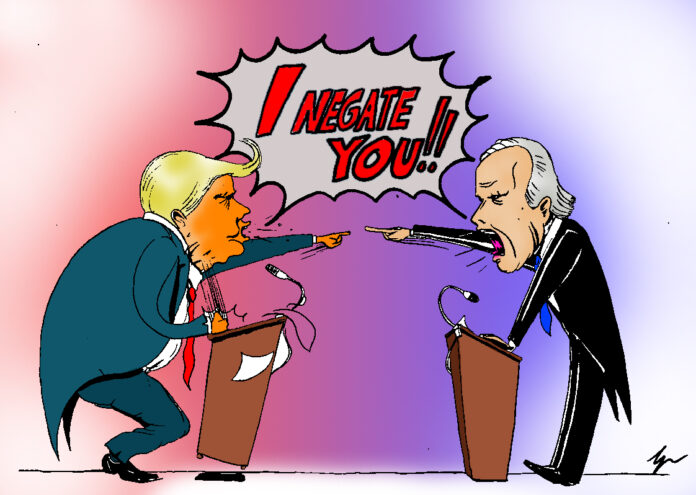
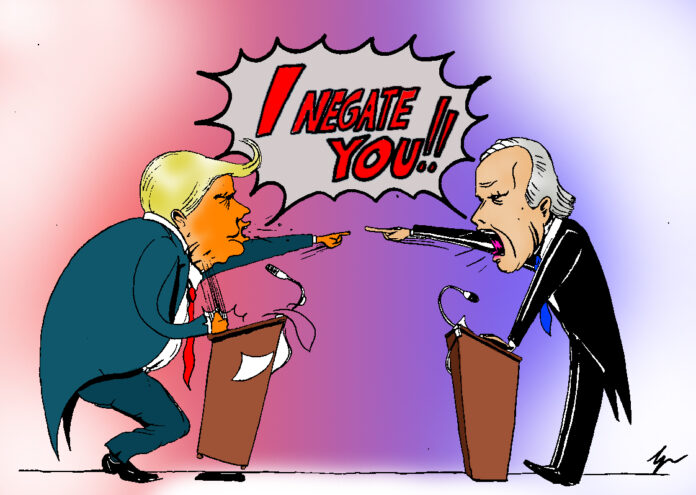
Il negazionismo scientifico è diventata la nuova peste culturale che cerca di bloccare l’evoluzione scientifica e tecnologica della nostra specie, sulla base di credenze, miti, parascientismo, complottismo e falsificazionismo interessato.
Questa peste ha ricadute politiche evidenti, basti pensare alla decisione di Donald Trump di uscire nel novembre 2019 dall’Accordo di Parigi sul clima, aderendo alle teorie avverse al riscaldamento globale. Oppure a quanto accaduto nel 2008 in Sudafrica, quando il suo Presidente Thabo Mbeki negò l’HIV impedendo alle madri di ricevere farmaci anti-retrovirali, così provocando la morte di oltre 330.000 vite umane.
Le cause del negazionismo..
Dunque il negazionismo scientifico incide profondamente sulle nostre vite, e “gli scienziati non dovrebbero essere lasciati soli a contrastare pseudoscienza e negazionismo” (Enrico Bucci e Gilberto Corbellini, Cattivi scienziati, 21/3/2019).
Gli analisti hanno individuato diverse ragioni della persistenza di tali atteggiamenti. Oltre ai negazionisti selettivi, parziali, integralisti, dubbiosi, dovuti ai diversi contesti religiosi e sociali, vi sono anche quelli che si oppongono al brand scientifico per la predilezione culturale verso il campo delle scienze umane e artistiche; oppure i complottisti, cioè persone che hanno fiducia nella scienza ma non negli scienziati, ritenuti al servizio di altri interessi (Bursn e Medvecky, 2018).
..e due in particolare
Tuttavia ci teniamo ad evidenziare due specifiche ragioni del negazionismo, connesse tra loro, una delle quali include anche una responsabilità degli scienziati:
la prima è la complessità attuale della scienza, intrisa di incertezza ‘liquida’ contrapposta alla precedente semplicità positivistica; complessità che comporta difficoltà di comprensione di temi astrusi (meccanica quantistica, entenglement, nanotecnologie, ecc…), dato che per la gente comune “l’omeopatia è più semplice del bosone di Higgs” (Claudio Bezzi, Scienza e tecnologia, 25/9/2017). Difficoltà dovuta anche
Scientific denial has become the new cultural plague, which seeks to block the scientific and technological evolution of our species, based on beliefs, myths, pseudoscience, conspiracy and self-interested falsifications.
This plague has obvious political implications, just think of Donald Trump‘s decision to exit the Paris Climate Agreement in November 2019, adhering to the theories against global warming. Or what happened in 2008 in South Africa, when president Thabo Mbeko denied HIV by preventing mothers from receiving anti-retroviral drugs, causing the death of over 330,000 lives.
The causes of negationism..
So scientific negationism has a profound impact on our lives and “scientists should not be left alone to counter pseudoscience and negationism” (Enrico Bucci and Gilberto Corbellini, Cattivi scienziati, 21/3/2019).
Analysts have identified several reasons for the persistence of such attitudes. In addition to selective, partial and uncertainly fundamentalists, and doubt deniers, due to different religious and social contexts, there are also those who oppose the scientific brand for cultural predilection towards the field of human and artistic sciences; or the conspiracy theorists, that is, people who have confidence in science but not in scientists, deemed to serve other interests (Bursn e Medvecky, 2018).
..and two in particular
However, we would like to highlight two specific reasons for negationism, related to each other, one of which also includes a responsibility of scientists:
The first is the current complexity of science, imbued with uncertainty ‘liquid’ as opposed to the previous positivist simplicity; complexity that involves difficulties in understanding abstruse themes (quantum mechanics, entanglement, nanotechnology, etc.), since for ordinary people “Homeopathy is simpler than
When a change of state occurs between one system and another, what happens is a disintermediation between the constituent elements of the system.
The glue between the parts in play dissolves.
Since time, we have passed from the industrial to the digital mode of production and for some time disintermediation has become evident among the decision-making system, politics, control systems, representatives of the productive world, the world of services, the third sector, banking system and so listing.
There is a lack of cohesion and trust. The links that allow a social system to remain cohesive (so to avoid to lead conflicts to the point of system collapse) have already been cracked.
Inevitably the causes are all internal to the productive system, to the ways how the social redistribution of wealth is managed and to the ability to affirm collective values, to implement growth processes and consequently hope.
Among today’s causes we can quote the distortions of neoliberalism, a widespread tendency of politics towards the concentration of powers, and also globalization with all its pros and cons, the disintegration of communities, a nihilistic drift, the anger of an alleged avenging god, an unexpected pandemic triggered by a violated and recalcitrant nature. They are all more or less plausible subjects: anyway, we can affirm that disintermediation arises from two factors.
The first is the overbearing and widespread establishment of the digital mode of production, that is the ’emergence’ of a profound cognitive otherness rather than a productive one. The second is the collective, widespread inability to use the categories that digital requires to define and manipulate reality.
That is, we are not able to think digitally. When you use unsuitable tools, you always do a bad job and often cause disasters.
How can we answer the disintermediation when it occurs, that is, when systems collapse? T
he alternatives normally are
a) to recompose the intermediation. That is reformism.
Or b) you allow deconstruction follow its catastrophic course by dreaming, prefiguring and motivating a new society. That’s revolution.
Will restorative conservation win perhaps because it is capable of controlling conflicts? Or will the redemptive revolution win, perhaps because it is capable of warming hearts?
Quando avviene un passaggio di stato tra un sistema e un altro ciò che accade è una disintermediazione tra gli elementi costitutivi del sistema. Si dissolve il collante tra le parti in gioco.
Siamo passati da tempo dal modo di produzione industriale a quello digitale e da tempo la disintermediazione si è fatta evidente tra il sistema decisionale, la politica, gli apparati di controllo, le rappresentanze del mondo produttivo, il mondo dei servizi, il terzo settore, il sistema bancario e così elencando. Viene a mancare coesione e fiducia. I nessi che permettono ad un sistema sociale di rimanere coeso (di non portare i conflitti sino al collasso di sistema) sono da tempo incrinati.
Le cause sono inevitabilmente tutte interne al sistema produttivo, ai modi della ridistribuzione sociale della ricchezza e alla capacità di affermare valori collettivi, di innestare processi di crescita e quindi anche speranza.
Oggi, come cause si possono indubbiamente invocare le distorsioni del neoliberismo, una diffusa tendenza delle politiche alla concentrazione dei poteri, la globalizzazione con tutti i suoi pro e contro, il disgregarsi delle comunità, una deriva nichilista, la rabbia di un presunto dio vendicatore, una inaspettata pandemia scatenata da una natura violata e recalcitrante, tutte argomentazioni più o meno plausibili, ma mi sembra di poter qui affermare che la disintermediazione nasce da due fattori: il primo l’insediarsi prepotente e diffusivo del modo di produzione digitale, cioè l’emergere di una profonda alterità cognitiva prima che produttiva; il secondo l’incapacità collettiva, diffusa e diffusiva di usare le categorie che il digitale richiede per definire e manipolare il reale. Cioè non sappiamo pensare digitale. Quando si usano strumenti inadatti si fa sempre un pessimo lavoro e spesso si fanno disastri.
Come rispondere alla disintermediazione quando si presenta, cioè quando i sistemi collassano? Le alternative usuali sono a) ricomporre la intermediazione. Si chiama riformismo. Oppure b) si lascia che la decostruzione faccia il suo corso catastrofico sognando, prefigurando e motivando una nuova società. Si chiama rivoluzione. Vincerà la conservazione restaurativa magari perché capace di controllare i conflitti, o la rivoluzione redentrice, magari perché capace di scaldare i cuori?
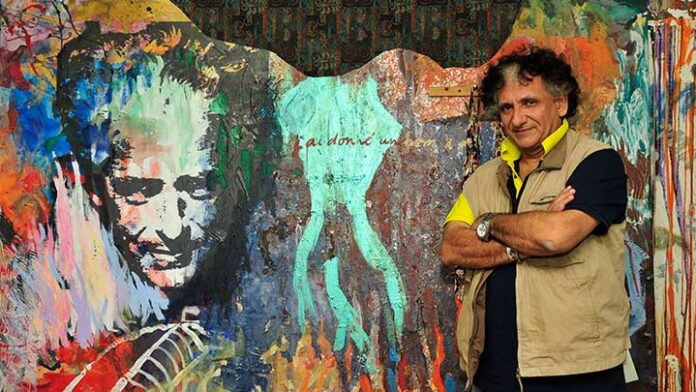
Bedri Baykam, How Dare You Place Me on a Canvas in 2011, Bedri How Dare U, 235×206 cm, mixed media on canvas,, 2011
Bedri Baykam’s painting is vital. Indeed, it is life in itself, a pure and plain state of mind. You enter the story, and you do not leave it until after imagining yourself not really contemplating it, but inside it, among its protagonists. Only then, eventually, you realize that you have been engulfed, encapsulated.
It is a similar experience to Edvard Munch’s, but at the same time an absolutely different one. The Norwegian painter catches you thanks to an atmosphere made up of landscape’s energies that spread regardless of the morphologic features of that landscape.
Actually, these energies are really active in the name of Einfühlung, of a unique common inspiration, of a true experience of empathy. So, you enjoy intimately and deeply. With Bedri you will enjoy later, after having experienced a collective performance, in which you have felt yourself as an integral part of a community.
Plastic realities
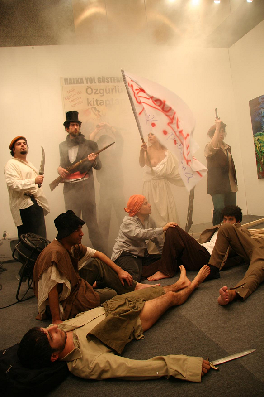
Bedri Baykam, Liberty leading people, Delacroix Happening 2006.
That’s also because the protagonists are not purely celebrated, they are instead grasped in the middle of their happening. And there is no doubt that, with his vitalism and energetism, Bedri transfers Fluxus and Allan Kaprow’s initiatory happening into his own painting. But with a very interesting surprise. The happening does not assume history, Bedri does.
The happening is an existential experience, and this is worth for Bedri, too. The artist doesn’t aim at embodying this experience into a two-dimensional condition, by “representing” it, let alone by “presenting” it and purifying it of its vital drive. Bedri turns that allusive, even spatial condition, into a real field of action.
Sometimes color, multimedia, brushstrokes of varying intensity and photography and virtuality even in 4D are docile means at the service of his body-mind in a hyperactive state which embodies in a real space with the whole of an endless expressive force and its rare beauty and concreteness.
Hence a plasticity both unstable and solid: solid in its surprising articulation. A rebellious plasticity that defines its messages fully respecting Bedri’s libertarian drive, up to moments of a wink at a sort of unprecedented classicism, especially in the iconographic reinterpretations which the artist really loves.
Bedri Baykam, The prostitute’s room. Oil and mirror on plywood. 120×240 cm. (4×8 feet). 1981
Very precocious in his push towards art, Bedri gave it a poetic structure and substance of high level where the strongly artistic atmospheres he lived in Oakland and Paris merge. So the happening and the action that animate his works come from a direct experience and not from a narrated one.
Leading artist, leading intellectual. Not only in the field of art, but also in the social field, and in civil and political battles.
Activism and education go hand in hand, strengthening rapidly between the five years spent in Paris (he graduated from the Sorbonne university) and the seven years in California. Also Bedri strengths his commitment to art in public life and in social events and political activism in Turkey where he returns in 1987. He exhibited in official museums all over the world while writing for papers, magazines and books.
He is also the author of The Bone, an allucinated and shiny novel which provides us with amazing insights into our time, intertwined jolts, overlapping themes and characters, up foreseeing – with about a year in advance – the tragedy of the Twin Towers.
Author of films and videoart, he plaid sometimes the role of a leading actor. President of the Turkish Plastic Arts Association connected with the International Association of Art (IAA), as an official partner of UNESCO, he is a deeply committed intellectual, capable of a very special original and strong ideas in international affairs, and not only in his country. A great example of an explosive research in art, a great new-style example of commitment in society.
Born in Ankara in 1957. Baykam is one of Turkey’s internationally most well-known artists and intellectuals. He has had international exhibitions since the age of six until today in Bern, Geneva, New York, Washington, Paris, London, Rome, Munich, Frankfurt, Stockholm, San Francisco, Monaco, Cannes, Berlin to name a few.
He studied at the Sorbonne University in Paris from 1975 to 1980 and got MBA degree. During this time, he also studied drama in L’Actorat, Paris. He lived in California during the years 1980-1987, studied painting and filmmaking at the California College of Arts and Crafts, (CCAC) in Oakland. He has had several shows in New York, California and Paris. He returned to Turkey in 1987 and has been living in Istanbul since.
Exhibitions
Bedri Baykam, Venus and Adonis after Rubens, 206×236 cm, mixed media on canvas, 2011.
He has had almost 150 one-man-shows in various countries in addition to participating to numerous group shows. His works have been shown in museums in Berlin (Akademie der Künste), Barcelona (Picasso Museum), Paris (Roland-Garros Museum), Pinacothèque de Paris, Stedelijk Schiedam Museum in Holland, Museum der Moderne Salzburg, Osthaus Museum Hagen, Künstlerhaus Bethanien Berlin, Bahrain National Museum and in Biennales such as Cairo, Venice, İstanbul and Buenos Aires. Among the private galleries: Daniel Templon, Stephen Wirtz, Yahşi Baraz, The Proposition, E.M. Donahue, Lavignes-Bastille, Opera Gallery.
Baykam is one of the pioneers of New-Expressionism in the early 80s and of multi-media, political art. He has directed several 16 mm films and videos and has acted in several parts in feature films. He is the author of 30 printed books, two feature film scripts and there are more than 50 catalogs and 8 books about his works.
He is the co-founder and actual President of Uluslararası Plastik Sanatlar Derneği (UPSD-Turkish Plastic Arts Association which is a member of International Association of Art (IAA) –official partner of UNESCO). Baykam was also elected as the World President of the International Association of Art at 18th General Assembly in Plzen in 2015, with his term lasting till 2021.
Recent commitment
Bedri Baykam, The drunken boat. 4D, 120×90 cm, 2007
In 2011, Baykam’s proposal for starting a World Art Day o n the occasion of the near 500 birthday of Leonardo da Vinci, was accepted unanimously by the participant countries, during the 17th General Assembly of IAA World in Guadalajara/Mexico. Since then every year a growing number of artists associations in several countries are celebrating “World Art Day”, with several art forms harmoniously blending together.
Baykam has been a columnist for several Turkish publications such as Tempo, Siyah-Beyaz, Aydınlık, Akşam and OdaTv among others. He currently writes for Cumhuriyet. He is one of the central characters of the artistic and political milieu in Turkey. He was a Party Assembly Member of CHP, the Turkish Social Democrats, in the second half of the 90s and a Presidential candidate for the same Party in 2003.
He is the founder of Piramid Publishing (1998) and Piramid Sanat (2006-art center) in Taksim Square, in Istanbul, one of the most active and independent spots in Turkish contemporary art.
Bedri Baykam, How Dare You Place Me on a Canvas in 2011, Bedri How Dare U, 235×206 cm, tecnica mista su tela, 2011
La pittura di Bedri Baykam è vitale. Anzi, è vita allo stato puro e pieno. Tu entri nel racconto, e non ne esci se non dopo esserti immaginato all’interno di esso, fra i suoi protagonisti, nel vivo dell’azione. Non si tratta di contemplare, ma di agire. E solo dopo rendi conto che sei stato fagocitato, incapsulato.
Come accade con Edvard Munch, ma ben diversamente da lui. Il pittore norvegese ti trascina per via di atmosfera fatta di energie paesaggistiche che finiscono col prescindere dai caratteri del paesaggio ma sono realmente attive all’insegna dello Einfühlung, di un unico afflato che accomuna, di una vera esperienza di empatia. E così, godi intimamente e profondamente.
Con Bedri godrai dopo, dopo avere fatto l’esperienza di una performance di gruppo, in cui ti sei sentito parte integrante di una comunità. Anche perché i protagonisti non sono puramente celebrati, sono invece colti nel pieno di un loro happening.
Realtà plastiche
Bedri Baykam, La libertà guida le persone, Delacroix Happening, 2006.
E non c’è dubbio che, col suo vitalismo ed energetismo, Bedri trasferisce nel dipinto lo happening primigenio di Allan Kaprow e di Fluxus. Ma con una sorpresa assai interessante. Lo happening non gioca con la storia, Bedri sì. Lo happening è esperienza esistenziale, e per Bedri pure.
E, a proposito della storia, non si tratta, certo, di “rappresentarla” o “ripresentarla” in una condizione bidimensionale purificata della sua carica vitale. Bedri fa di quella condizione di piglio allusivo, anche spaziale, un campo di azione reale. Colore, multimedialità talvolta, pennellate di varia intensità e riporti fotografici e virtualità anche in 4D sono mezzi docili al servizio del suo corpo-mente in stato iperattivo in uno spazio reale con una forza espressiva ed un’efficacia di rara bellezza e concretezza.
Si determina così una plasticità nello stesso tempo instabile e solida, cioè solida nella sua sorprendente articolazione. Una plasticità ribelle che definisce i propri messaggi nel pienorispetto della spinta libertaria dell’autore, fino a momenti di ammiccamento ad una sorta di inedita classicità, specie nelle rivisitazioni iconografiche così care all’artista.
Bedri Baykam, La stanza della prostituta. Olio e specchio su compensato. 120×240 cm, 1981.
Precocissimo nelle sue spinte verso l’arte, Bedri ha poi dato ad essa una struttura e sostanza poetica di alta levatura, col contributo delle atmosfere artistiche impegnate da lui vissute nei vivacissimi anni passati tra Usa e in Francia. Lo happening e l’azione che animano i suoi lavori vengono dunque da un’esperienza diretta e non narrata.
Artista di punta, intellettuale di punta. Non solo nel terreno dell’arte, ma anche del sociale, delle battaglie civili e politiche.
L’attivismo e la formazione vanno di pari passo rafforzandosi rapidamente fra i cinque anni vissuti a Parigi (si laurea alla Sorbonne) e i sette in California. Egli fortifica anche l’impegno dell’arte nella vita pubblica e nei fatti sociali e anche l’attivismo politico in Turchia dove rientra nel 1987.
Mostre in musei ufficiali in ogni parte del mondo. Attivista anche con la penna in riviste, giornali, libri. Autore anche del romanzo The Bone, uno spaccato mirabolante sul nostro tempo, intrecciato di sussulti, sovrapposizioni di temi e personaggi, fino al racconto allucinato che prevede, con circa un anno di anticipo, la tragedia delle Torri Gemelle.
Autore di film e video arte, talvolta anche lui attore protagonista, presidente della Turkish Plastic Arts Association collegata con la International Association of Art (IAA), partner ufficiale dell’UNESCO. Un intellettuale profondamente impegnato, capace di una lucidità assai speciale e di idee forti nelle faccende internazionali, e non solo nel suo Paese. Un grande esempio di ricerca esplosiva nell’arte, un grande esempio di impegno nella società.
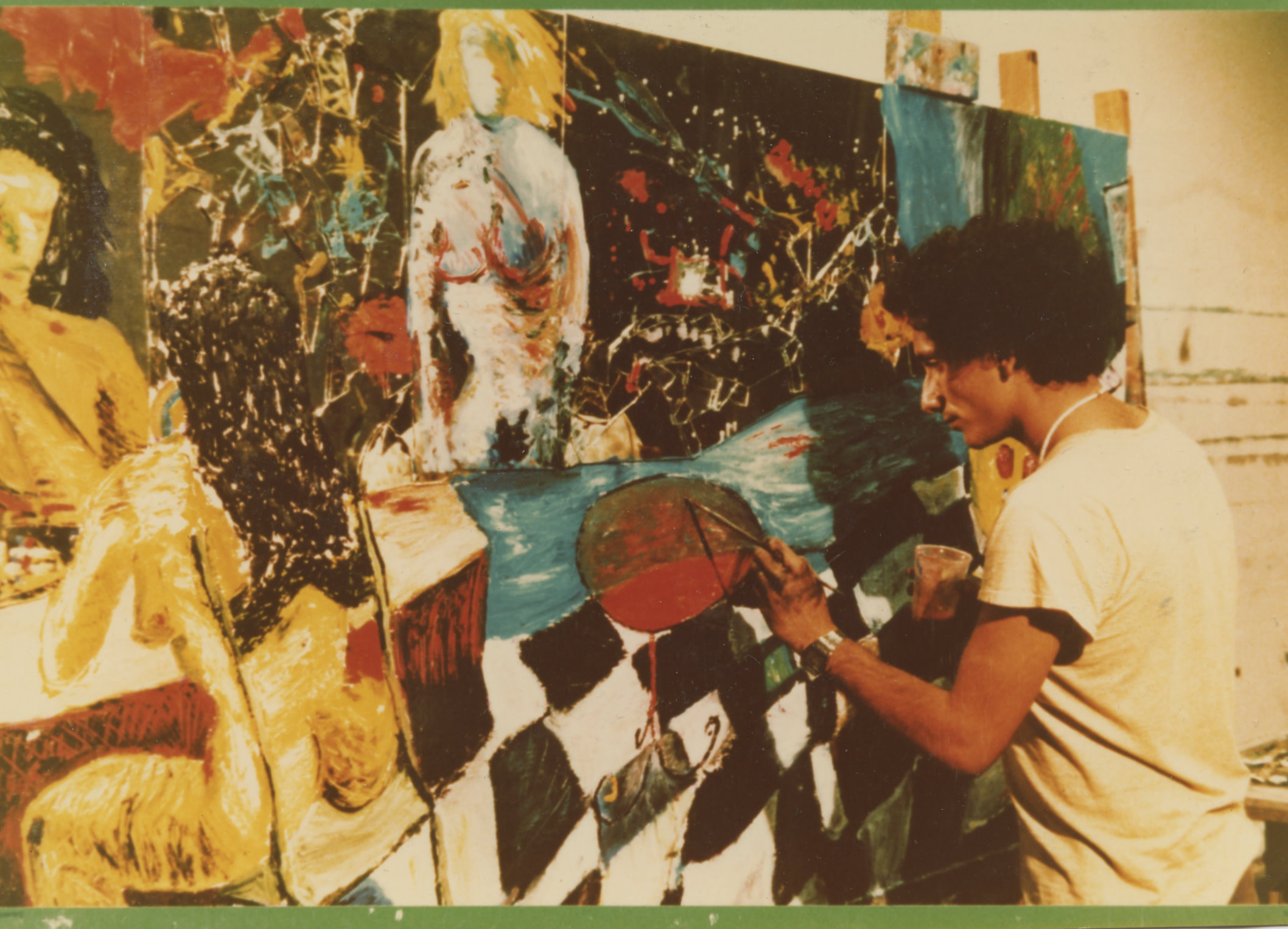
Bedri Baykam nel 1982
Bedi Baykam
Gli inizi e la formazione
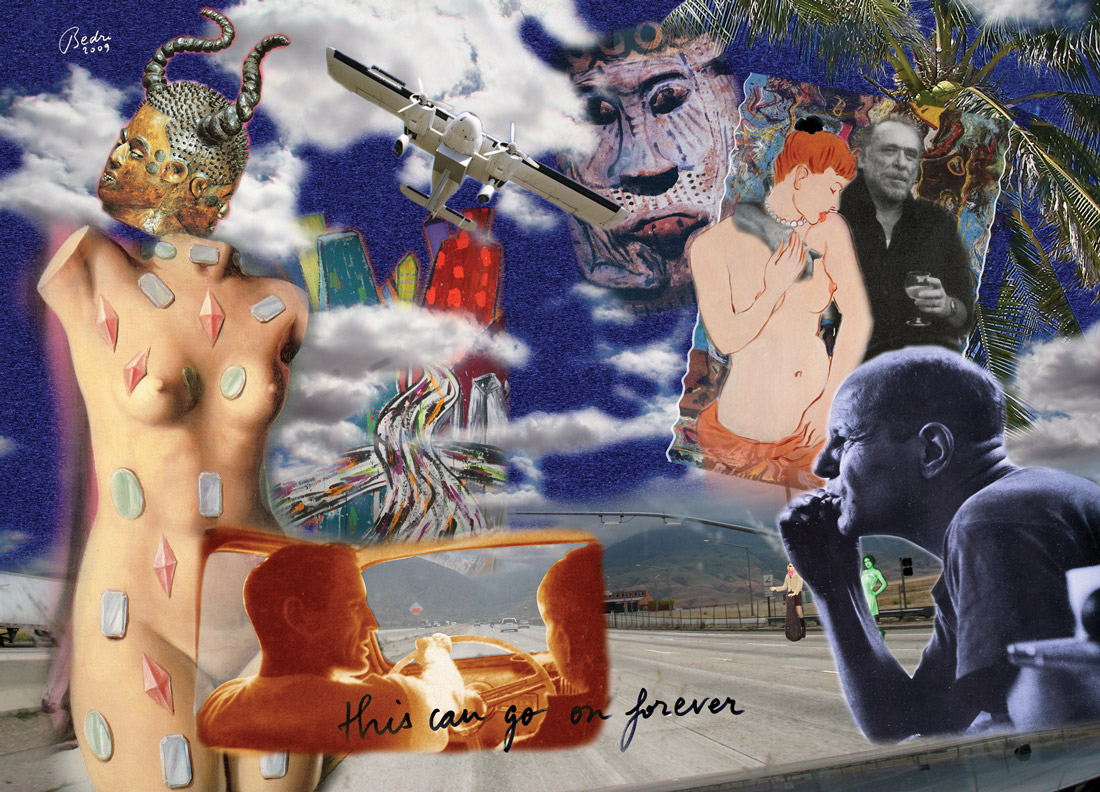
Bedri Baykam, Expressive beat. 4D, 180×240 cm, 2009
È nato ad Ankara, nel 1957. È uno degli artisti e intellettuali turchi più noti internazionalmente. Dall’età di sei anni fino ad oggi ha tenuto mostre in varie parti dl mondo, come Berna, Ginevra, New York, Washington, Parigi, Londra, Roma, Monaco, Francoforte, Stoccolma, San Francisco, Monaco, Cannes, Berlino.
Ha studiato all’Università della Sorbona di Parigi dal 1975 al 1980 dove ha conseguito un MBA e dove ha anche studiato recitazione all’Actorat. Ha vissuto in California negli anni 1980-1987. A Oakland ha studiato pittura e cinema al College of Arts and Crafts, (CCAC). Ha tenuto diversi spettacoli a New York, California e Parigi. È tornato in Turchia nel 1987 e da allora vive a Istanbul.
Mostre
Bedri Baykam, Venere e Adone dopo Rubens, 206×236 cm, tecnica mista su tela, 2011.
Ha tenuto circa 150 mostre personali in vari Paesi e partecipato a numerose collettive. Le sue opere sono state esposte in musei a Berlino (Akademie der Künste), Barcelona (Picasso Museum), Parigi (Roland-Garros Museum), Pinacothèque de Paris, Stedelijk Schiedam Museum in Holland, Museum der Moderne Salzburg, Osthaus Museum Hagen, Künstlerhaus Bethanien Berlin, Bahrain National Museum e in Biennali come Il Cairo, Venezia, Istanbul e Buenos Aires, le gallerie come Daniel Templon, Stephen Wirtz, Yahşi Baraz, The Proposition, EM Donahue, Lavignes-Bastille, Opera Gallery.
Baykam è uno dei pionieri del nuovo espressionismo nei primi anni ’80 e dell’arte politica e multimediale. Ha diretto diversi film e video in 16 mm e ha recitato in diverse parti in lungometraggi. È autore di 30 libri a stampa, sceneggiature di due lungometraggi, oltre 50 cataloghi e 8 libri sulle sue opere.
È co-fondatore e attuale presidente di Uluslararası Plastik Sanatlar Derneği (UPSD-Associazione Turca delle Arti Plastiche che fa parte dell’Associazione Internazionale d’Arte (IAA), a sua volta partner ufficiale dell’UNESCO). É stato anche eletto Presidente mondiale dell’Associazione Internazionale d’Arte alla 18ma Assemblea Generale a Plzen nel 2015, con un mandato fino al 2021.
Attività recenti
Bedri Baykam, The drunken boat. 4D, 120×90 cm, 2007
Nel 2011, la proposta di Baykam di iniziare una Giornata Mondiale dell’Arte in occasione della vicina celebrazione dei 500 anni della nascita di Leonardo da Vinci, è stata accettata all’unanimità dai paesi partecipanti durante la 17a Assemblea Generale di IAA World a Guadalajara, Messico. Da allora ogni anno un numero crescente di associazioni di artisti in diversi paesi celebra la “Giornata mondiale dell’arte“, con diverse forme d’arte che si fondono armoniosamente insieme.
É stato editorialista per diverse testate turche come Tempo, Siyah-Beyaz, Aydınlık, Akşam e OdaTv. Attualmente scrive per Cumhuriyet. È uno dei personaggi centrali dell’ambiente artistico e politico in Turchia. È stato membro dell’Assemblea del Partito di CHP, i socialdemocratici turchi, nella seconda metà degli anni ’90 e candidato alla presidenza per lo stesso partito nel 2003.
Ha fondato Piramid Publishing (1998) e Piramid Sanat (2006-art center) in Piazza Taksim a Istanbul, uno dei luoghi più attivi e indipendenti dell’arte contemporanea turca.
We can celebrate her in this way: Woman endlessly beautiful mystery; or, in this way: Woman… who has come from heaven to earth to show us a miracol. Or in the way everyone, man or woman, likes better. She can be an involuntary source of jealousy, and of course not guilty of something. Jealousy, a beautiful feeling that obviously woman also feels, but that we human men, when stupid and falsely sensitive, are able to transform from exalting passion into abuse, possession and, even often, tragedy. We must spread the culture of freedom and equality elsewhere in the world.
Possiamo cantarla così: Donna mistero senza fine bello; oppure, così: Donna… venuta dal cielo in terra a miracol mostrare. O nel modo che ognuno, uomo o donna, vuole. Ma senza dimenticare che si tratta di essere umano. La donna può essere fonte involontaria di gelosia, ma non per questo colpevole di qualcosa. La gelosia, un sentimento bellissimo che ovviamente anche la donna prova, ma che noi gli umani uomini, quando cretini e falsamente sensibili, siamo capaci di trasformare da passione esaltante in abuso, sopruso, possesso e, persino spesso, tragedia. Diffondiamo in ogni parte del mondo la cultura della libertà e della parità.
Alexander Ekman (Stockholm, 1984), studied at the Royal Swedish Ballet, where he entered at 16 years old. He has danced at the Junior Nederlands Dans Theater and at the Cullberg Ballet. The choreographic call came early, at the age of 21. In 2010 he created Cacti, a piece that also entered the repertoire at the Balletto dell’Opera di Roma.
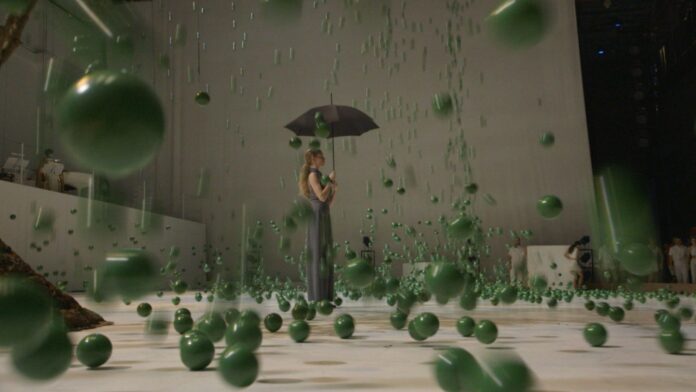
The works for which Alexander Ekman is best known as choreographer are a Swan Lake which was immersed in 5000 liters of water, and Play for the Opéra de Paris ballet company.
His creations have been welcomed at Ballets de Monte-Carlo, Semperoper Dresden (A Midnight’s Summer Dream), Norwegian National Ballet (Swan Lake), Nederlands Dans Theater, Boston Ballet, Wiener Staatsballett, Sydney Dance Company, and at São Paulo City Ballet.
Cacti (that Eleonora Abbagnato wanted to import to Rome), with 16 dancers hoisted on white platforms, is a cultured and witty piece. Ekman said it is “a parody of the clichés of modern dance and of the critics’ gaze on dance itself, what they think viewers should see or not”. He played with words and bodies between falls, clashes, escapes, in the middle of a small prickly cactus forest, keeping the public’s attention alert, always with bated breath, like dancers.
Sguardi di Eros Donna (Demon of Transformation) is the title of the new e-book by the essayist Vitaldo Conte by Tiemme Edizioni Digitali. It concludes a drive path, which began with the previous e-book Dioniso Legami.
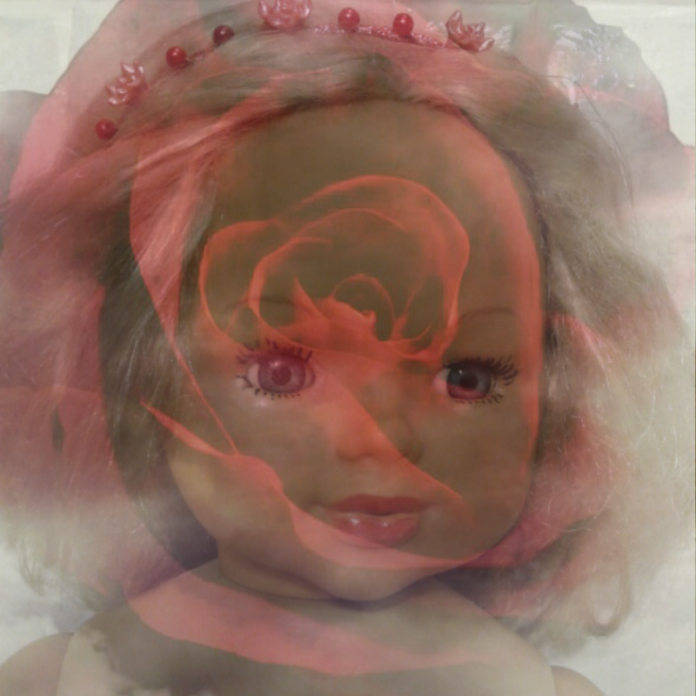
The quotation from Friedrich Nietzsche, with which the text begins, is significant: “Dionysian art wants to convince us of the eternal joy of existence: except that we must seek this joy not in appearances, but behind appearances. In the introduction, the author writes “The Demon Woman of Transformation is an archetype of Eros: she lives in the ancestral calls of being. Her appearances are many: divine, feminine or transgender, however infected by Dionysus. The gazes of this demonic seduction “ignite” (to the point of obsession) artists, writers and philosophers, and also human behavior in general.Woman’s skin and make-up can be transmuted into Beauty Art. Her dancing body is a sensual attraction-dynamic in Tango. The Red Rose, a symbol of desire (profane and mystical), can become a body of love. The drive for an imaginary of extreme seduction also lives in the Fantastic through a Woman – Robot or Doll – of cybernetic Eros”. In the electronic book there are the texts, published in “Fyinpaper”, on the Fantastic Eros of Robots and Love Dolls.
Alexander Ekman (Stoccolma 1984), si è formato alla scuola del Royal Swedish Ballet, dove poi è entrato sedicenne. Ha danzato nel Nederlands Dans Theater junior e nel Cullberg Ballet. La chiamata coreografica è arrivata presto, a 21 anni.
Nel 2010 ha creato Cacti, un pezzo entrato in repertorio anche al Balletto dell’Opera di Roma.
I lavori per cui è più noto sono un Lago dei cigni/Swan Lake immerso in 5000 litri d’acqua e Play per la compagnia di balletto dell’Opéra de Paris.
Le sue creazioni sono state accolte ai Ballets de Monte-Carlo, alla Semperoper Dresden (A Midnigt’s Summer Dream/ Sogno di una notte d’estate), al Norwegian National Ballet (Swan Lake), al Nederlands Dans Theater, al Boston Ballet, al Wiener Staatsballett, alla Sydney Dance Company, al São Paulo City Ballet.
Cacti, che Eleonora Abbagnato ha voluto importare a Roma, con 16 ballerini issati su bianche pedane, è un pezzo colto e spiritoso, “una parodia dei cliché della danza moderna e dello sguardo dei critici sulla danza stessa, su cosa secondo loro gli spettatori devono vedere o no”, dice Ekman stesso, che ha giocato con la parola e con i corpi tra cadute, scontri, fughe, in mezzo a una piccola foresta pungente di cactus, mantenendo ben vigile quindi anche l’attenzione del pubblico, sempre con il fiato sospeso, come i ballerini.
Sguardi di Eros Donna (Demone della Trasformazione) è il titolo del nuovo e-book del saggista Vitaldo Conte presso Tiemme Edizioni Digitali. Conclude un percorso pulsionale, iniziato con il precedente e-book Dioniso Legami.
La citazione di Friedrich Nietzsche, con cui inizia il testo, risulta significativa: “L’arte dionisiaca vuole convincerci dell’eterna gioia dell’esistenza: senonché dobbiamo cercare questa gioia non nelle apparenze, ma dietro le apparenze”.
Nell’introduzione l’autore scrive “La Donna Demone della Trasformazione è un archetipo dell’Eros: vive nei richiami ancestrali dell’essere. Le sue apparenze sono molteplici: divine, femminili o transgender, comunque contagiate da Dioniso. Gli sguardi di questa seduzione demonica “accendono” (fino all’ossessione) artisti, scrittori e filosofi, e anche comportamenti umani in generale. La pelle e il trucco della Donna possono trasmutarsi in Beauty Art. Il suo corpo danzante è una sensuale dinamica-attrazione nel Tango. La RosaRossa, simbolo di desiderio (profano e mistico), può divenire un corpo d’amore. La pulsione per un immaginario di estrema seduzione vive anche nel Fantastico attraverso una Donna – Robot o Bambola – di Eros cibernetico”.
Nel libro elettronico ci sono i testi di Vitaldo Conte, pubblicati su “Fyinpaper”, sull’Eros Fantastico dei Robot e delle Bambole d’amore.
L’aumento dei ricoveri nelle terapie intensive e nei reparti ordinari hanno convinto a provvedimenti d’urgenza. Le previsioni delle curve dei contagi indicano una crescita esponenziale. Per gli ospedali di Milano e della Lombardia sono numeri difficili. Qualsiasi errore o evento imprevisto potrebbe mettere in serie difficoltà il sistema sanitario. Raffreddare il contagio è diventata la parola d’ordine. É una partita che si gioca da subito ma che si snoderà con lockdown parziali e progressivi per tutto il mese di novembre.
Con questi dati ogni ripresa dell’economia diventa impossibile. Il sindaco Beppe Sala e il presidente della Lombardia Attilio Fontana hanno messo temporaneamente a tacere l’aspra diversità di vedute politiche e collaborano a malincuore e solo parzialmente per evitare l’emergenza. La speranza è di evitare un nuovo lockdown totale.
Antonio Pesenti, membro CTS e direttore Rianimazione Policlinico, è molto franco: “A Milano girano 2 milioni di persone. Se Milano diventa come Bergamo, i camion dell’esercito non basteranno”. Mai come in queste ore l’urgenza del quotidiano si coniuga con il lungo periodo.
Milano è arrivata alla crisi del Covid con un settore dell’Intrattenimento e Food sovradimensionati, tarati su milioni di turisti che non verranno e su redditi che proprio per questa ragione non saranno prodotti. Milano dopo il Covid sarà una città con meno reddito di quanto ne avesse prima della crisi.
Il lavoro a distanza, o smart working, cambia il lavoro e riduce la richiesta di uffici. Si calcola che coinvolgerà intorno al 30% degli occupati. Milano è una città direzionale e terziaria. L’impatto sulle attività sarà travolgente.
Ultimo il Commercio, causa l’online, è stato investito, ben prima della pandemia, da un processo di ridimensionamento, specialmente nei centri commerciali. Qui la vittima principale in ordine di tempo è il centro storico che si è voluto trasformare in un’area monoprodotto di intrattenimento, food e lusso. Insomma è diventato un centro commerciale. Le sue specializzazioni trovano ora una domanda molto inferiore. Non c’è nessun biglietto di ritorno al mondo come era prima, proprio per questo difendere tutto è un errore.
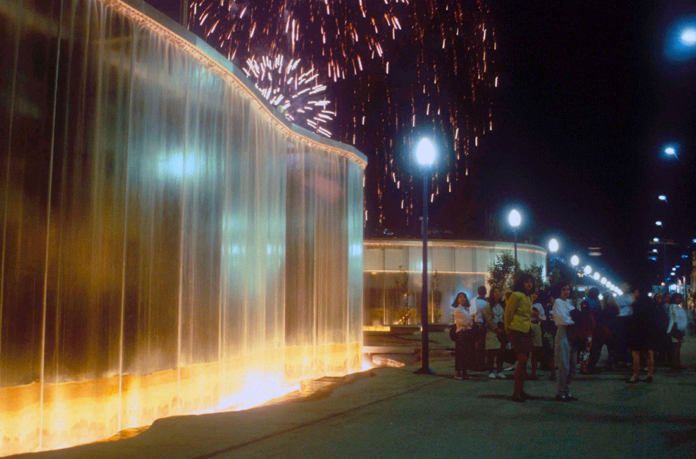
Avenue Five Central Plaza and Water Buildings - Seville World Expo 92 - Seville Spain - 1992 - Main section of water wall at night. Site James Wines
The numbers say a lot. Real estate sales in the office sector fell well over 30%. Real estate stocks are below an average of 40%. It is only a matter of time for the price to reduce.
Luca Dondi, CEO of Nomisma, said: “I’m the first to hope I’m wrong, but, sooner or later, you will also see an effect on prices and therefore on the fees that, until now, has not been seen in large real estate transactions. Perhaps because the real estate managers who have invested in recent years need to confirm the value of their investment”. It is a cryptic statement. It comes from a research company based in Bologna where hyper-assessment phenomena did not occur and who can therefore look around with greater serenity.
The most city accused is Milano, where the assessments were excessive. Outrageous prices in urban regeneration operations were the norm.
Two indications of the most popular urban planners, Stefano Boeri and Carlo Ratti, have tried to clarify a possible future. The first, from the Polytechnic University of Milan, the second from MIT, Boston. Looking carefully, this situation illustrates a different attractiveness of urban centres. For Milan they are the ideal cure. Stefano Boeri aims to equip small villages with digital networks that, in these years, have suffered a consistent depletion of activity and population. Carlo Ratti instead aims at a digital management of the city. Then flattening of the congestion curves and reductions in overcrowding in the use of infrastructure and services. Together with the Mayor of Stockholm, with whom he worked, excellent results have been achieved.
If these models are also successful, we will move from highly concentrated cities to more extended urban areas. It’s the sunset of the neoliberal city model with its extreme concentration of wealth and inequality.
After Covid, more digital, better infrastructure management and fairer cities. Certainly, even lower prices. It’s the digital revolution!
Avenue Five Central Plaza and Water Buildings - Seville World Expo 92 - Seville Spain - 1992 - Main section of water wall at night. Site James Wines
I numeri dicono molto. Le compravendite immobiliari nel settore uffici calano di ben oltre il 30%. Le azioni del settore immobiliare sono sotto mediamente del 40%. Una riduzione dei prezzi è solo questione di tempo.
Luca Dondi, amministratore delegato di Nomisma, ha dichiarato: “Sono il primo a sperare di sbagliarmi, ma, prima o poi, si vedrà anche un effetto sui prezzi e quindi sui canoni che, finora, nelle grandi transazioni immobiliari, non si è visto. Forse perché i manager immobiliari che hanno investito in questi anni hanno l’esigenza di confermare il valore del loro investimento”. E’ una dichiarazione sibillina. Viene proprio da una società di ricerca basata a Bologna dove fenomeni di ipervalutazione non si sono verificati e che può quindi guardarsi attorno con maggior serenità.
La grande accusata è Milano, dove le valutazioni sono state eccessive. Prezzi spropositati nelle operazioni di rigenerazione urbana sono state la norma.
Due indicazioni dei più quotati urbanisti, Stefano Boeri e Carlo Ratti, cercano di chiarire un possibile futuro. Il primo, del Politecnico di Milano, il secondo del MIT di Boston. Guardate con attenzione, illustrano una diversa attrattività dei centri urbani. Per Milano sono la cura ideale. Stefano Boeri punta a dotare di reti digitali i piccoli borghi che, in questi anni, hanno sofferto un depauperamento consistente di attività e di popolazione. Carlo Ratti punta invece a una gestione digitale della città. Quindi appiattimento delle curve di congestione e riduzioni dell’affollamento nell’uso di infrastrutture e servizi. Insieme al sindaco di Stoccolma, con cui ha lavorato, sono stati raggiunti ottimi risultati. Se questi modelli avranno anche un relativo successo, si passerà da città molto concentrate ad aree urbane più distese. É il tramonto del modello di città dell’Epoca Neoliberale con la sua concentrazione estrema di ricchezza e diseguaglianze.
Nel dopo Covid più chip, più digitale, miglior gestione delle infrastrutture e città più eque. Sicuramente prezzi anche più bassi. É la rivoluzione digitale, bellezza!
Questo sito web utilizza cookie o tecnologie simili per finalità tecniche e, con il tuo consenso, anche per altre finalità come specificato nella cookie policy. Puoi liberamente prestare, rifiutare o revocare il tuo consenso in qualsiasi momento. La chiusura del banner comporta il consenso ai soli cookie tecnici necessari.
Quando visiti un sito Web, esso può archiviare o recuperare informazioni sul tuo browser, principalmente sotto forma di cookies. Controlla qui i tuoi servizi di cookie personali.