
Il match Sala-Salvini
Come sempre succede quando il mandato di un sindaco si avvia alla conclusione, aumentano i permessi di costruzione e gli annunci di nuovi interventi. Se poi il sindaco concorre per un secondo mandato, l’attività diventa frenetica. Tra meno di un anno e mezzo il sindaco Sala scenderà in campo per cercare di ottenere un secondo mandato. Non si conosce ancora chi sarà il suo oppositore ma si sa che Salvini sta meditando su una rosa di nomi, anche se al momento pare che nessuno della rosa lo lasci del tutto tranquillo. Un passaggio intermedio per capire i toni e i temi che verranno toccati nelle elezioni comunali milanesi nella prima parte del 2021 saranno le elezioni regionali in Emilia Romagna. Bologna è diventata con Milano e Treviso uno dei nuovi vertici del triangolo industriale italiano e forse l’area più simile a Milano è quella lungo la via Emilia tra Bologna, Reggio e Modena. Qui su una scala più ridotta si ritrovano le tematiche principali legate al Welfare di Milano. Dalle case popolari, alle politiche sociali, dalle infrastrutture alla partecipazione politica. Se Salvini e la sua candidata Borgonzoni saranno capaci di vincere, in Emilia, anche nei centri con più di sessantamila abitanti allora vorrà dire che il Sindaco Sala quasi certamente si troverà di fronte un candidato forte. Se invece l’attuale presidente della Regione Emilia Romagna, Bonaccini, riuscirà a spuntarla, molto difficilmente Salvini troverà un candidato “forte” che possa giocare ad armi pari con Sala. Il sindaco di Milano per ora sembra assolutamente vincente, impressione che lui non manca di alimentare. E non è soltanto questione della sua brillante presenza a ogni tipo di evento insieme alla compagna Chiara, figlia del Prof. Giovanni Bazoli, presidente emerito di Intesa San Paolo. Questa allure è dovuta anche all’accorta gestione e vendita del “Modello Milano”. Gli si deve riconoscere che ha saputo capitalizzare in modo intelligente il lavoro delle precedenti amministrazioni lanciando Milano in assoluta solitudine nella corsa per il ruolo di Capitale del Sud Europa. Gli ingredienti principali sono stati un rispetto ossessivo dei permessi di costruzione e trasformazione urbana sottoscritti con fondi di investimento e fondi immobiliari esteri. Una continua pace sociale che ricuce solo nei casi di maggior sofferenza l’entrata in scena di una imprenditoria completamente nuova nel settore immobiliare, assieme all’assicurazione continua di margini di redditività superiori rispetto a operazioni di uguale entità all’estero. Solo una voce ha dissacrato il “Modello Milano”, quella del tutto inusuale e inaspettata della rivista Wired dove viene riferito degli affitti esosi delle abitazioni. È diventata la lettura preferita di Salvini.

Crossing, Christmas

Do not lean too much, she was shouting with windy voice. She who had given birth hanging from a tree. She had shared the same fate with Judas, even though she hadn’t attended the last supper and the rite of bread and wine. And yet, her flash turned into a prodigy of sin. As a sinner they had pointed at her because she had given birth to a fatherless child.
She repeatedly said she was impregnated by the Holy Spirit when she abandoned herself to the sea’s flatteries. But no one believed her, the surrender lasted a downpour of rain. And she looked for the reasons of the instincts, avoiding foresight, she was touching her own body almost scratching away her thoughts.
She remembered Madeleine, despised even in her limbs. Meanwhile, the filament outlined the sunset and the clouds, gasping angels were gathering to face the thrill of the unknown.
She felt a pat on her nape and her gaze moved towards the path made stunned by the wedging of the light while raised hands signaled surrender and rebellion
Attraversamento, Natale
Non sporgerti troppo gridava, con voce di vento. Lei che aveva partorito penzolante da un albero. Le era toccata la stessa sorte di Giuda, anche se non era stata a tavola nell’ultima cena e non aveva assistito al rito del pane e del vino. Eppure la sua carne si era fatta prodigio di peccato. Perché peccatrice l’avevano additata per aver messo alla luce un essere di cui si sconosceva il padre.
Ripeteva che era stata ingravidata dallo Spirito Santo in un momento in cui si era concessa alle lusinghe del mare. Ma nessuno le dava adito, l’abbandono era durato lo scroscio di una pioggia. E cercava, oltre la lungimiranza, la ragione degli istinti e si toccava il corpo quasi a graffiarne le congetture.
Pensava allora a Maddalena, vilipesa anche nelle membra. Il filamento intanto segnava il tramonto e le nubi, angeli boccheggianti, si raggrumavano per fronteggiare il palpito dell’ignoto.
Sentì una pacca sulla nuca e lo sguardo si evolse verso il tracciato che l’incunearsi della luce lasciava tramortire su mani alzate a guisa di resa o di rivolta.
Orientarsi, tra mondo esterno e interiore

Guardando al mondo in cui viviamo, ne sono evidenti il disordine e le precipitose trasformazioni verso una direzione sconosciuta. Ne deriva la perdita di un orientamento, mentre siamo in preda ad innumerevoli abbagli, in ogni campo e soprattutto in noi stessi.
Si è creata una frattura fra la forza originaria che unisce l’universo, la natura e l’uomo in un tutto armonico, e l’attività di una mente che ignora questa vivente unità, frammentandola nella scienza, alienandola in una tecnologia sempre più invasiva, e orientando l’uomo verso valori astratti, beni e consumi senza limiti, divertimenti che lo allontanano da se stesso; senza parlare del profitto, che è divenuto l’unico e supremo valore, a cui subordinare ogni cosa.
È un vero e proprio delirio, che ci spinge verso un avvenire alieno. Il predominio di una ragione materialistica, che ha iniziato con la negazione di Dio e dell’anima, finisce col negare l’uomo stesso, provocando un fondamentale squilibrio e la probabile catastrofe a cui esso ci sta portando.
Viviamo oggi in una di quelle fondamentali svolte della storia, in cui termina una civiltà e ne inizia una nuova. Accadde qualcosa di simile alla fine dell’impero romano, con la decadenza di una società opulenta e scettica come la nostra mentre, nello stesso tempo, nasceva nel cuore degli uomini il bisogno di una nuova spiritualità. Fu come ritrovare una sorgente di vita e di verità, in mezzo all’aridità del mondo di allora. Riusciremo a trovarla anche noi nel nostro?
La nuova spiritualità che cambierà il mondo seguirà lo stesso fondamentale impulso radicato da sempre nell’uomo – quello di un’integrazione della sua condizione mortale in una prospettiva più ampia che le conferisca un senso – ma non vorrà più limitarlo, fino a imprigionarlo e spegnerlo, nelle rappresentazioni religiose e nelle tante elaborazioni filosofiche del passato. Vorrà invece realizzarlo attraverso l’esperienza del mondo di oggi, a cui partecipare intensamente pur cercando un orientamento che aiuti ad evitare la probabile catastrofe a cui le sue tensioni lo conducono o, se essa non potrà essere evitata, che possa guidarci nel cammino verso un mondo migliore.
Un orientamento centrato sull’Uomo, sul suo vero essere e sul suo compimento, che chiamiamo “Sé”, fine e archetipo dell’uomo, a cui guardare nonostante gli errori e le bassezze di cui siamo capaci. Lo si ritroverà con tale centratura, non certo una hybris antropocentrica ma una nuova consapevolezza con cui rinasceranno l’unità e l’armonia fra il cuore e la mente, il femminile e il maschile, la natura e la civiltà, lo Yin e lo Yang, fondamentali polarità con cui procede la vita nella sua incessante evoluzione; e con cui si affermerà una laicità matura capace di ritrovare anche un senso religioso, oggi perduto.
Ne saranno aspetti determinanti:
– un costante riferimento ai valori dello spirito e della vita, in luogo di un’economia, di un potere, e di una cultura fine a sé stessi;
– una vera conoscenza, che non può più essere separata dalla coscienza;
– una nuova etica, adatta ai problemi emergenti del mondo di oggi;
– delle leggi ed azioni tanto realistiche quanto illuminate, da conformare allo spirito, alla conoscenza-coscienza e all’etica;
– un’educazione dei giovani, che si ispiri a questi principi, in modo da costituire il fondamento di un’umanità rinnovata.
Anche i più grandi problemi sociali, economici, ambientali, politici, possono essere risolti alla luce di tale orientamento mentre, senza di esso, non potranno che aggravarsi. Ma chi sarà il legislatore? Chi sarà l’educatore? Lo sarà ognuno di noi, cominciando con l’educare se stesso, se saprà guardare al proprio centro interiore invece che alla superficialità e al delirio del mondo attuale. Riconoscendo in questo centro la nostra vera e spirituale essenza, nutriremo di essa i nostri sentimenti, pensieri e azioni, trasformando a sua immagine noi stessi, la città e il mondo.
Guerritore-Guerritrice per la causa del teatro

Promotrice di un’idea che diventi istanza al Presidente della Repubblica: conferire riconoscimenti agli eroi dello spettacolo. Così, Monica Guerritore, in questi giorni, in un programma televisivo. La si vede spesso sul piccolo schermo, semplice nell’aspetto, nei modi e nelle parole e ricca di contenuti. Battagliera, sempre, sempre di più, per cose positive e meritorie nel sociale. Per gli ideali, i simboli delle cose vere e autentiche. In questo senso il teatro ha un ruolo importante, non sempre facile da svolgere, specie quando le risorse finanziarie inadeguate, o peggio, lo rendono claudicante, misconosciuto. Sono i casi in cui gli eroi dello spettacolo sono costretti ad alzare il livello del loro eroismo. Da sostenere in pieno, l’idea della valorosissima attrice. Pugnace. È scritto nel suo nome, no? Anche se Guerritore non è un errore dell’anagrafe e anche se, da quando ebbi il piacere di incontrarla (molti anni fa, a Taormina Arte, in una splendida estate, tra pranzi avvolti in una scenografia mozzafiato), mi è capitato talvolta, con scherzosa ammirazione, di chiamarla Guerritrice.
Edward Lucie-Smith, his Poems between Life and Society
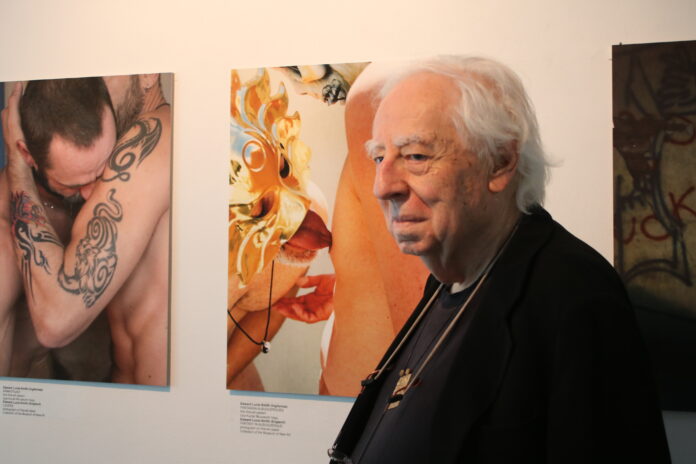
You are a leading internationally known figure in the field of arts, but also a well recognized artist-photographer and poet. Two years ago, you celebrated your birthday (84) publishing another collection of your poems titled “Surviving”. What did you intend refer to?
“First of all, simply to the fact of having been alive for so long. I will be 87 at the end of February. Secondly, to the fact that I am still very active in the world of the arts, not brooding in some retirement home.”
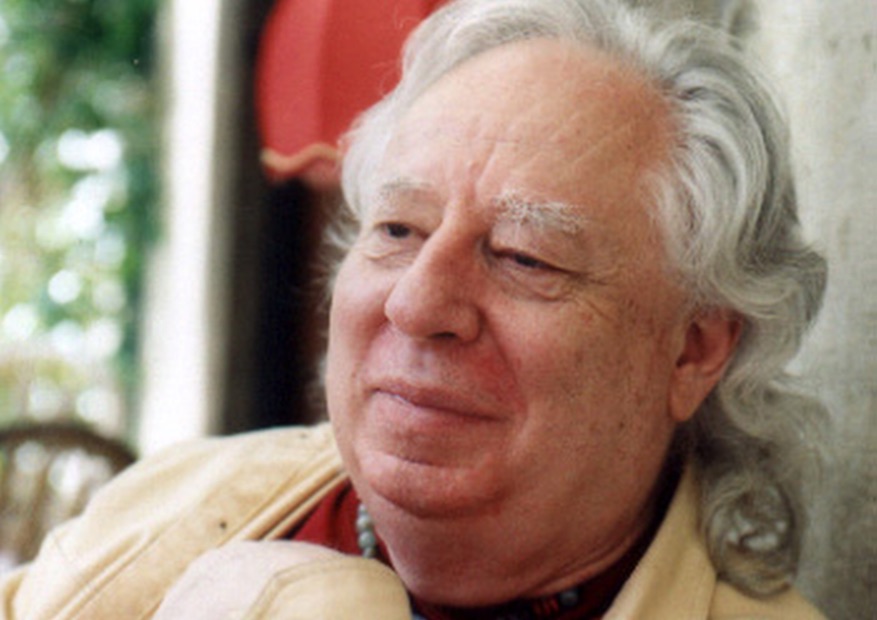
In one of the various interviews you released, you told about your activism in the poetry field as a runner, in London, precisely in the decades Fifties and Sixties. Can you remind us what was the social and cultural climate in that city at that time? In your opinion, what would be relationship to today’s cultural climate in London?
“By “runner” what you mean is that I was the chair-person and organizer of a group of poets (just called The Group) who met at my flat in London every week. Texts of the poems to be discussed were distributed in advance, and just one poet read on each occasion. It wasn’t a free for all. I didn’t found the group – I inherited it from Philip Hobsbaum, when he moved to Belfast and founded another group in that city. Seamus Heaney, the Irish poet who became a Nobel Prizewinner for literature, was a member of this Belfast group. The two groups used to exchange what we called ‘song-sheets’. The poetry world was much smaller then than it is now. Performance poetry, related to rap, was less important. There was a smaller range of ethnicities.”
You had the opportunity to stress your admiration for two important public figures who were also poets, Sir Thomas Wyatt (XVI century) and John Wilmot, the Earl of Rochester (XVII century). All this happens in spite of the deep difference, in style and tune, with your poems. What are the main features of the two personalities which particularly touched you?
“Basically, that they were both completely independent and not literary careerists. Poetry was part of their lives, but certainly not all of their lives. I never wanted to be a ‘professional poet’. It creates too many burdensome expectations if that’s how people see you.”
Your life is very rich as far as its geographical background is concerned. I ask you if, and in case how, this richness of yours affected your poems as well as your critical and theoretical writing, alongside with your growth as an international intellectual.
“Basically, I’m a child of the British Empire, rather than specifically British. My father’s family have lived in the Caribbean region – Barbados, then Demerara (now Guyana), then Jamaica, from around 1630. My mother was descended from an 18th century chairman of the British East India Company. My father and my mother met because of World War I. He was already established as a civil servant in Jamaica, but came to Europe to fight after his younger brother, who belonged to the West India Regiment, was killed. He was gassed early in 1918, and – now considered as unfit to fight at the front – was send across the Channel to be the ADC of an elderly home-front general, who was my mother’s uncle. My dad returned to Jamaica to be demobilized in September 1919 – that is a whole year after the war ended. He promptly made a mixed-race son, whom I learned about only fairly recently. This son was given my father’s unusual fore-name – Dudley – and used our even-more unusual surname, Lucie-Smith. He has descendants in Jamaica who are convinced that my dad and their grandmother were married, but I don’t think that is true. Realizing that he couldn’t, at that period, stay in the British civil service with a mixed-race wife, he returned to Britain on leave in the summer of 1922 and proposed to my mother, who was an orphan. In the spring of 1923she came out to Jamaica and married him. I appeared in 1933, ten years after the marriage. My father died of lung cancer in 1943 – he was a heavy smoker but having been gassed can’t have helped. My mother got out of Jamaica in 1946 and brought me to post-World War II Britain to be educated. I won a scholarship for the sons of civil servants at King’s School Canterbury, then, after that, a full scholarship at Merton College Oxford.
My suspicion now is that my dad remained in touch with his alternative family – I saw very little of him when I was a child, but that, in any case, was typical of old-style colonial society.
Both sides of my family were slave-owners in the West Indies in the 18th and early 19th centuries. However my great-grandfather on my mother’s side was a Member of Parliament who was closely allied to Wilberforce in fighting the slave-trade, so tale your pick.
I had my DNA analyzed a few years back. I have no African blood. I am 18 percent Jewish – a great-grandmother on my father’s side who belonged to a Jewish family who emigrated in the early 19th century from Venezuela to Curacao. One of them was a sea-captain – a very unexpected thing for a Jew to be. I am slightly less that 50 per cent European Caucasian. The rest is Finnish, or possibly Estonian. I have no information about that. Finns are basically Central Asian immigrants who moved, in the very long ago, to the shores of the Baltic. All this mixed blood comes from my father’s side, as far as I can make out. The West Indies were a melting pot.
In Britain my father’s European ancestors were categorized as ‘London Dutch’, but ‘Lucie’, which they started to use in the mid-18th century, is emphatically not a Dutch name. My guess is that it is originally Huguenot French. Apologies for the length of this, but it explains how, under the umbrella of the British Raj, I come both from everywhere and from nowhere.
Perhaps this is why I’ve travelled so much – maybe more than poets – and indeed others – who are classified as travelers. If a country has something that can be called an art world, it’s 80% certain that I’ve been there. Some omissions I regret. For example, I’ve never been to Poland. Nor to Pakistan. But to China, Russia, Japan, Iran, most of Europe, most of Latin America, Canada, Australia, New Zealand. Much of the United States. Yes.”
You normally compose your poems in a private and intimate atmosphere. But when you deal with social or public subjects, you do this in a very synthetic and strong way. One can find an example even in your already mentioned “Surviving” collection. I particularly refer to “Preaching to the converted”. It looks like a kind of secular decalogue for individual behaviour in society. Vibrant and very dry and harsh is your message about “What you want to hear” and about “What you don’t want news of”. For instance, “war is bad”. But, by the way: what’s your vision about this matter, considering the current geopolitical phenomena worldwide?Regarding global warming, have you any idea to solve the problem, or, at least, to dominate it? The list is short but bears fundamental matters, such as the closing sentence: “What you don’t what to hear is this poem”. Do you think that in our era, which dislikes poetry, the latter can help us?
“I try to look at the world as it is, not as I might want it to be, In Victorian times, my mother’s family were what was then called ‘logical positivists’, which means that they were, in today’s terms, atheists. The paradox is that one of them, my great-uncle Vernon Lushington, was responsible for introducing Burne-Jones to Rossetti, thus setting in motion the second phase of the Pre-Raphaelite Movement. Which was very different from its first phase and led on to European Symbolism and Blue Period Picasso.
I wouldn’t presume to tell people how to put a stop to global warming. If they don’t take steps humanity itself maybe will be wiped out. But, being so old, I won’t be here to see that. And I don’t think I’ll be sitting upstairs on a cloud, saying “I told you so.” Should I find myself on that cloud, looking down at events, I’m more likely to say: “Tout passe, tout lasse, tout casse” – there are millions of other planets, can I please look at a nicer one?
The reader is likely to feel as if your “Surviving” collection has been performed together with Joe Machine, a very impressive artist who has illustrated the book. How did you plan this deep pattern of collaboration?
“It’s an odd alliance. I like Joe very much as person. I also like his work as a painter. We just happened to get together He’s very different from me – sturdily working-class, got dome of his early education in Borstal (juvenile prison). His work shows that there is a future for narrative art, pictorial stories of a kind that anyone, whatever language they speak, can hope to absorb. Figurative art talks to a wider public than poetry. And it’s more specific than music. It’s not the only thing that art can do, but it’s an important part of what it does. If you look at the history of Russian art in the past century or so, figurative art was always there, and never entirely stopped being experimental. Russian abstraction (Futurism) came to a complete halt around 1923, except among Russian artists who emigrated, and had to start again with perestroika in the 1980s.
Here is the West, Minimal Abstraction, a big deal in the 1970s, now looks pretty much dead and the more recent abstract revival that took place in the middle 2000s, was pretty much wiped out by the financial crash of 2007. What seem to matter now are social issues, and also collaborations between art and technology – immersive art, if you like. The Video Games universe is currently a lot more advanced in this respect than the whole flock of current artists who make dinky little ‘art’ videos you can play on your iPhone.
Between your photography and your poetry where your deepest soul is more properly expressed? And which of them does make you happier?
I don’t really distinguish between the two. Photography is a way of seeing the world and showing other people what you see. Poetry is a way of talking about the world in a way that you hope other people will understand.”
Edward Lucie-Smith, poesia, vita, società

Figura di spicco a livello internazionale nel campo delle arti, ma anche noto artista-fotografo e poeta. Due anni fa lei ha festeggiato il suo compleanno (84°) pubblicando un’altra raccolta di poesie intitolata “Surviving”. A cosa intendeva fare riferimento?
“Prima di tutto, semplicemente al fatto di essere vissuto così a lungo. A fine febbraio avrò 87 anni. In secondo luogo, al fatto che sono ancora molto attivo nel mondo delle arti, e non a rimuginare in qualche casa di riposo.”

In una delle varie interviste rilasciate, Lei ha parlato del suo attivismo nel campo della poesia, in quanto figura di riferimento, a Londra, precisamente negli anni Cinquanta e Sessanta. Ci racconta quale era il clima sociale e culturale in quella città? Quali sarebbero le differenze con il clima culturale di oggi a Londra?
“Riferimento in quanto ero il presidente e l’organizzatore di un gruppo di poeti (chiamato The Group) che si incontrava nel mio appartamento di Londra ogni settimana. Oggetto di discussione erano i testi delle poesie che erano distribuiti in anticipo. Ogni volta a leggere era solo un poeta. Non è stata un’opportunità aperta a tutti. Non ero io fondatore del gruppo ma l’ho ereditato da Philip Hobsbaum che quando si trasferì a Belfast, ne costituì uno nuovo. Seamus Heaney, il poeta irlandese che avrebbe vinto il Premio Nobel per la Letteratura, era un membro di questo gruppo di Belfast. I due gruppi usavano scambiarsi i lavori che chiamavamo “fogli di canzoni”. Allora il mondo della poesia era molto più piccolo di adesso. La poesia performativa, legata al rap, era meno importante. L’etnicità era meno estesa.”
È nota la sua ammirazione per due importanti personaggi pubblici, che sono anche stati poeti: Sir Thomas Wyatt (XVI secolo) e John Wilmot, Conte di Rochester (XVII secolo). Tutto ciò nonostante la profonda differenza, nello stile e nel tono, con la sua poesia. Quali sono le caratteristiche principali delle due personalità sopracitate?
“La poesia faceva parte delle loro vite, ma certamente non era tutto. Io non ho mai voluto essere un “poeta professionista” perché, in questo caso, si creano forti aspettative.”
Il suo background geografico ha reso ricchissima la sua vita. Le chiedo se, ed eventualmente come, tale ricchezza abbia influenzato le sue poesie e la sua scrittura critica e teoretica, e così pure il suo cammino intellettuale.
Sono figlio dell’Impero britannico, non direi semplicemente britannico. Infatti dal 1630 circa la famiglia di mio padre ha vissuto nella regione caraibica: Barbados, poi Demerara (oggi Guyana),infine Giamaica. Mia madre era discendente di un presidente della British East India Company, vissuto nel 18° secolo. Mio padre e mia madre si incontrarono durante la prima guerra mondiale. Mio padre a quel tempo prestava servizio civile in Giamaica. Quando ebbe notizia della morte del fratello minore – che apparteneva al reggimento indiano dell’ovest e affrontava la guerra in Europa – imbracciò le armi e si trasferì in Europa per combattere. All’inizio del 1918, sotto shock e considerato non adatto a combattere al fronte, diventò fu inviato attraverso la Manica per fare da ADC (Attack Defense Carry) di un anziano generale in congedo che era lo zio di mia madre. Tornò in Giamaica per essere smobilitato nel settembre del 1919, subito ebbe un figlio di razza mista di cui ho saputo solo recentemente. Fu chiamato Dudley, che era l’insolito nome di battesimo di mio padre, ed ebbe un cognome ancora più insolito, Lucie-Smith. Egli ha figli in Giamaica convinti che mio papà e la loro nonna fossero sposati, ma non credo sia vero. Rendendosi conto che in quel periodo non poteva rimanere nel servizio civile britannico con una moglie di razza mista, mio padre tornò in Gran Bretagna l’estate del 1922 e propose a mia madre, che era orfana, di sposarlo. Lei, nella primavera del 1923, lasciò la Giamaica e lo sposò. Io sono apparso nel 1933, a dieci anni dal matrimonio. Mio padre morì di cancro ai polmoni nel 1943. Era un forte fumatore ma essendo depresso non aveva potuto farne a meno. Mia madre abbandonò la Giamaica nel 1946 e mi portò in Gran Bretagna per la mia formazione. Ho vinto una borsa di studio per i figli dei dipendenti pubblici della King’s School Canterbury, e successivamente una borsa di studio completa al Merton College di Oxford. Il mio sospetto è che mio padre mantenesse i rapporti con la sua famiglia alternativa. Fin da piccolo avvertii qualcosa di misterioso nella sua vita. Ma in ogni caso, si trattava di comportamenti tipici della società coloniale vecchio stile.
Entrambe le linee della mia famiglia erano proprietari di schiavi nelle Indie occidentali nei secoli XVIII e XIX. Tuttavia, il mio bisnonno da parte di mia madre era un membro del Parlamento strettamente alleato di Wilberforce.
Previsioni sbagliate
Sembra una questione semplicemente tecnica ma non lo è. Gli indici di edificabilità furono molto ridotti con l’adozione del nuovo Piano Generale Territoriale. Siamo all’esordio della amministrazione del sindaco Pisapia. Si voleva da parte delle forze politiche di centrosinistra che dopo più di vent’anni riconquistavano il Comune di Milano, dare un segnale di cambiamento. Finiti gli anni del Sindaco Albertini e della Moratti e con essi gli anni del boom Berlusconiano prima della crisi del 2008 con un’economia ormai in profonda crisi sembrava un’opzione felice quella che pur conservando le maggiori operazioni di rigenerazione urbana si andasse a ridimensionare le aspettative di crescita. Quindi riduzione drastica della edificabilità e controllo attento su espansioni urbane che divorassero terreno agricolo. Viene cancellata l’idea della Amministrazione Moratti di fare di Milano qualcosa di simile a Berlino. Farne cioè una città economica che costasse poco ,in cui le case soprattutto fossero abbordabile da qualunque ceto sociale e in particolare potessero essere comperate o abitate dai giovani. La sconfitta della Moratti portò a un cambiamento del piano e a un taglio drastico delle previsioni edificatorie. Non si prevedeva che le città nel breve volgere di pochi anni sarebbero tornate molto attrattive. Ed è esattamente quello che è successo. I grandi centri urbani non solo in Europa registrano tutti una crescita della popolazione dovuta a forti movimenti di immigrazione di forza lavoro qualificata e di popolazione giovane. Le grandi città e con esse Milano sono diventate dei magneti dove la crescita economica e il mercato del lavoro sono in assoluto più vibranti del resto del territorio nazionale. Sono la scena dove il settore tecnologico e quello dell’Education si radicano come fattori dominanti. Ma con il successo Milano è diventata estremamente cara. Non a caso come simbolo abitativo della città viene spesso evocato “Il bosco verticale” dell’Architetto Boeri, un edificio costosissimo fatto di appartamenti di lusso. Negli anni Ottanta, invece, un edificio simbolo dell’abitare a Milano era quello di Aldo Rossi al Gallaratese. Un’edificio di grande qualità architettonica ma anche spartano e poco costoso. Se si confrontano i prezzi degli affitti di Milano con quelli di Berlino la differenza è enorme. Vonovia la più grande immobiliare tedesca affitta a 6,50 a metro quadro mese. A Milano gli affitti dei monolocali sono tra i quindici e i venti euro al metro quadro al mese. La situazione è completamente scappata di mano al sindaco Sala. Con gli interventi di rigenerazione urbana proposti verranno messe sul mercato abitazioni troppo care anche per gli stipendi pagati dal settore tecnologico. Il maggior successo del Sindaco Sala è stato quello di rendere attrattiva Milano ai grandi Fondi di investimento esteri trasformandola nella capitale del Sud Europa. Ma l’altro aspetto basilare per gli investitori esteri era che Milano continui ad avere un mercato del lavoro con i profili professionali richiesti da un economia avanzata ma il tutto a prezzi inferiori rispetto a quelli di molte città europee in diretta concorrenza. Senza questo elemento salta l’equazione della redditività aspettata. Il Sindaco Sala farebbe bene a preoccuparsi di inondare il mercato con abitazioni a prezzi bassi quindi a aumentare l’edificabilità con edifici nuovi. La rigenerazione è troppo costosa. Servono edifici e quartieri come quelli progettati negli ultimi anni del Novecento da Vittorio Gregotti e Aldo Rossi.
Joker, The Ludicrous Review
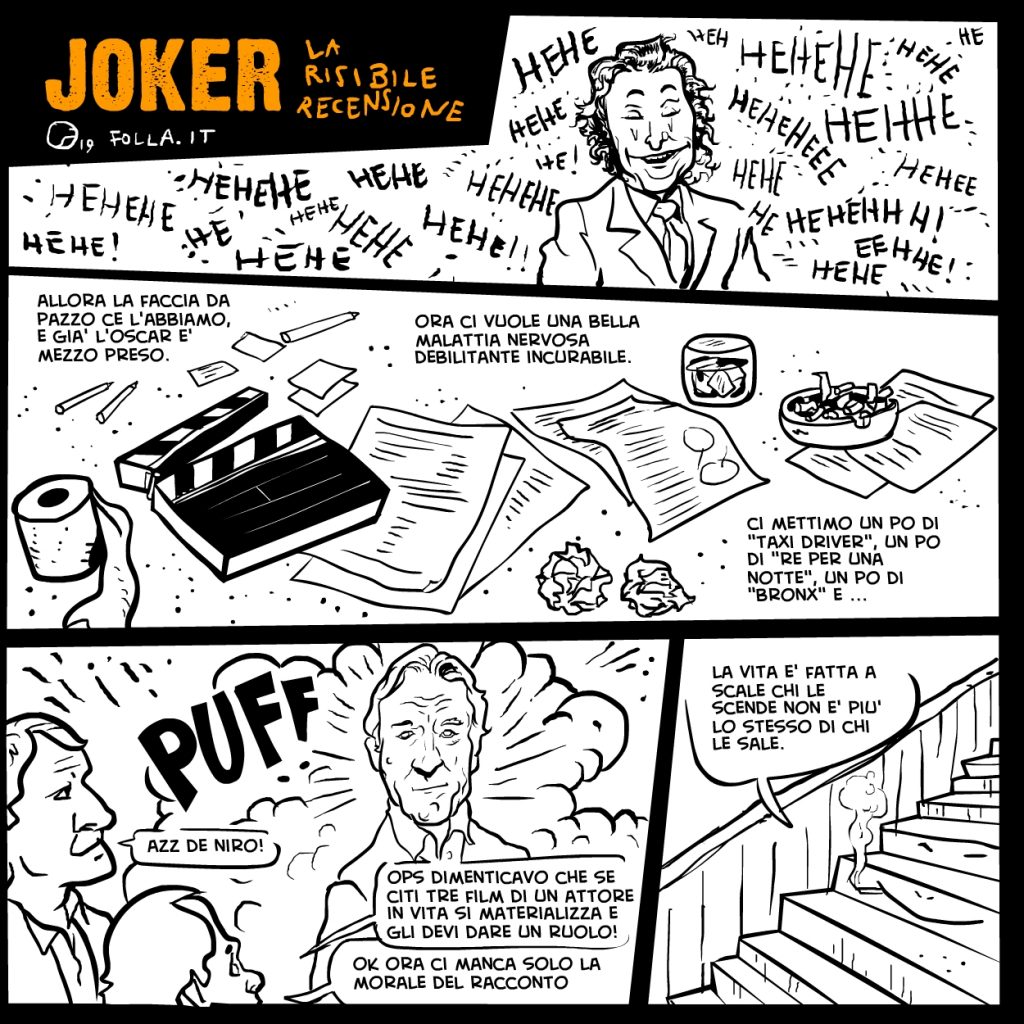
Take a walk around the dark side of life, as Lou Reed would sing, come with us to climb every day, step by step, laboriously those stairs that they become increasingly steep and cold and buffers. Taste yourself a little of the poison that can lurk in the heart of a clown. Come and find a corner where you don’t feel so inadequate and rejected. Here, when your heart is about to collapse, put on a happy face (put on a happy face) and go down those stairs with us, dancing on a music, imaginary perhaps, but so much liberating.
Chi parla? Chi ascolta?

Un tempo a queste domande la risposta era scontata. Chi parlava era l’oratore, il politico, l’artista, chi ascoltava era il pubblico, il fedele, il sognatore. Il primo mirava a convincere, destare ammirazione, commuovere. Il secondo si abbandonava alle parole o alle immagini, assorbendone il significato, studiandone la logica. Questo legame tra chi parlava o scriveva e chi ascoltava o leggeva era fortissimo. Esso si basava sui tempi dell’una o dell’altra esperienza, sulla attivazione della memoria, su una corrispondenza di un comune sentire.
Oggi questo legame si è allentato, e la responsabilità di questa perdita è dovuta al trionfo della tecnica. Un minuscolo telefonino può trasmettere qualunque discorso, politico, sociale o culturale, la cui istantaneità è però pagata dalla sua brevità- Tutta la cultura e la capacità di socialità del nostro tempo restano spesso racchiuse in poche frasi, in poche parole, addirittura in qualche pupazzetto che sorride o fa il broncio per trasmettere un’accettazione o una rinuncia. Perfino il concetto di menzogna, che un tempo si ergeva come protezione dinanzi alle insidie del pensiero, si propone oggi come una antiverità che reclama la propria innocenza. Ciò che conta è comunicare.
Ogni messaggio culturale paga la sua conquista della universalità con la sua universale diffusione, che ne spezza il legame con la ragione ordinatrice e lo abbandona a un pensiero sfilacciato e pieno di insidie. Ciò mette in ballo un ormai antico capovolgimento culturale, vale a dire il definitivo predominio della tecnica sulla scienza, che ha tolto il valore all’approfondito sapere per trasformarlo in un concitato fare. Tutto quello che la scienza metodicamente affrontava e risolveva, la tecnica sbroglia sul piano dell’utilità immediata.
Che fare? La domanda, antica e sempre incalzante, presuppone una risposta drastica, ancorché dubbiosa. Il rapporto tra la scienza e la tecnica, un tempo regolato da precise disposizioni gerarchiche, si è capovolto bruscamente. Il passaggio dal soggetto dominatore (l’“io penso” cartesiano) all’oggetto predominante (l’”io possiedo” mercantile), ha riportato il pensiero sulle cose, distruggendone però la capacità di distinzione fra esse. Per di più i due estremi si toccano. Questa è epoca della ibridazione, della mescolanza tra alto e basso, dove l’opera, così come viene presentata a un pubblico indifferente, risulta a un tempo unica e ripetibile, d’eccezione o di massa.
Per superare questa secca, in cui la cultura e l’anticultura sembrano affondare tenendosi per mano, bisognerà allora avere la forza e l’astuzia di riportarle entrambe sullo stesso livello, facendo della scienza un modello da seguire e della tecnica un cardine di comportamento, attribuendo alla prima un valore simbolico e alla seconda un valore di scambio. Con l’intesa, però, che le reciproche posizioni possano scambiarsi, dando alla scienza un carattere popolare e alla tecnica un valore più alto. Certo, il successo dell’operazione va contrattato ogni volta, giorno per giorno. Ma almeno qualche cosa, all’orizzonte, si muoverà.


Essere e funzionare
Da tempo e da più parti si afferma che non dobbiamo più chiederci che cosa “è” una cosa, ma come “funziona” e non quali sono i “fatti”, ma quali sono le “conseguenze”. È così che ci troviamo costretti a reimmaginare che cosa sono le cose e come le conosciamo e persino cosa siamo noi, e a mettere in discussione concetti filosofici, ma anche scientifici, usuali come il tempo, lo spazio, il soggetto, l’esperienza e altro ancora. Non questioni di poco conto né per la filosofia né per la scienza (e direi nemmeno per la teologia). Questo sarebbe dovuto al fatto che non siamo più nel dominio del modo di produzione industriale, ma di quello digitale nel quale il codice software risulta essere il motore primario dell’economia, della cultura e della nostra stessa civiltà. Questo apre ad una serie di domande: che cosa è e che cosa può essere una società digitale, una software society? Ci siamo collettivamente preparati a governare una tale società? Quali resistenze o rifiuti sono in atto? Come e perché superare tali resistenze e come demotivare tali rifiuti? La metafora più usata per descrivere questa situazione è, con un tono che non va inteso in chiave apocalittica, il codice software si sta “mangiando il mondo” e lo sta mangiando attraverso logiche diffuse di disruption, con accelerazioni tecnologiche, con singolarità emergenti grazie ad intelligenze artificiali ed esponenziali e facendo saltare modelli di business-as-usual. Cosa significa vivere in una software society che permea tutta la vita: le logiche, le pratiche e le tecniche di controllo, la comunicazione, le forme della rappresentazione, della simulazione, della decisione, della visione, della scrittura, dell’interazione e i modi della memoria privata e collettiva? Cosa significa elaborare, governare, confrontarsi, essere governati, dal codice software in un approccio di continuous design and delivery cioè in un sistema per propria natura in continua evoluzione, fatto di instabilità, adattabilità, discontinuità con la necessità strutturale, e non occasionale, di continui aggiornamenti, variazioni, integrazioni? In questo mondo domina l’”aggiornamento”. Essere è essere aggiornati, pena il malfunzionamento sistemico. E questo apre ad una epistemologia del disimparare. Dati i cicli di accelerazione e disruption, obsolescenza e innovazione tecnologica sempre più ravvicinati saranno fondamentali le capacità di disimparare e reimparare rapidamente (…). Molte delle applicazioni con cui interagiamo non sono ancora state inventate, quelle che stanno emergendo arriveranno attraverso processi di rapida prototipizzazione e dismissione e, quelle sul mercato verranno costantemente aggiornate per abilitare nuove funzioni e interfacce. A fronte di questo stato di cambiamento continuo, saper disimparare sarà una competenza professionale e personale importante almeno tanto quanto saper apprendere rapidamente. È l’attuale sistema formativo configurato in modo tale da dare una risposta a questo cambiamento? Dovremmo chiederci non solo che cosa sono i media e le loro dinamiche (opportunità e pericoli ), come se fossero solo degli strumenti responsabili o meno rispetto alle loro funzioni o alle loro potenzialità, ma dovremmo chiederci che cosa è “il mondo”, che cosa è diventato e che cosa potrà diventare, visto che il codice software ridefinisce, ontologicamente, le sue stesse condizioni di possibilità del mondo stesso. Domande non più rinviabili. Il vero pericolo è fingere che nulla sia cambiato. Quando cambia un modo di produzione cambia tutto, decisamente tutto, persino l’idea che abbiamo di noi, della stessa soggettività e delle nostre relazioni sociali; se di fatto non siamo più nel modo di produzione industriale che ci ha accompagnato e formato nelle sue varie fasi, dalla metà del Settecento ad oggi (o quasi), ma siamo nel predominio del modo di produzione digitale; se questo non significa che non si produce più industrialmente, significa che la formazione dei valori (economici quanto sociali) viene governata dal digitale; se in questo cambiamento, che non è solo economico, ma anche e soprattutto epistemologico, si è passati dalla centralità sistemica (industriale, tecnologica, etica) del trasferimento delle tecnologie al trasferimento dei saperi, cioè dal materiale all’immateriale; se il modo di produzione industriale aveva bisogno per la propria stessa sopravvivenza, di redditività e legittimità e per il dominio del sistema di saperi divisi e di professionalità vincolate alla stessa organizzazione dello Stato mediatore e ad una sorta di burocrazia cognitiva, saperi precodificati, ripetitivi, standard, sostanzialmente mimetici ed etero diretti; se in questo scenario la creatività come l’intelligenza si configura non più nei modi del privato, ma in quelli diffusivi del pubblico con inevitabili valenze sociali; se tutto questo ha anche un minimo di plausibilità, allora è urgente chiedersi come rielaborare o superare i saperi politecnici, o quelle modalità dei saperi che hanno innervato il modo di produzione industriale soprattutto considerando che ad animare il modo di produzione digitale sono sostanzialmente saperi e creatività collettive.
No longer beccafico recipe sardines
As Marine Biology tells us, this fish live in various areas in the world, especially in the Atlantic ocean and Mediterranean sea. Quite small, brightening of light blue, they are very sensitive and unselfish. Actually, they provide us with number of vitamins, last but not least, Omega-3 whose effectiveness keeps integral when they are really fresh and not canned or in oil. It is worth to emphasize that they tend to pile up in huge shoals, up to many thousands of individuals. Incredible: a female can even produce till 80.000 roes. That’s the science. Socially speaking, everybody can freely connect him/herself to whatever metaphor. On the contrary, he/she can reject even science’s results and just taste some recipes: Sicilian style beccafico or pasta with sardines or Venetian saor sardines. It’s a manner to feel satisfied, by satisfying his/her own taste and stomach. Meanwhile, some people, not only youngsters, are livening up.
Non più sarde a beccafico
La biologia marina dice che questo pesce vive in varie aree del mondo, in particolare nell’oceano Atlantico e nel Mar Mediterraneo. Abbastanza piccoli, balenanti di azzurro, sono molto sensibili e altruisti. In realtà, ci forniscono un buon numero di vitamine, ultimo ma non meno importante Omega-3 la cui efficacia si mantiene pienamente quando quel pesce è fresco e non in scatola o sott’olio. Questi pesciolini tendono a raggrupparsi in enormi banchi, fino a molte migliaia di individui. Incredibile: una femmina può persino produrre fino a 80.000 uova. Fin qui la scienza. Dal punto di vista sociale, ognuno può assumere liberamente la metafora che vuole. Oppure, al contrario, può rifiutare anche i risultati della scienza e limitarsi ad assaggiare alcune ricette: beccafico alla siciliana o pasta con le sarde o sardine in saor, secondo la ricetta veneziana. È un modo per sentirsi soddisfatti, soddisfacendo i propri gusti e il proprio stomaco. Nel frattempo, alcune persone, non solo i giovani, si stanno animando.
Dmtrij Sostakovic, Between Adulation and Celebration

It is amazing. Now the Soviet musician is known and appreciated in Western countries, but firstly he was discovered in the UK, in the Us during the World War Two and little by little, his fame grew all over Europe. In URSS his life was characterized both by great glory (the same of Sergueï Prokofiev, his biggest competitor) and harsh disregard. In 1948, he was attacked by the jdanist wing of the Communist Party for his 9thsymphony, qualified as « Sinfonietta ». He had to do self-criticism publicly therefore losing his tenured professorship. Also his son had to disown him! Six years before, he was asked to compose a symphony in honour of his hometown besieged by Germans, called “Leningrad”. Stalin sent him to Kouïbychev to seek shelter in order to complete his work.
The symphony was performed for the first time in March 1941 in this town. Few days after, it was performed in Moscow, and spread to the whole country through the radio speakers in the streets. Then, it was done again in August 9th1942. In 1943, he composed the 8th symphony called “Stalingrad” (but it was not his willing). Therefore, his popularity was huge. He written two opera arias (among them Lady Macbeth in 1934), several ballets, four film soundtracks and a long series of quartets, quintets, 15 symphonies, concerts and sonatas…
In this book which contains a very rich iconography, with many documents related to its creation, but also to life in the revolutionary Lenigrad (portraits of a group of inhabitants, political or sports demonstration in the streets …), customs and scenarios which were designed for his operas or balletshe made musicfor, such as Le Clair ruisseau which was much criticized in 1936. There is also the fabulous story of the seventh symphony. Withthese essays, it is possible to understand a large part of his fireplace as a musical universe that was not the easiest since the political context, which was very adventurous even in the sphere of art. Without being an exhaustive biography, without studying in details every opéra he wrote, the reader can make a clear idea of who was this exceptional musician, who had to always play between the very classicism and newer music (it was already in his way of doing music because he never wanted to break the bridges between the past and the present). But he was a man capable of creating surprising, sometimes exaggerated forms in all kinds. Being classic and modern at the same time it was already a considerable challenge! It now belongs to the history of twentieth century music, but also to the great history.
DmitrijSostakivic, the great Soviet composer, presentedby Gino du Maggio, Mudima, 614 p., 40 €.
KE’BEK-LEPAGE, the Photographs by Marzio Emilio Villa
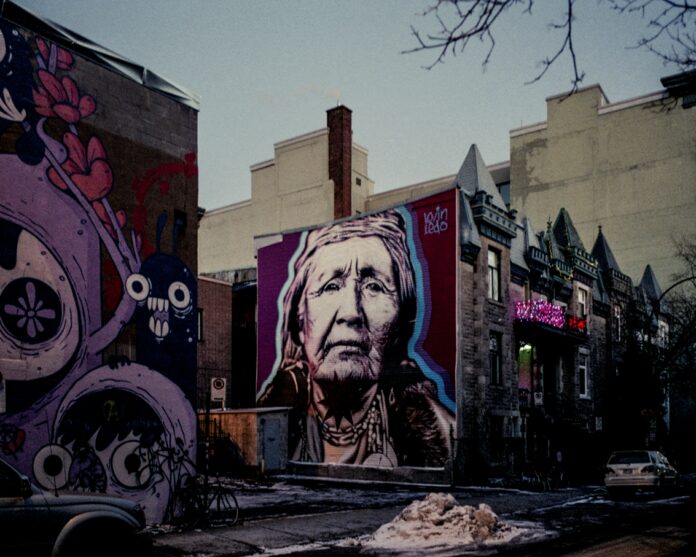
On the occasion of the exhibition at the UniversitàStatale di Milano, within Bookcity 2019
Images are “symbolic complexes […] ‘connotations’ (multi-voices): they leave room for interpretation”
(V. Flusser, for A ‘Philosophy of Photography’ (Folisofiadellafotografia), 1983)
Vilém Flusser argues that the observer of a photograph has the possibility to grasp one element after anothe, wandering with his eyes on the surface of the image, with a procedure called scanning(Ivi, p.5), which produces in his mind temporal realisation between the parts. One can, in fact, return to the elements already seen, elevating them to the meaning of the image. The possibility of a live show to have a historical linearity in which nothing is repeated is cancelled, everything has a cause and consequence. The work by Marzio Emilio Villa is a seemingly simple iconographic product, but it is actually the result of a skilled compositional process, which establishes the travel photographs on a complex analytical excavation of the place, subconsciously proposing to the observer a framework with a predefined significant element.
Marzio Emilio Villa, a young Italian photographer with Brazilian origins, recently was invited to exhibit in the prestigious Espace photographique du Laika Store in Paris (La marée de la mémorie, September-November 2019). He has often prepared exhibitions from travels, developing intangible heritage safeguarded by the places. In this case it is the investigation of the trail of Robert Lepage, in which the territorial elements and suggestions which inspired his works are rediscovered. Anna Maria Monteverdi is the curator of the exhibition, an in-depth connoisseur of the playwright-director Quebecois, to which she devoted much of her academic research. Together, they created a ‘journey’ into the multicultural universe, a very clear problem to Villa, which constitutes the complex environment of Quebec, where Lepage was formed, had worked, and where he undertook cultural battles.
“The theme we tried to develop is ‘The Invisible Theatre’”, Monteverdi says. “There are no pictures in theatre, of a stage or of the actors, there are faces fixed with a mastery and an almost touching sensibility from Marzio Emilio Villa, caught in the street, in the Montreal metro and in the Chinese quarter”, associated with landscapes in character/scene pairs, as in the Lepage spectacle ((A.M. Monteverdi, inL. Sestini, L’altro Quebec a Milano: allaStatale la mostrasulKebek di Robert Lepage, ItaliaNotizie24, 13/11/2019)
There are places often found without human presence, where life is perceptible; the photo, an infinitesimal time space, inserts the here and now between the before and after, a distant past and nested future in which the observer’s mind can build and visualise, according to a culture and a personal feeling. A “subconscious optic”, in the words of Benjamin (Piccola Storia della Fotografia, pp.7-8), in that the photo can provide us with, allowing us to load it, quantitatively and qualitatively, of feeling, suggestions, history, and meanings. We are witnessing a process that is starting from something elaborate through the awareness of the photographic medium, and the photographer’s choices, producing something elaborate subconsciously with the eyes of the spectator: a theatre?
The groups of collected images comprise a selection of the largest exhibition that, in July 2019, was exhibited at the Pasquini Castle in Castiglioncello (near Rome), for the In equilibrio Festival. The images exhibited for the Bookcity 2019, in the atrium of the State University of Milan, constituted a route between territories and significant moments of life, discovering Lepage’s lieux-ressource. The ‘luoghi-risorsa’ (Resource-Places) are concepts derived from the ‘objet ressource’; that is, the matrix objects of the story, based on his working methodology. They are the spaces that generate scenic writings, strongly biographical, worked on-stage by Lepage in absolute freedom from realistic conventions. We could say that the pictures by Villa give back the sense of the place, using Kevin Lynch’s categories for his reading (K. Lynch, A Theory of Good City Form, 1984), the more complex one that captures its soul and scans its meanings, which also oscillates in the show.
This re-mediation experiment that transfers the spectacular imagery into photography, provides a possible form to a scenic idea: the “subjective” of a potential “reader-viewer”.
Visitor crosses the “inhabited” landscape of Quebec, countries far from our imagination, activating mental processes with continuous changes of scale.
Unspoilt natural landscapes are exclusively inhabited with vegetation and water: rivers and lakes, where “the mirror surfaces double or dematerialise the fixity of the topographic configuration”, where snow and ice transfigure reality by making its borders indeterminate (C. Norberg Schulz, Genius Loci. Paesaggio, Ambiente, Architettura, 1979, p. 35).
Urban landscapes are multi-ethnic settlements, “cultural landscapes” that reveal the metissage through ‘backdrops’ of everyday life: material culture is found there with its architectural connections, rich in stylistic and linguistic hybridizations; domestic intimacies and the survival of unresolved social demands and repressions emerge through symbolic elements.
These images are theatre, because they seize identity based on memory: the theatre for Lepage is “the great sport of remembering”.
The shots, sought after and caught in the immediacy of unrepeatable moments, they visually concretize that reservoir of resources for Lepage’s stage writings; they are his “iconographic fulcrums”, memory enhancers: life lived, political and social battles, forming elements for his works (A.M. Monteverdi, Memoria, maschera e macchinanelteatro di Robert Lepage, 2018, p.63).
“In Lepage’s Theatre”, writes Monteverdi, “pictures dissolve to a precise dramaturgical function: highlighting a subtext, creating a context, an emotional atmosphere, showing the interior of the protagonist, becoming its immaterial ‘deuteragonist’ […] or self-reflexive mirror. The images reveal in the photographic sense of the term, that is, they bring to light” (Ivi, p.214). In these images by Villa we see a suspension of the linearity of the stories that Lepage tells with skilful mixture of events, without incurring narrative inconsistencies; photography, a medium often used in his plays. In fact, it collaborates in a non-traumatic way to this transduction: a writing in essence that activates an interpretation process in the viewer.
The meeting of the ideas of Marzio Emilio Villa and Anna Maria Monteverdi has shifted the focus from art to things that have a life of their own, dismantling the shows so as to go back to the most intimate roots and, sometimes, undeclared. The result is not guaranteed for all theatre writers, but for the few who has the places as a fundamental role in creation. It is an abacus of theatre/life combination, from which the observer can depart (as would Lepage himself) at a time of always new journeys ‘without destinations’, triggering mechanisms of “infinite creation”(A.M. Monteverdi, Il teatro di Robert Lepage, 2004, p.89).
The catalogue, curated by Anna Maria Monteverdi, was presented with the participation of the authors. This in the context of Milano Bookcity 2019, at the opening of the exhibition, on November 14th, by the Rector of the Milan State University, prof. Elio Franzini, the director of the Department of Cultural Heritage, prof. Alberto Bentoglio, the Italian delegate of Quebec, Dr. Marianna Simeone, and the writer.
The exhibition will continue its journey to La Spezia, hosted in the Palazzina delle Arti, from March 3rd to May 6th, 2020, again in its most complete form.
Betta
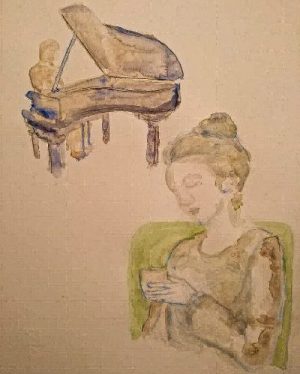
I’m so sorry, dear, you can’t imagine how much. I’ll see you soon, all right? So Betta greeted you on the phone when she couldn’t reach you to a dinner or a tea party at someone’s home.
A philosophy graduate from the Università Statale of Milan, she had stayed a few years in Heidelberg for a PhD. and then she had come to Palermo to be a creative.
It was not clear to us what she actually did, but she was always busy with meetings, conferences, departures to Rome, to the north or even abroad. We also knew that she didn’t miss any of the most important marches to save the planet from some of the major risks it was running. An environmentalist, animalist, vegan, no global, no vax, no tav, she was all of everything. When she came and see you at home, you didn’t know where to hide the pack of plastic cups that you kept in the cupboard in case there were water scarcity problems or you had the flu and had not the energy to do the washing up. You would have liked to show her a certificate of good behaviour for playing your part in the fight for a better world though in silence. But this kind of document did not exist and Betta, even if you had displayed one in front of her face with all the possible stamps on it, would have looked at you straight into your eyes and, strucking you down with her beautiful smile, would have told you: oh, don’t worry, each of us does what we can. Whatever she and her colleagues were dealing with, it was always something about a small group of eccentrics who were doing a thing putting their heart into it not being able anymore to find time even for their basic needs. She said this thing about the eccentrics, smiling and looking downwards as if she were speaking to herself and also shaking her head slightly as mothers do when they talk about the mischiefs done by their children, who are on the other hand des enfants prodige. Like any creative deserving respect, Betta never wore jumpers of her size; she always appeared with fake or real homemade sweaters with sleeves that covered half her hands. Wearing low-necked tops underneath, she made her envelop by a thick and soft wool scarf that left her décolleté uncovered.
Her hair, long and fine, was always wrapped in a sort of chignon fastened with an elastic band or even a pencil; what was important was that it resembled as much as possible some kind of tools she had come across while doing creative things. Once she had secured it with a brush, thus I gave her a resentful look: she had always been saying she was not able to draw even an O with a cup, let alone painting. And oh, not the brush, please, that could not become a part of a disguise!
One day she came and see me because she needed a 1972 issue of the Quaderni del Conoscitore di Stampe; after so many years that she had been visiting my home, the last time she came she realized that I had a myriad of interesting things, so she “promised” me that she would sometimes come and rummage around for a work that she had been given. She had arrived half an hour earlier than the time we had agreed on and I was still dealing with an informal painting that I was trying to tame. I had opened the door in my coat, my hands dirty with colour and some clips on my hair. Cool!, Awesome!, she had repeated excited about my work clothes and my appearance, peeking into the study where there was my easel and from which a pungent smell of turpentine came. While I was going to the bathroom to wash my hands so that I could take the magazine she would borrow from me, she had gone into the living room straight to the library. Would you like a cup of tea? I had asked her while the water was flowing into the sink. She had answered yes, she‘d love to, mumbling something I hadn’t heard well about the latest variety of green tea she had tasted during one of her trips abroad. The only thing I liked to do in her company was having a cup of tea. She used to taste its flavor thoroughly. Looking at her while she brought the steaming cup to her lips, I always felt that she got the same restorative pleasure from that drink as I did. It didn’t happen with anyone else.
It was a pleasure that started from an olfactory perception of every nuance of that effluvium, which, slowly emanating from the porcelain, was able to wrap whoever abandoned themselves to it in a reassuring embrace and later continued inside, once the precious liquid, reddish and sharp, gave off its heat radiating every organ. I also liked her long white fingers, whose nails were painted with vermilion enamel, on the cup. We had drunk a delicious black cinnamon tea that a friend of mine had recently brought me from Canterbury, accompanied by fragrant orange biscuits. Considered in the delightful role of a passionate tea drinker, it had become easier not only lending her a magazine I cared about, but also a book, one of those which used to be defined as “cult”, that she had admitted she had never read. “Thanks for the delicious tea, I really needed it, I hadn’t been drinking a cup of tea sitting comfortably on a sofa for months” she had said with one of those bright smiles she made use of to mean that you had saved her life with a little gesture. Then, with a long sigh, she had added “Lucky you …”. We had greeted each other with a hug that she had emphasized with her usual hateful short massage on the back pretending to mean ” you are so dear to me, I’d stay here for centuries”, then I had opened the door and waited for the lift to swallow her up (the spell produced by the tea was visibly coming to an end).
Betta was unquestionably convinced that she was part of the World Best Youth and considered herself, her colleagues and few other young local intellectuals as the only persons entitled to think of themselves as being part of an élite that possessed all the necessary (and even more) requirements to contribute to the civil and cultural growth of Palermo and of the whole planet.
One evening the others and I had let her know that we would go to the cinema together; she had answered that unfortunately she could not join us. We had just sat down when one of us noticed that she had appeared with a friend. Same kind of coat on long skirts up to the ankles, same handmade scarves around their necks, same boots with thick rubber soles, same big cotton bags with long shoulder straps. We had waved at her and when she had seen us, she had opened her eyes wide with wonder,meaning from behind her John Lennon glasses “What are you doing here?”. The film was the first one in the schedule of a festival on the great Japanese director Yasujiro Ozu. Betta could not believe that we poor nerds who had graduated from the best universities throughout Europe and had ended up teaching in Italian high schools, could be interested in a Japanese film that would be watched in its original language and in black and white. The world was showing little signs of progress and Betta, looking at it from above, congratulated offering it her snobbish and distant smile.
Once we met her at the airport. She was leaving to Bruxelles. Regretting she had not been able to attend my boyfriend’s last concert at the Conservatorio,she had asked him to perform for her playing the piano in the departures hall. All the while she had been listening with an ecstatic look, then her flight had been called and she had run away saying mechanically “Bravo, I’m terribly sorry today that my plane is not late”. I had given Andrea a very bad look, he had been an idiot and had deserved her condescending behaviour.
Like any good intellectual, Betta had a habit and hers was the passion for shoes. Sometimes I liked a pair of them, but I avoided asking her where she had bought them: she could answer, with a desolate smile, that it was the last pair she had found in a second-hand shop in Bremen or some other interesting place. In short, the less Betta spoke (and above all, the less she smiled) and the better it was for everyone.
On a winter evening, while we were all having dinner at my home, we remembered her after Pietro and Giovanna’s daughter had expressed her wish to enrol on a PhD in Germany. We looked at each other in silence for a few seconds and then we burst out laughing.
Why had we started calling her “la Betta”? Well, because once she had tried to phone one of her colleagues from Milan University and had told the girl’s mother to tell her daughter “la” Betta would like to talk to her!
She did not live in Palermo anymore; where she was, what she was doing, none of us could tell. Little by little she had abandoned us to our destiny of uncool people, sometimes interesting, but nevertheless fond of a life spent far from the European cultural epicenters, typical of a southern city like ours. To me, it was almost funny, in comparison to Betta, feeling all that attachment for a place that in fact might be sometimes considered a bit unsatisfactory even by me (who was not originally from there).
In the end, however, I was convinced that the guys like her would have been feeling wasted everywhere, with those faces of know-it-all missionaries who distributed culture here and there to help raise a little the level of so many less fortunate people.
But the world was spinning like this, and it was still very difficult at all latitudes to find someone who would appreciate a good cup of tea and had also a beautiful soul.