
“As Above, So Below” ― Hermes Trismegistus
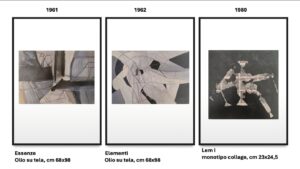
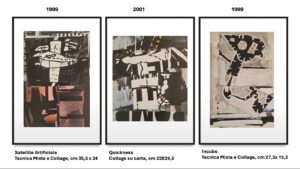
Here we interpret the light and darkness dichotomy in the context of Cosmist theology through the art of the Italian painter Renato Volpini (Naples, 10 December 1934 – Milan, 3 February 2017), whose “superfluous machines” from the second half of the 20th century—encountered during fieldwork conducted by the Centro Studi di Milano ’900 under the guidance of Marco Marinacci (see: Le machine metamorfiche -Dipinti e opera su carta dal 1959 al 2002 di Renato Volpini a cura di Floriano de Santi— for gifting us that and various art catalogues about the painter, a special thank goes to Jacopo Masini, the curator of the Archivio Renato Volpini) —became art objects that do not function like real machines but instead explore imagination and perception.

“You’re in bad shape. It looks like you’re developing a soul.” ― Yevgeny Zamyatin, We
After World War II, as the USSR entered the Cold War with the U.S., Soviet leaders saw space exploration as a symbol of ideological superiority. Artists began to depict rockets, satellites, even before the first launches, inspired by earlier Cosmist philosophy that viewed space as humanity’s spiritual destiny. To make these futuristic images accessible, artists often borrowed spiritual visions from Orthodox iconography as halo-like framing and symbolic verticality converting spiritual forms into secular, technological ones.
Paradigmatic Reflection of Cosmist-graphy
“ For, bearing in mind the divine quality of the ancients’ minds as revealed in the remains still to be seen among the ruins of Rome, I do not find it unreasonable to believe that much of what we consider impossible seemed, to them, exceedingly simple.’’
― Quote from a letter of Raffaello Sanzio da Urbino to pope Leo X (c. 1519)
Renato Volpini trained in Urbino and was active mainly in Milan. He developed a distinctly personal style in which images came form into anthropomorphic objects, sounding playfully introspective. In the 1960-1970s they were lightly shaded, playful, and almost human-like whilst from the 1980s onward they became opaque, darker with suffocating profundity.
IX.
“ When he had wrought the lovely instrument,
He tried the chords, and made division meet,
Preluding with the plectrum, and there went
Up from beneath his hand a tumult sweet
Of mighty sounds, and from his lips he sent
A strain of unpremeditated wit’’
Hymn to Mercury
Translated from the Greek of Homer
Published by Percy Bysshe Shelley, Posthumous Poems 1824
Carl Jung often emphasized the symbolic polarity of light and darkness as archetypal forces within the collective unconscious. Light represents consciousness, knowledge, spirit, and individuation; darkness embodies the unconscious, shadow, and chaos. (See: Carl Gustav Jung, Symbols of Transformation. Vol. 5 of The Collected Works of C. G. Jung. Translated by R. F. C. Hull, Princeton University Press, 1956, §§301–310), therewithal interprets alchemical imagery of light emerging from darkness as symbolic of psychic transformation. (See: Carl Gustav Jung. Psychology and Alchemy. Vol. 12 of The Collected Works of C. G. Jung. Translated by R. F. C. Hull, Princeton University Press, 1968).
Reading Renato Volpini in this frame, as an artistic allegory of the cosmic dualism in ancient cosmological hermeneutics, reveals a dynamic in which light and dark in an abstract sense, oscillate between radiant genesis and obscure negation. The transparency of light evokes the Zoroastrian khvarenah or “radiance,” a principle of creation in which light generates order and life; by contrast, the obscure entanglement resonates with Gnostic and Manichaean traditions, where the cosmos is torn between the suffocating profundity of darkness and the luster of light.
Ancient Cosmological Traditions
“Art is a line around your thoughts’’ ― Gustav Klimt
In Zoroastrianism, the opposition between asha the truth, associated with light and druj the lie, associated with darkness, highlights the Bundahišn, where the creation of the world is marked by the struggle of luminous and dark principles (see: The Bundahišn: The Zoroastrian Book of Creation, trans. E. W. West, Oxford: Clarendon, 1880). Manichaean cosmogony likewise conceives the universe as the site of conflict between the Realm of Light and the Realm of Darkness, with human perception itself seen as a fragment of divine luminosity trapped in matter (see: Henri-Charles Puech, Le manichéisme. Son fondateur, sa doctrine, Paris: Gallimard, 1949). Gnostic sources such as the Apocryphon of John present a similar tension, where aeon light descends into the obscurity of the material cosmos. Within this allegorical framework, takes place the èkphrasis of ontological existence of light and darkness.
“Amor Vincit Omnia (Love conquers all)’’ ― Caravaggio
_______________________________
Books
Carl Gustav Jung, Symbols of Transformation. Vol. 5 of The Collected Works of C. G. Jung. Translated by R. F. C. Hull, Princeton University Press, 1956
Carl Gustav Jung. Psychology and Alchemy. Vol. 12 of The Collected Works of C. G. Jung. Translated by R. F. C. Hull, Princeton University Press, 1968
Henri-Charles Puech, Le manichéisme. Son fondateur, sa doctrine, Paris: Gallimard, 1949
Le machine metamorfiche -Dipinti e opera su carta dal 1959 al 2002 di Renato Volpini a cura di Floriano de Santi,Palazzo Ducale Urbino
The Bundahišn: The Zoroastrian Book of Creation, trans. E. W. West, Oxford: Clarendon, 1880